March 2022

President’s Message

I have been deep in thought about many things this month. I recently turned 50 and as a result, my reflections have been deeper than usual, and the dream of the planet has been weighing heavily on my mind. We are witnessing more history with the plight in the Ukraine currently. As a child, I grew up under the red scare. I have seen the Wall fall in Germany, the fall of the USSR, several wars worldwide, the current pandemic and so many other pieces of history. I have friends worldwide that I am concerned for and stand with. For a person of ethics and empathy for all humanity, this can feel daunting and heavy. At the same time, I feel a tremendous sense of hope. Hope for change. Hope for the future. Hope for human strength in the solidarity of humanity. Hope for the best of ourselves to triumph. Hope for peace. Hope for wisdom. Hope for growth.

In my half a century of life, witnessing so much on a global scope, I have lived a full life on a personal level too. Connection with people from all the avenues I have travelled has been my proudest accomplishment. My relationships and friendships with people are treasured above all. It is with this in mind, that our community’s health and strength is part of my focus. I have heard from many of you about what you would like to see moving forward. This ranges from going back to normal and having monthly meetings to still staying remote until we are further assured of safety by credible authorities of this pandemic. For the next couple of months, we will be remote, but with hope, we will plan our summer BBQ and possibly other activities so that we can meet safely and be together.

My friends, I see you. I hear you. I think about you often. I want safety and happiness for you. Witness the world around you. We are all craving connection. Think about how you, as a humanist, can provide connection safely to your circles. Be the example that you feel helps spread hope in our message. Until we can meet again, we wish you happiness and safety. Keep pursuing knowledge and strength during this time. But most importantly, know that you are in our thoughts and that you are not alone.

See you all soon,

Melanie White-Curtis
President, HoU


Belief in the Hereafter

Secular humanists do not believe in the hereafter. That’s fine. But there is something going on here that might make us change our minds. It is this. Believers in the afterlife can never find out that they are wrong. They can never be disappointed. After all, if there is no life after death, then there is no disappointment after you die. No life, no disappointment.

But suppose that there is life after death. Then believers will be fine with that. So, either way, whether there is life after death or not, after they die, believers are not going to be disappointed.

It seems, then, that we should all believe in the hereafter—considering that the belief makes us happier right here right now. And in the end, we have nothing to lose.

OK. Now that we believe in the hereafter, we can think more about what this implies. For one thing, members of other species would have to be included. The idea is that, if we humans survive death, then so do our fellow primates. Not to mention the cows and pigs on our farms, and the puppy dogs and pussy cats in our homes. However, most people consider the idea that animals survive death to be absurd. After all, if animals cease to exist when they die, then why should we think that humans are any different?

So, in conclusion, we see three things: first, that we have nothing to lose by believing in immortality; second, that we really do stop existing when we die; and third, that being in touch with reality may not be not consoling.

All of which brings to mind a poem by Czeslaw Milosz. It goes like this:

If there is no God
Not everything is permitted to man
He is still his brother's keeper
And he is not permitted to sadden his brother
By saying there is no God.

In the end, when thinking about the hereafter, the real question has got to be: what are we here after? People differ here.

—Laurent Beauregard
Humanists of Greater Portland
March 2002 Newsletter


Darwin Exhibition

Currently there is an exhibit of Charles Darwin’s life and work going on at the Bean Life Science Museum on BYU’s campus in Provo, UT. I visited it last week and was very impressed. First, I was amazed that on a religious school’s campus, it would be as well done as it is. That said, it is at the Bean Life Science Museum, which, is very impressive. There are no admission fees, and it is a wonderful activity for all ages.

The exhibit is small and lovely. It talks about Darwin and his adventures. It focuses on his work and common misperceptions about who he was, his work and why it is so important now. There are several copies of the Origin of the Species on display, ranging from children’s books to a copy of the first edition publication. Have fun and enjoy!

Melanie White-Curtis


February 2022

Darwin Day 2022

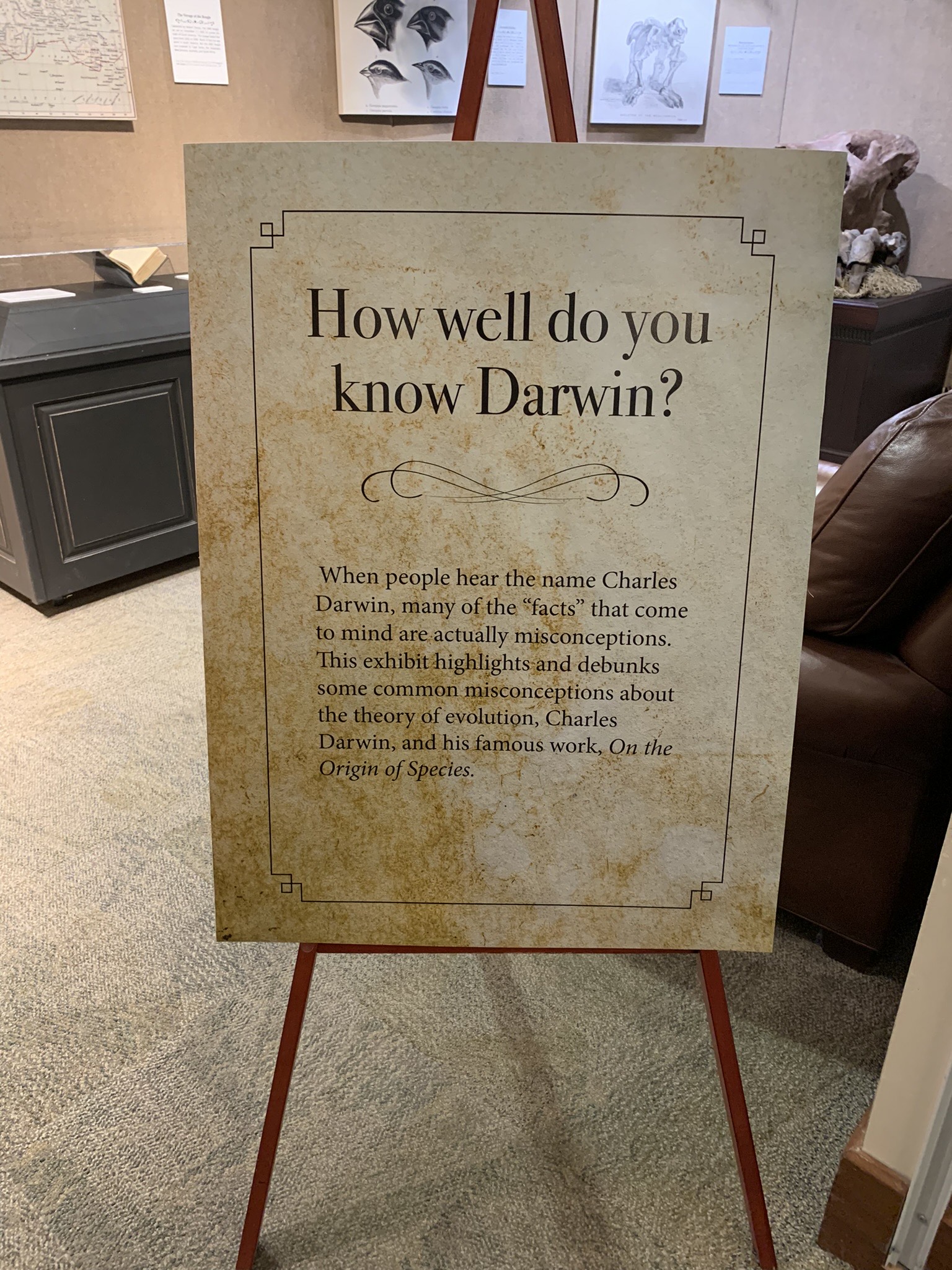
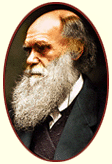
Charles Darwin

This year we will be celebrating Darwin Day online; again, due to the pandemic.

The history of Darwin Day is intriguing. Charles Darwin, the man who would come to be known as the father of natural selection, was born on February 12, 1809. He was the fifth of six children in a wealthy English family. His father was a doctor, and his grandfathers were naturalists who laid the groundwork for the discoveries that Charles would go on to make. In 1825, Charles, who had been helping his father caring for the poor and sick in Shropshire, left for medical school. He found it dull, and he didn’t put much effort into his studies. It wasn’t long until his father sent him to Christ’s College in Cambridge to become an Anglican parson.

Though he was on a religious course of study, Charles found himself drawn to natural sciences. A friend at the time got him interested in beetle collecting and he became acquainted with other parson naturalists, who spurred his interest even more. He positioned himself to join his professor on a trip to the tropics to study natural history.

After his return, Charles received an offer to serve as a naturalist on an expedition that headed down the coast of South America. The ship was the HMS Beagle, the captain was Robert FitzRoy. The ship set out on it’s voyage in 1831 and spent five years aboard the ship. Across South America, Charles was exposed to a wealth of new geology, anthropology, zoology, and botany. He carefully collected samples of fossils, rocks, plants, and bugs to bring back to England. Darwin and FitzRoy both kept journals of the trip, which are impactful documents to this day.

Darwin’s theories of evolution were already percolating as the HMS Beagle returned to England. It was especially the finches in the Galapagos Islands that illustrated his theories. He madly rewrote his journals from the trip to gain a better understanding, read the work of Malthus, and conducted experiments with plants to test his theories. During this time of overworking, he got married but also developed a chronic illness.

Finally, in 1859, Charles published On the Origin of Species, a book that described the case for natural selection. While the book was unexpectedly popular, there was pushback from the church, that taught Divine Creation as the source of life. He continued to work and publish on evolution and natural selection for the next 22 years. He would eventually die of heart disease in 1882, which likely originated from the chronic Chagas disease he suffered from.

Charles Darwin’s research, journals and legacy is still alive and well and utilized often in the science communities. We honor his work, his legacy, and his vision.

Kindest regards
Melanie White-Curtis
President, HoU


President’s Message

I have been thinking very heavily about the state of the world, the state of our country, our state specifically and especially about our communities. During this time of Covid, which unfortunately is alive and well, our world and lives have been drastically modified all the way down to the way we even interact with each other. I am a people person, so this has been difficult to navigate on many days. I miss seeing you all and talking face to face. I am very grateful that technology is as advanced as it is, so we are not completely isolated and can still do many things we enjoy – such as learning and researching.

This in mind, I admonish you to take time to really develop your humanist beliefs. We will be sending out prompts through social media and emails to give your ideas on where to start searching in your quests for knowledge. All of us are on different levels of our humanist journey. Our lives are unique and beautifully our own. This is part of the human fabric that makes this world wonderful. Deepening where you already are not only helps you, but it also helps all of those you come in contact with and spreads in a pay it forward way.

Some key issues that we are committed to building an inclusive America are – we are grounded in an embrace of reason, ethics, scientific inquiry and compassion rather than religious dogma. This does not mean that we are above anyone or that we are exclusionary of those who are religious. We have members who are spiritual and some who even still religiously practice. This is part of their journey at the present time. We, as an organization, do not include religious dogma in our organization—creating a level space for open minded, free thought conversations and an all-inclusive community. There is no recruitment here—only folks who are looking to promote social justice, scientific integrity, enforce the separation of religion and government (they are independent of each other and should stay this way), defending non-theists and all secular rights and promoting peace.

Charles Darwin Day is in February, and we will not be able to have our normal event due to COVID. We will again do an online version of celebrating the day! So stay tuned to your social media and emails for details to come.

My friends, stay healthy, safe and know that you are in my thoughts often as we navigate this time of COVID. Empower yourself with knowledge during this time – you are worth the investment.

Kindest regards
Melanie White-Curtis

President , HoU


Chaplain’s Corner

A few months ago, I was invited as part of the Salt Lake Interfaith Roundtable to talk to Senate President Adams and members of his staff. During that meeting I was able to share some thoughts about humanism and the increasing number of non-religious Americans and even Utahans. Represent!

At the end of the meeting, we were asked if anyone would be interested in offering the invocation for Senate sessions, as President Adams wanted a range of perspectives. I volunteered. When I received a call inviting me to give an invocation, I felt both eagerness and a sense of responsibility.

My goal with this Humanist Senate Invocation was to share an inspiring message that would resonate with the broadest possible spectrum, while remaining specific and pointed enough to make people feel the importance of showing up to the democratic process. I knew that I wanted to address the dangerous political and cultural divisions that are literally compromising our country.

When my pro-Trump prison Lieutenant and queer black Humanist Chaplain mentor both loved my prayer, I knew I was on the right track.

Utah State Senate Session Invocation
Given by Jared Anderson
January 20, 2022

Let us take a breath and take a moment.

In this moment, as citizens, as servants, as staff, as Senate we take a moment to pause, to breathe, to center ourselves in our values, our principles, our purpose. We take a moment to remind ourselves with gratitude of our privilege, of our great power and great responsibility.

We take a moment to name and honor the fear that so many of our citizens are feeling. We honor the fear and confusion and overwhelm as disease and disaster disrupt our daily lives. We honor the exhaustion of those who work and the despair of those who do not have enough opportunity and support. We honor the complexity and challenge of the current connected world.

We name the fear and confusion as change accelerates, difference illuminates, and anger incinerates.

And in this moment, having named it, we release the fear and confusion and even exhaustion.

In this moment we again connect ourselves to our highest values, to our commitment to freedom and opportunity. We affirm our common humanity and right to dignity. We affirm our need and possibility and invitation to lean in and open up to courage and compassion towards each other. We affirm the need and ability to have the hard conversations and make the right choices. We affirm our ability to show up to life and to our values. We dedicate ourselves to show up to ourselves, to show up to each other, to life, to this precious civilization.

We take a moment to remind ourselves that we have an opportunity to design and facilitate opportunities for better moments and better days, to give us a better chance to be our better selves.

And by showing up to this moment, we dedicate this Session of the Utah State Senate to those highest values, to productivity and purpose, to opportunity.

And so it is, and so with our work may it be even better. Amen.

—Chaplain Jared Anderson


Gloomy Gus

I joined Humanists of Utah in 1996 and have submitted probably over one hundred articles to this newsletter on a wide range of subjects. I published my first “President’s Report in October 2005. Lately, when I sit down to write an article, I discover that what I’ve decided as the subject is one that I’ve written about before. With some subjects like the environment or religion, you all know that is a special interest of mine, for which I’ve made abundantly clear over the years. But in the last few years, I feel like I have been sort of a “Gloomy Gus,” with a fair amount of focus on the bad news and criticizing certain groups of people and some individuals. However, we’ve been through a lot in this country in the last few years and there are a lot of things to be critical of.

Bob Lane

In that vein, there is a quote by Thomas Paine.: “All religious institutions are human inventions, set up to terrify and enslave mankind and monopolize power and profit.” Reading it got me thinking about science deniers and the fact that for the most part, they consider themselves to be religious. I decided that calling them “science deniers” was being too kind. I think we need to call them “science haters.” They hate science because it tells them the earth is round, revolves around the sun, and that the earth is billions of years old. It tells them, by way of DNA, that life has evolved over eons of time on this water planet. They hate it because it turns long held beliefs on their head.

As I am writing this, this would also be the time of year, that we would be getting prepared for our annual Darwin Day event. Unfortunately, the pandemic continues to make it impossible to get together. I want to be hopeful that we might be able to have Darwin Day next year, but we will just have to see. Perhaps soon we can have more outdoor get-togethers, like our BBQ, or just a bring your own picnic.

I also want to close on a few positive notes, one being some actual good news from this Supreme Court and their recent vote of 8 to 1 against Trump’s attempt to keep documents away from Congress. The January 6 Commission and the press already are in possession of many of these documents, which will no doubt make some people squirm a little bit, I think. This is a good news item!

Also, I want to give a review and thumbs up to a CD Amy gave me for Christmas. It’s called “Juno to Jupiter” by Vangelis. The music is reflective of the NASA mission Juno to Jupiter and his involvement in that project. The CD’s liner notes give thanks to pretty much everyone that has ever been involved in the exploration of space. It is quite enjoyable to listen to this music while thinking about how wonderful it is to live in a time when we can launch an instrument-laden vehicle on a journey to help us study such a magnificent planet so far away. I know I have mentioned before the words of Carl Sagan from the first Cosmos series, but it bears repeating: “We are a way for the Cosmos to know itself.” It very satisfying to me to live at a time when we can learn and understand so much about the cosmos from the sub-atomic to the entire universe and be one of those creatures with a brain that allows the Cosmos to know itself.

—Bob Lane


January 2022

Earl Wunderli

April 1, 1931 ~ December 20, 2021

Earl at March for Peace Feb ’03

One of the most influential members of Humanists of Utah died on December 20. His wife Corrine reported that he went peacefully. There is so much to say about Earl but perhaps the most revealing is from Board Member Lisa Miller, “thinking about this news that feels like a punch, what continues to pop into my head is that particular twinkle in his eye. And his chuckle—I can hear his chuckle. What a legend of a life well lived. And I truly miss him.”

Earl joined HoU in 1993 after retiring from IBM’s legal department. He quickly became involved by writing “Member Spotlight” articles for the this newsletter. Worked to get a new podium for our meetings, served on Darwin Day committees for several years.

He often wrote poetry pieces to read at our annual meetings. Here is one from 2008 entitled, Ho, Ho, Ho

Tis the season to be jolly, and drink some hot cocoa,
And snuggle up before the fire and watch the glistening snow.

Our wreaths are hung, our lights are lit, our houses are aglow,
And children all are listening to hear that ho, ho, ho.

Parties go on all around. Libations freely flow,
Midst food, and friends, and kin, and fun beneath the mistletoe.

Norman Rockwell’s captured just such scenes as these, although
He’s also painted poorer folk who aren’t in this tableau.

We are among the fortunate whose breaks in life we know.
We have no cause, however, for braggadocio.

No man is an island, as John Donne wrote long ago.
We’re lucky to be where we are, and a heavy debt we owe.

By sheer good luck we’re Americans and living now, you know,
In this land of liberty where happiness can grow.

For this we thank our founding fathers for reading Diderot,
And Locke and Montesquieu and Jean Jacques Rousseau.

We thank the brave explorers like John Glenn and Marco Polo,
Who opened up the heavens above and the world here below.

And we thank all those before us who heeded “Westward-Ho,”
And settled here in Utah instead of Idaho.

We thank the great historians who’ve informed us apropos
Of Greece and Rome and Persia, too, in ages long ago,

And all the great scientists like Newton and Galileo,
Who’ve explained the world to us. To them we say “Bravo.”

Orators and statesmen like the great Greek Cicero,
And Greek philosophers like Socrates and Plato,

Painters and sculptors like the Italian Donatello,
Composers and singers like the sublime Caruso,

Playwrights and authors like Harriet Beecher Stowe,
Essayists and poets like Edgar Allan Poe,

Our public schools and patient teachers, both which need more dough,
Our servicemen who keep us safe to freely come and go,

Doctors and, dare I say it, the lawyer Clarence Darrow,
And even sports heroes like Babe Ruth and DiMaggio,

And let’s not forget our chapter, where ignorance we outgrow
And which was nurtured from the start by a man you know as Flo,

All these and more enrich our lives; to them a debt we owe
That we cannot begin to pay the interest on, and so,

Because we all live better than old kings in a chateau,
We owe it to the future to make this world a place of show,

A world in which the struggling Jane and ordinary Joe
Can live a life surpassing ours, the best we can bestow.

There is no need tonight to be like Woody Allen, though,
Who can’t be happy if anyone has misery and woe.

So, as we party here tonight and bask in winter’s glow,
I’ll wish you all the very best and a hearty “Ho, ho, ho.”

Earl spent many years writing a book, and indeed rewrote it several times. An Imperfect Book is a scholarly review of the Book of Mormon that comes to the conclusion that not only could of Joseph Smith written LDS standard work but that he almost certainly did and wrote it without any Golden Plates given to him by an Angel of God. The book was published in 2014

Our website has a number of “Personal Journeys to Humanism” pieces. Here is the conclusion of Earl’s Journey:

Humanism is the rational, ethical, positive philosophy that I discovered little by little. My faith is that, unless we destroy ourselves first, it will prevail in the future because it is rational, science-based, and open-minded. My faith may be misplaced, given the slow pace at which rationality progresses among humankind. But reason ultimately seems to prevail. Virtually everyone now accepts that the earth is round and revolves around the sun. Although many still do not accept biblical higher criticism or the theory of evolution, in time they may make today’s religious superstitions seem as untenable as the Gods on Mt. Olympus. Meanwhile, the American Humanist Association and Humanists of Utah serve important purposes. They would have helped me earlier in my life and I believe may help many others who just have to learn of them. And as human beings gradually let go of mythology, the humanist philosophy the AHA and Humanists of Utah espouse will be there to catch them.

—Wayne Wilson


President’s Message

Happy New Year Friends!

Welcome to 2022. With the start of a new year and the ending of the previous one, it is a time of reflection, soul searching and strategizing on goals and dreams. In reflection of 2021, our group has been adapting to the times of COVID. During the summer, we had our annual BBQ, which ended up being our only in person event this year. It was wonderful seeing many of you in person, meeting new friends and enjoying a beautiful day at Sugarhouse Park. With the current surge, we shifted gears again back to online with our Website HumanLight celebration and on our Facebook page. Our humanitarian efforts started this fall with providing fun gift bags for the children at Shriners Hospital’s Halloween Costume Parade. We also, provided gift cards for displaced and struggling people in the community to buy necessities. Currently we are putting plans together to do many more activities, humanitarian efforts and offer online education to you all.

It is imperative to keep hope alive during this very LONG pandemic and for our resilience to shine through. Many are struggling, both publicly and privately. It is crucial for us to remain kind, plug in to our ethical and strong value systems and to continue to live with reason and strong ethics.

I wish you the very best for this upcoming year. I send you all my friendship, my kindest regards, and my dedication to work to the best of my ability. I am very proud of this organization and of all of you for helping make the world a better place—one person, one deed, one thought at a time.

Kindest regards
Melanie White-Curtis

President , HoU


Chaplain’s Corner

New Year, No You

It seems that breaking New Year’s Resolutions is as much of a tradition as making them. That’s the joke, right? In January we commit to gym memberships and new diets and healthier approaches to relationships. And by February, we have reverted back to our regular habits, the main difference being whatever we paid for our newfound and quickly abandoned hobbies or memberships.

Even if our follow through on ritual resolutions leaves much to be desired, we do gain one powerful benefit from the New Year’s habit: Introspection. Whether we follow through on our resolutions or not, most of us genuinely do take time to reflect on what we would like to be different or better in our lives.

The great secret (that we all know intuitively) is that we can benefit from the New Year Resolution ritual any time. I recommend that we embrace the framing of Discern, Motivate, Empower. Instead of making goals and then feeling guilty, we can tap into the organic process of growth. We can release resistance and focus instead on redirection, channeling what is toward what we want.

Discern: This is what we already do around the New Year. Instead of focusing on what other people tell you what you should do, take time to figure out what you value and what you want. Don’t make goals. Figure out what your goals actually are.

Motivate: Once we figure out what we genuinely want and value, we can tap into sources of motivation that are also organic and natural. In general, we are as productive as our contexts, so I find it helpful to change my context in ways that incentivize behavior aligning with my goals. For example, I have been interested in martial arts most of my life, so signing up for a six-month commitment to jujitsu and kickboxing helps me follow through. To use a simpler example, I’m going to move my dresser into my boys’ room, which will create discomfort that motivates me to organize my own space. Finding the natural consequences and pressure is much more effective than setting goals we think we should have.

Empower. Once we connect to our genuine goals and plug into our motivation, we can ask ourselves what resources and support we need to follow through. We can also look at what resources we already have that trigger a virtuous cycle to better living. For example, I’m interested in fitness, so I spent $30 on a calisthenics app that doesn’t need much equipment.

The playful title of this column comes from the Buddhist concept of anatman, or “not self.” I confess that when I taught World Religions at Westminster College, I didn’t understand Buddhism very well. Life is suffering and there is no self? Well, that’s not very life affirming, I thought. My hypothesis was that this depressing worldview was a coping mechanism to survive in miserable circumstances.

It wasn’t until my own Buddhist training years later that I realized how brilliant Buddhism is, including the concept of “not self.” It isn’t that there is no you so much as that there is no you in particular. The concept of self can be as limiting as the concept of New Year’s resolutions. Just as New Year’s culture implies that that is the best or even only time to make dramatic improvements in our lives, the stories we tell about who we are also limit us. “I couldn’t do that”, we tell ourselves. “I’m not good at that.” With our words we cast spells that constrain us.

I use the word spell intentionally, because the way that we think genuinely does impact our physical reality, especially when it comes to our bodies. Our bodies our very loyal, turns out, and the way that we think is literally a matter of life and death. Our mindset and thought habits not only influence what we do without bodies, but also strongly impacts how our bodies metabolize stress and other stimuli.

My recommended resolution is to release the pressure of the idea of the new year or new you. The truth is that every day is new. Every moment is new. Every moment is an opportunity to live in a different, better way. We can respond to each moment as an invitation, and with those choices, create habits that shape our current and future selves.

And however, any given day goes, we always have another chance and another self tomorrow.

—Chaplain Jared Anderson


New Year Orison

Protons, electrons, neutrons, and tachyons, with other elements and heavy metals necessary for the cornucopia of life, made the trillions of cells that allowed us to be the best creative, rational, positive, ethical, and diverse people possible.

—Cindy King


Happy New Year!

Happy New Year Fellow Humanists and Freethinkers, I hope that your holiday season has been a pleasant one. Mine has been one of near total gluttony. I’m talking chocolate here: One gift from friends included: assorted chocolates, chocolate truffles, a giant brownie and chocolate covered graham crackers, a package of chocolate bark with popcorn and nuts, a box of chocolate cherries, chocolate pretzels, chocolate malted milk balls, a couple of chocolate bars, and two bags of moose munch!. I’m still working on it. Someone must eat it. Add to that, the fact that each year we give away my home baked cookies and we also have been baking pumpkin cranberry bread and banana nut bread. And of course, I must test it all to make sure it’s fit to give away.

Growing up here in Salt Lake City, my family cooked the same common traditional holiday meals, turkey with stuffing and a number of other delectable entrees and desserts for Thanksgiving. Ham on Christmas and leftovers of both for New Year’s Day. But in recent years we’ve changed things up a bit like a Halibut bake, and a prime rib roast. It makes for an enjoyable change. ‘Tis the season for feasting and I’ve been enjoying it.

I don’t make New Year’s resolutions, but it is a good time to reflect on the past year and think about changes one may want to make. I don’t have the energy these days to do much volunteer work so one of the things I’m doing is to donate more money to the causes I feel like supporting. That, for me means giving more to organizations concerned with climate change and there are a lot of them all over the planet in need of funds. I also plan to give more in the political world, to candidates who will fight to save democracy from those who would trade it for dictatorship. I don’t want to say much right now about politics. I’ll be saving that for the coming months as we near the election.

I want to express my sadness when on the passing of Earl Wunderli. Earl was a longtime member of Humanists of Utah and a board member for several years where his financial investing acumen took a generous endowment to the chapter that is now worth more than the original investment even though we have spent thousands of dollars on things like Darwin Day, annual summer picnics, and Solstice banquets. We have also dipped into the funds to give to disaster related events.

I enjoyed his friendship for years as a fellow member of our poker club. We played nickel ante poker where you felt like a big winner if you ended the night three or four dollars ahead of everyone else. He will be sorely missed.

With the winter solstice behind us and the days now getting longer, I’m already looking forward to spring, even though it’s still a few months away. Again, Happy New year and I hope we can meet in person again soon.

—Bob Lane


December 2021

Kurt Vonnegut, Jr

Kurt Vonnegut, 1922-2007, has been one of my personal heroes since I discovered his work. Sometime in 1974 I was discussing life with a bartender when he asked me if I was familiar with Vonnegut, I was not. He told me about play that was showing and recommended that I see it. The show was Happy Birthday Wanda June by Kurt Vonnegut. I was enthralled. I went to the book store and purchased Player Piano, Mother Night, Siren’s of Titan, etc. etc. etc. My personal library now has quite a few first edition hardcover and other special editions of Vonnegut’s writings.

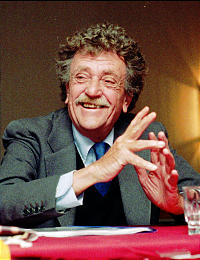
Kurt Vonnegut
Author Kurt Vonnegut, Jr. smiles before receiving an award in Albany, N.Y., Sunday, Oct. 30, 1994, from the Firemen’s Association of the State of New York. The association gave Vonnegut its “Golden Trumpet” award in appreciation of the recognition and respect he has paid volunteer firefighters in many of his literary works. (AP Photo/Tim Roske) (Submission date: 10/10/2002)

This is also about the time that I discovered humanism and joined Humanists of Utah. Kurt Vonnegut was the Honorary President of the American Humanist Association at the time. I was actually thrilled when I got my first mail from the AHA, the return address was under the name: Kurt Vonnegut!! My first HoU summer picnic was a potluck luncheon attended by maybe a dozen people. For my food contribution, since the picnic was held on my own birthday, I went to a bakery and bought a birthday cake decorated with the phrase, “Happy Birthday Wanda June.” In the play Wanda June’s role is that of a little girl who was hit and killed by a car the day before her birthday. The cake, which had it’s price discounted because the family did not pick it up, was purchased by one of the actual characters in the play who was returning to his dysfunctional family after may years on Safari Hunts in Africa. A lot of Vonnegut plots can be described as “dysfunctional.”

Sometime in the early 1990s, I was made aware a Kickstarter (fund raiser) to bank roll a biographical film about Vonnegut. I donated with a promise of a DVD and listing my name in the movie credits. Fast forward 40 years or so and that Documentary, Unstuck in Time, has been released to movie theaters and streaming on Amazon Prime. There is no chance that I will get the DVD as I have moved, probably twice, and changed my email address, again probably twice, but my name is in the second-to-last line of the credits! A website for the project also lists my name and has a link “to my website,” which I entered so long ago, as humanistsofutah.org.

Unstuck in Timeis part of the opening sentence of Slaughterhouse 5, or the Children’s’ Crusade. It is among the boldest and clearest pacifistic arguments ever made. Vonnegut served in Europe during World War II and was captured by the Nazis and imprisoned in a hog slaughterhouse outside of Dresden during the Allied Fire Bombing of that city. He spent many weeks pulling dead bodies out of basements after the attack. The subtitle makes the point that most of the soldiers were, and still are, children. The so-called Children’s Crusade of 1212 CE, was a movement of two armies of perhaps 20,000 children. They had no money for transport and many were sold into slavery. Many Vonnegut fans who already know this will also know that the last line of the novel is, “One bird said to Billy Pilgrim, ‘Poo-tee-weet?” The documentary features a small animated bluebird, sometimes just a black and white drawing, of a bird that hops around and poo-tee-weets.

I am dedicating this newsletter to the memory of Kurt Vonnegut, Jr. and filling it with book reviews of his work from our website published over the years. Not all of the reports will fit in this printed newsletter but they are all on our website.

—Wayne Wilson


President’s Message

Happy Holidays and Seasons Greetings!

My hope is that this newsletter finds you well, safe, and happy. While we all embark on the end of this current year, this is a time of reflection, celebration, hope and promise for the future. Even though, we are still in the throes of much turmoil with the pandemic, political issues, community issues and personal struggles, there is so much to be hopeful for. There is good news all around us for us to work with, surround ourselves with, plug into and participate with. As humanists, we do not embrace the traditional holiday affairs which are centered around religious ideology. But this season is not exclusive to these beliefs. There are many holidays and celebrations to be had worldwide and personally that are fully encompassed with this time of year. There is a general sense of gratitude, community connectedness, service and love now that is heightened. Find what makes you happy, go toward what calls to you, reach out within your levels of safety and comfort for connection and know that we, in this group, care and are here. This month is our HumanLight celebration. We will be doing it remotely. You will receive emails with the worksheet and friendly reminders. It is a wonderful way to connect and is family friendly. We hope for the time when we can get back to meeting in person again, but we do not know when that will be – so we will be doing more events online and providing awesome content for you all to enjoy.

Happy holidays to you all and the very best wishes from me and the rest of your Board for the ending to 2021.

Kindest regards
Melanie White-Curtis


Chaplain’s Corner

DIY Holiday

All of us do holidays in our own special way… we have family and personal traditions when it comes to what we serve at a meal or how we decorate a Christmas tree, or who performs which tasks.

One fascinating insight from history is that holidays are combined and personalized across centuries and cultures as well. For example, for Christians Easter commemorates the resurrection of Jesus, but it’s name comes from the pagan Ostara. Jesus died during the Jewish festival of Passover, which commemorated the Exodus of the Israelites from Egypt, which in turn originated as a Spring festival related to the birth of the season’s lambs.

Similarly, Christmas supposedly celebrates Jesus’ birth, though we don’t know when he was born (though historians are quite sure he was born in Nazareth, not Bethlehem), though it may have been during the spring. Who was born December 25? Mithras, an originally Persian God as woshipped by the Romans. December 25 is also time to celebrate the time when days lengthen after the winter solstice, when light overcomes the darkness. Sol Invictus. The “unconquered son” was celebrated on December 25 and associated with the Persian God Mithra. And many of our current Christmas traditions come from the Nordic celebration of Yule. See how that works?

Most holidays celebrate the shifting of seasons and the flow of life, especially in temperate climates when summer is bright and hot and winter is dark and cold. Agricultural life has its patterns–birth and planting in the spring, work in the summer, harvest in the fall in preparation for the challenges of winter. Celebrating these milestones help encourage groups to work and especially to cooperate. As a bonus, many of the celebrations are fun! Unless you are dinner.

What does this have to do with Humanism? We don’t tend to believe in Santa or even Jesus Christ, but our disbelief in traditional mythology need to diminish our appreciation for the holiday season. This month I want to celebrate HumanLight with you, while also encouraging you to develop your own holidays and rituals.

HumanLight is a made up holiday made up later than the other made up holidays. The New Jersey Humanists founded the holiday in 2001, and it was adopted by the American Humanist Association in 2004. HumanLight celebrates Humanist values such as reason, compassion, and hope. In honor of the theme of light in darkness, our HumanLight focus is going to be Grief, Gratitude, and Growth.

We need to honor each of these to process our feelings and show up to life in healthy ways. We are often tempted to take shortcuts and avoid pain and challenge, but we know we can’t. One invitation from Covid-19 is that has shown us many truths. Many of these truths are unpleasant, such as the actual views of our family members, but Covid has also highlighted the power of science, the preciousness of relationships, and the fragility of the status quo. Covid has shown us both darkness and light, and both the limits and power of humanity.

This December 9th, we will gather together, apart, to grieve what we have lost and regret, to express gratitude for all we have, and to both celebrate and set intention for present and future growth.

—Chaplain Jared Anderson


What is a Humanist?

Do you know what a humanist is?

My parents and grandparents were humanists, what used to be called Free Thinkers. So as a humanist I am honoring my ancestors, which the Bible says is a good thing to do. We humanists try to behave as decently, as fairly, and as honorable as we can with any expectation of rewards or punishments in an afterlife. My father and sister didn’t think there was one, my parents and grandparents didn’t think there was one. It was enough that they were alive. We humanists serve as best we can with only abstraction with which we have any real familiarity which is our community.

I am, incidentally, Honorary President of the American Humanist association, having succeeded the late, great science fiction writer Isaac Asimov in that totally functionless capacity. We had a memorial service for Isaac a few years back, and I spoke and sait at one point, “Isaac is up in heaven now.” It was the funniest think I could have said to an audience of humanists. I rolled them in the aisles. It was several minutes before order could be restored. And if I should ever die, God forbid, I hop you will say, “Kurt is up in heaven now.” That’s my favorite joke.

How do humanists feel about Jesus? I say of Jesus, as all humanists do, “If what he said is good, and so much of it is absolutely beautiful, what does it matter if he was God or not?”

—Kurt Vonnegut
A Man without a Country


Vonnegut Content

I am a little surprised at the selection of Vonnegut’s work that has been reviewed in our newsletter over the years. It leaves out most his most famous and well read novels:

Player Piano, The Sirens of Titan, Cat’s Cradle, Mother Night, Slaughterhouse Five, Breakfast of Champions, Deadeye Dick, Galapagos, and Bluebeard.

Here is a list of linked articles (click to be taken to the review on our website)

· God Bless You Mr. Rosewater; or Pearls Before Swine

· Slapstick; or Lonesome no More

· Jailbird

· Hocus Pocus

· Timequake

· God Bless You Dr. Kevorkian

—Wayne Wilson


The printed version of this newsletter included a review of Jailbird which is linked above


November 2021

President’s Message

Greetings to you all during this fall season.  I hope you are all well and enjoying the change in the seasons and so many wonderful things on the horizon. With elections in full swing, I admonish you to get out and vote. It is always important to have a say in how we would like our community leaders to help us all. The holidays are coming, along with the end of this year and there is much to be grateful for. There is hope, there is growth, there is knowledge, we have a great community and we are part of creating history. Small changes and small acts of kindness are ever so important. Our organization provided gift bags for Shriner’s hospital for the children’s Halloween costume parade last month. Due to pandemic protocols, it was a closed event, so we could not attend. Moving forward, though, during these times of personal distance, we will be participating in giving to these types of events. It is a great way for us to put action into what we believe and stand for. There will be more about these events on our facebook page and future newsletters. Stay tuned!   

Kindest regards,
Melanie White-Curtis, President


Chaplain’s Corner

Want to Feel Better?
Do the Same Things
Differently

After six years as a Chaplain, I am somewhat bemused to realize I am not a Chaplain. Not primarily at least. Probably why people’s minds bend a bit when I explain that I am a Chaplain, and a humanist.

What I actually am, first and foremost, is a Wellness Integrator. I am passionate about well-being and fascinated by human nature. I also prioritize efficiency as one of my highest values, and there is little of anything more potent than religion.

We each have our feelings about religion, and wariness is understandable and valid. But whatever our feelings about religion may be, in a very real sense our bodies are religious.

Why am I writing about religion in a humanist newsletter? Because religion has coevolved with our human physiology, psychology, and sociology. Our bodies, brains, and cultures are all calibrated to religion. And that means that whatever we believe and feel about religion, the elements of religion contain shortcuts to well-being. I do not tell people to convert to religion. I tell people to convert religion to themselves. That is why my approach to religion is practical and subversive, powerfully effective, and appropriately humanistic.

I have begun doing wellness trainings for the staff members at the hospital where I work. One of the most ironic problems with wellness programs is that they end up making you more stressed! You are told you just need to eat better or sleep more or exercise or do meditation or yoga or go to therapy. All these habits can indeed be healthy, but most of us are busy and overwhelmed, so being told we need to do more just adds guilt to the already overwhelmed.

My approach is different. That’s exactly it. Do the same things you already do, just with small changes that will make huge differences. Life is hard, but you have hidden resources that have already evolved into you. You can access the power of your brain and its sensitivity to ritual and meaning to more efficiently process stress and even trauma. The way we think about things literally changes the way our bodies respond. Our mindset is a matter of life and death. You just need to take a few minutes to plug into these resources.

Here are a few ways you can change your daily habits to increase your well-being, without adding much extra time or even effort. I will unpack some of the science in future columns, but for now, try these out and see how it feels. I am using work as an example, but you can use these practices throughout your day, wherever you are. For best results, talk to yourself, out loud.

When you wake: Take a moment to express gratitude. Tell yourself (or someone else, or your pet or plant) one thing you are grateful for.

As you go to work: Clear your mind and take big breaths. If you have time, you can place your hands on your stomach and chest and meditate for five minutes (when you are not driving!), but on days you do not do that, you can calm yourself while you go from one place to another.

When you get to work: State one of your highest values and remind yourself how your daily work connects to these values.

When you are at work: Be in your body by noticing what you are sensing. Take moments to actually feel what you are touching. For example when you wash your hands, note and feel the temperature of the water, the softness of the soap, and the texture of the towel.

At the end of work: Say one thing that is true, positive or negative doesn’t matter. Just speak the truth about the day, either to yourself or someone you trust.

When you get home: Remind your body that you are home, perhaps by changing clothes. I change into cozy clothes immediately.

When you wash: Say out loud “I am washing off the day” (or whatever you need to process.) The combination of sensory input with this ritual will relieve stress incredibly efficiently.

At bedtime: Talk to yourself. Tell yourself something you are happy about or proud of. Journal if you can.

When you need to turn yourself off and on again, you can take a deep breath, hold it, and let it out slowly, at least five seconds each. Our breath is incredibly powerful, our main body process that is controlled both unconsciously and consciously.

You may feel stressed or overwhelmed in this moment, but your body has millions of years of wisdom you just need to plug into. Practice these rituals and you will not only feel less stress, but you will also feel happier and greater well-being in general.

—Jared Anderson


How to Talk to a Science Denier

~Book Report~

This book by Lee McIntire is subtitled, Conversations with Flat Earthers, Climate Deniers, and Others Who Defy Reason.” by Lee McIntyre. The book with his recollections of a convention held as the Flat Earth International Conference (FEIC) in 2018. The recollections he shares are somewhat amusing and at the same time informative. While we may think this is a fringe group, they are more numerous than you might guess and quite serious about their beliefs. This look at Flat Earthers helps introduce us to the next covered concept, “What is Science Denial?” We learn to see that what people believe becomes part of who they are, it is part of their identity. This results it becoming an attack on them personally when you question or denigrate their beliefs.

In trying to understand what science denial is, he gives us five common factors researchers have identified.

1. Cherry-picking evidence

2. Belief in conspiracy theories

3. Reliance on fake experts (and the denigration of real experts)

4. Committing logical errors

5. Setting impossible expectations for what science can achieve

McIntire notes that, “virtually all conspiracy theorists are what I call ‘cafeteria skeptics.’ Although they profess to uphold the highest standard of reasoning, they do so inconsistently. Conspiracy theorists are famous for their double standard of evidence: they insist on an absurd standard of proof when it concerns something they do not want to believe, while accepting with scant to nonexistent evidence whatever they do want to believe.”

The middle of the book is a bit dense with comparisons and discussions of various research projects on the subject of science denial. But the last part of the book is a good discussion about the title’s question of “how to talk to a science denier?” In a way, it comes down to being willing, as hard as it is sometimes, to keep a civil tongue, to be respectful and trying to find ways to impart new information to science deniers. We already intuitively know this, because making someone angry is not going to get them to listen to reason. You need to establish trust first.

I can say the book is well written and loaded with good information and advice on the subject. In fact the concepts were validated recently when I was T.V. surfing. I happened on the last part of an interview of Norman Lear. While he was discussing the character Archie Bunker, he stated how he got hundreds of letters saying, he’s just like my uncle or father or someone they know. He also stated that “Archie Bunker types are terrified of progress. To me that describes one of the main characteristics of the right-wing/Republicans/conservatives in this country. They are afraid of losing what is left of their white privileged status.

Something else I saw in the op. ed. section was someone’s use of an adage I have heard before but not recently, that is, “I’m ever hopeful but not all that optimistic.” This describes how I have felt about many things in recent years. I could put it before subjects like progress on climate change or preserving democracy from the threats by Republicans or convincing anti-vaxxers to get the shot. Just a thought.

—Bob Lane

Further Discussion

This subject was addressed by the late and great Carl Sagan. The Demon Haunted World: Science as a Candle in the Dark in particular distinguishes between real science and popular conspiracy theories Here are a couple of related links:

Richard Layton Discussion Group

What is the Future of Science? By Wayne Wilson


Great Ideas From Bertrand Russell

Bertrand Russell is often considered the most eminent freethinker of the 20th century. He revolutionized contemporary philosophy and changed how we think about truth, logic, math, and metaphysics. Despite imprisonment and constant social pressure, he was also an outspoken civil rights advocate, agnostic, pacifist, and socialist.

Russell was born in 1872 to aristocratic British parents whose atheism and activism for women’s suffrage, birth control, and other human rights issues were largely unwelcomed in “polite society.” Before their deaths early in Bertrand’s life, they asked the great John Stuart Mill to be his godfather and insisted that their son be raised as an agnostic. Bertrand Russell was, however, raised as a Presbyterian by his religious maternal grandparents. After a childhood riddled with depression, he found himself questioning his beliefs at age 15. By the time he was an adult, he was an outspoken Atheist and Agnostic. “There is no practical reason for believing what isn’t true,” he said, “either a thing is true, [and we should believe in it] or it isn’t [and we shouldn’t]…”

“Three passions, simple but overwhelmingly strong, have governed my life: the longing for love, the search for knowledge, and unbearable pity for the suffering of mankind.”

After graduating from Trinity College, Russell worked as a professor, mathematician, and logician. However, his unapologetic anti-war activism and support for socialism, atheism, women’s rights, LGBTQ rights, etc. lost him several positions in academia and even resulted in his imprisonment on multiple occasions. In defense of his friend, Albert Einstein once wrote, “Great spirits have always encountered violent opposition from mediocre minds…”

In 1955, Russell and Einstein created a manifesto warning the world’s leaders of the dangers of nuclear war. In it, they wrote, “remember your humanity, forget the rest.”

Russell won the Nobel Prize in literature after writing several books on philosophy, science, logic, mathematics, freethought, life, and happiness, including his most famous work, A History of Western Philosophy.

If you want people to believe in your claim, then you’ll need to do more than make assertions that are hard (or impossible) to disprove. It’s your responsibility to provide good reasons for why people should consider your claim in the first place. Russell illustrated this principle with the thought experiment known as Russell’s Teapot. In summary: if I claimed that there was a teapot orbiting the sun between the earth and Mars, too small to be seen by any telescope, then the burden of proof is mine. It is not the responsibility of everyone else to search the vast reaches of space to refute my claim.

Russell questioned and criticized things like the USSR, the Vietnam War, the formation of the state of Israel, and other major issues. As a true skeptic, however, he didn’t stop there.

It was his love of math, Russel once said, that saved him from suicide as a young child. Yet, despite what it means to him, he still exercised his skepticism and successfully found valid things to criticize in modern mathematics. Russel spent a decade writing the multivolume work Principia Mathematica with Alfred North Whitehead. In it, the authors tried to identify and correct all of the illogical or baseless assumptions in math, taking more than 360 pages (for example) to prove that 1+1 does indeed =2.

Russell didn’t hesitate to point out the flaws, contradictions, and paradoxes found in science, logic, and philosophy. This is the essence of freethought! His approach was summarized in the first sentence in the first chapter of his book The Problems of Philosophy: “Is there any knowledge in the world which is so certain that no reasonable man could doubt it?”

In one of his last interviews, Bertrand Russell offered advice for future generations in two parts, an intellectual and a moral part. His intellectual advice is that when we consider the truth of anything, we should only look at the facts. We must not get distracted by what we wish to be true. We also should not blindly accept what we think would benefit society if it were believed. We must look only at the facts.

Russell’s moral advice is that love is wise and hatred is foolish. By using knowledge, kindness, and courage, we’ll make the best world we can.

Condensed from The Free Thought Forum, September 2021 Newsletter

FreeThoughtForm.org


What’s Happened to Reason?

Reason and rationality are in the news. A rash of new books are out on the topic. And no wonder, with the impact of vaccine naysayers and election opponents and climate change deniers and so on. Why are we having this trouble; what are its causes?

As Walt Kelly, author of the Pogo cartoon, said: “We have met the enemy, and he is us.” One of the causes is visceral response to emotional appeals. Another cause is, as Robert Cialdini says in Influence: The Power of Persuasion, reliance on cues about what other people think. In other words, “Social Proof,” rather than scientific or factual proof.

Modern technology enables political and profit-motivated players to use new levers to take advantage of our unreasoning side for their own benefit. Purveyors of disinformation dispatch emotionally skewed falsehoods to get us to click and believe. It’s been called the “algorithmic society”, referring to the internet algorithms that push messages—true or misleading or even false—to people based on the likelihood of clicks and responses.

What does HFFC (Humanists and Freethinkers of Fairfield County, Connecticut) have to with this? We came to the table early, standing for Compassion and Reason. Compassion is uppermost and is most effective when coupled with Reason. We seek to educate and inform, examining topics carefully with a breadth of facts, analysis, and discussion facilitating various points of view. Our Books Etc. discussion group’s choices are wide ranging, including Cialdini‘s work. The latest findings about the world are examined in our Science Readers group. How we are impacted is shared in our Social Hour. We bring experts on so many topics to our second Monday of the month general meetings. We believe that bringing relevant knowledge and dispassionate discussion in fascinating ways will advance Reason over confusion and unreality.

—Your Prez
Cary Shaw

HFFC