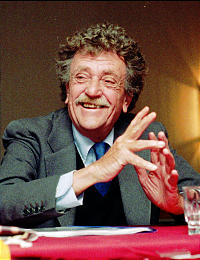
Kurt Vonnegut, 1922-2007, has been one of my personal heroes since I discovered his work. Sometime in 1974 I was discussing life with a bartender when he asked me if I was familiar with Vonnegut, I was not. He told me about play that was showing and recommended that I see it. The show was Happy Birthday Wanda June by Kurt Vonnegut. I was enthralled. I went to the book store and purchased Player Piano, Mother Night, Siren’s of Titan, etc. etc. etc. My personal library now has quite a few first edition hardcover and other special editions of Vonnegut’s writings.
Author Kurt Vonnegut, Jr. smiles before receiving an award in Albany, N.Y., Sunday, Oct. 30, 1994, from the Firemen’s Association of the State of New York. The association gave Vonnegut its “Golden Trumpet” award in appreciation of the recognition and respect he has paid volunteer firefighters in many of his literary works. (AP Photo/Tim Roske) (Submission date: 10/10/2002)
This is also about the time that I discovered humanism and joined Humanists of Utah. Kurt Vonnegut was the Honorary President of the American Humanist Association at the time. I was actually thrilled when I got my first mail from the AHA, the return address was under the name: Kurt Vonnegut!! My first HoU summer picnic was a potluck luncheon attended by maybe a dozen people. For my food contribution, since the picnic was held on my own birthday, I went to a bakery and bought a birthday cake decorated with the phrase, “Happy Birthday Wanda June.” In the play Wanda June’s role is that of a little girl who was hit and killed by a car the day before her birthday. The cake, which had it’s price discounted because the family did not pick it up, was purchased by one of the actual characters in the play who was returning to his dysfunctional family after may years on Safari Hunts in Africa. A lot of Vonnegut plots can be described as “dysfunctional.”
Sometime in the early 1990s, I was made aware a Kickstarter (fund raiser) to bank roll a biographical film about Vonnegut. I donated with a promise of a DVD and listing my name in the movie credits. Fast forward 40 years or so and that Documentary, Unstuck in Time, has been released to movie theaters and streaming on Amazon Prime. There is no chance that I will get the DVD as I have moved, probably twice, and changed my email address, again probably twice, but my name is in the second-to-last line of the credits! A website for the project also lists my name and has a link “to my website,” which I entered so long ago, as humanistsofutah.org.
“Unstuck in Time” is part of the opening sentence of Slaughterhouse 5, or the Children’s’ Crusade. It is among the boldest and clearest pacifistic arguments ever made. Vonnegut served in Europe during World War II and was captured by the Nazis and imprisoned in a hog slaughterhouse outside of Dresden during the Allied Fire Bombing of that city. He spent many weeks pulling dead bodies out of basements after the attack. The subtitle makes the point that most of the soldiers were, and still are, children. The so-called Children’s Crusade of 1212 CE, was a movement of two armies of perhaps 20,000 children. They had no money for transport and many were sold into slavery. Many Vonnegut fans who already know this will also know that the last line of the novel is, “One bird said to Billy Pilgrim, ‘Poo-tee-weet?” The documentary features a small animated bluebird, sometimes just a black and white drawing, of a bird that hops around and poo-tee-weets.
I am dedicating this newsletter to the memory of Kurt Vonnegut, Jr. and filling it with book reviews of his work from our website published over the years. Not all of the reports will fit in this printed newsletter but they are all on our website.
—Wayne Wilson
President’s Message
Happy Holidays and Seasons Greetings!
My hope is that this newsletter finds you well, safe, and happy. While we all embark on the end of this current year, this is a time of reflection, celebration, hope and promise for the future. Even though, we are still in the throes of much turmoil with the pandemic, political issues, community issues and personal struggles, there is so much to be hopeful for. There is good news all around us for us to work with, surround ourselves with, plug into and participate with. As humanists, we do not embrace the traditional holiday affairs which are centered around religious ideology. But this season is not exclusive to these beliefs. There are many holidays and celebrations to be had worldwide and personally that are fully encompassed with this time of year. There is a general sense of gratitude, community connectedness, service and love now that is heightened. Find what makes you happy, go toward what calls to you, reach out within your levels of safety and comfort for connection and know that we, in this group, care and are here. This month is our HumanLight celebration. We will be doing it remotely. You will receive emails with the worksheet and friendly reminders. It is a wonderful way to connect and is family friendly. We hope for the time when we can get back to meeting in person again, but we do not know when that will be – so we will be doing more events online and providing awesome content for you all to enjoy.
Happy holidays to you all and the very best wishes from me and the rest of your Board for the ending to 2021.
Kindest regards Melanie White-Curtis
Chaplain’s Corner
DIY Holiday
All of us do holidays in our own special way… we have family and personal traditions when it comes to what we serve at a meal or how we decorate a Christmas tree, or who performs which tasks.
One fascinating insight from history is that holidays are combined and personalized across centuries and cultures as well. For example, for Christians Easter commemorates the resurrection of Jesus, but it’s name comes from the pagan Ostara. Jesus died during the Jewish festival of Passover, which commemorated the Exodus of the Israelites from Egypt, which in turn originated as a Spring festival related to the birth of the season’s lambs.
Similarly, Christmas supposedly celebrates Jesus’ birth, though we don’t know when he was born (though historians are quite sure he was born in Nazareth, not Bethlehem), though it may have been during the spring. Who was born December 25? Mithras, an originally Persian God as woshipped by the Romans. December 25 is also time to celebrate the time when days lengthen after the winter solstice, when light overcomes the darkness. Sol Invictus. The “unconquered son” was celebrated on December 25 and associated with the Persian God Mithra. And many of our current Christmas traditions come from the Nordic celebration of Yule. See how that works?
Most holidays celebrate the shifting of seasons and the flow of life, especially in temperate climates when summer is bright and hot and winter is dark and cold. Agricultural life has its patterns–birth and planting in the spring, work in the summer, harvest in the fall in preparation for the challenges of winter. Celebrating these milestones help encourage groups to work and especially to cooperate. As a bonus, many of the celebrations are fun! Unless you are dinner.
What does this have to do with Humanism? We don’t tend to believe in Santa or even Jesus Christ, but our disbelief in traditional mythology need to diminish our appreciation for the holiday season. This month I want to celebrate HumanLight with you, while also encouraging you to develop your own holidays and rituals.
HumanLight is a made up holiday made up later than the other made up holidays. The New Jersey Humanists founded the holiday in 2001, and it was adopted by the American Humanist Association in 2004. HumanLight celebrates Humanist values such as reason, compassion, and hope. In honor of the theme of light in darkness, our HumanLight focus is going to be Grief, Gratitude, and Growth.
We need to honor each of these to process our feelings and show up to life in healthy ways. We are often tempted to take shortcuts and avoid pain and challenge, but we know we can’t. One invitation from Covid-19 is that has shown us many truths. Many of these truths are unpleasant, such as the actual views of our family members, but Covid has also highlighted the power of science, the preciousness of relationships, and the fragility of the status quo. Covid has shown us both darkness and light, and both the limits and power of humanity.
This December 9th, we will gather together, apart, to grieve what we have lost and regret, to express gratitude for all we have, and to both celebrate and set intention for present and future growth.
—Chaplain Jared Anderson
What is a Humanist?
Do you know what a humanist is?
My parents and grandparents were humanists, what used to be called Free Thinkers. So as a humanist I am honoring my ancestors, which the Bible says is a good thing to do. We humanists try to behave as decently, as fairly, and as honorable as we can with any expectation of rewards or punishments in an afterlife. My father and sister didn’t think there was one, my parents and grandparents didn’t think there was one. It was enough that they were alive. We humanists serve as best we can with only abstraction with which we have any real familiarity which is our community.
I am, incidentally, Honorary President of the American Humanist association, having succeeded the late, great science fiction writer Isaac Asimov in that totally functionless capacity. We had a memorial service for Isaac a few years back, and I spoke and sait at one point, “Isaac is up in heaven now.” It was the funniest think I could have said to an audience of humanists. I rolled them in the aisles. It was several minutes before order could be restored. And if I should ever die, God forbid, I hop you will say, “Kurt is up in heaven now.” That’s my favorite joke.
How do humanists feel about Jesus? I say of Jesus, as all humanists do, “If what he said is good, and so much of it is absolutely beautiful, what does it matter if he was God or not?”
—Kurt Vonnegut A Man without a Country
Vonnegut Content
I am a little surprised at the selection of Vonnegut’s work that has been reviewed in our newsletter over the years. It leaves out most his most famous and well read novels:
Player Piano, The Sirens of Titan, Cat’s Cradle, Mother Night, Slaughterhouse Five, Breakfast of Champions, Deadeye Dick, Galapagos, and Bluebeard.
Here is a list of linked articles (click to be taken to the review on our website)
Greetings to you all during this fall season. I hope you are all well and enjoying the change in the seasons and so many wonderful things on the horizon. With elections in full swing, I admonish you to get out and vote. It is always important to have a say in how we would like our community leaders to help us all. The holidays are coming, along with the end of this year and there is much to be grateful for. There is hope, there is growth, there is knowledge, we have a great community and we are part of creating history. Small changes and small acts of kindness are ever so important. Our organization provided gift bags for Shriner’s hospital for the children’s Halloween costume parade last month. Due to pandemic protocols, it was a closed event, so we could not attend. Moving forward, though, during these times of personal distance, we will be participating in giving to these types of events. It is a great way for us to put action into what we believe and stand for. There will be more about these events on our facebook page and future newsletters. Stay tuned!
Kindest regards, Melanie White-Curtis, President
Chaplain’s Corner
Want to Feel Better? Do the Same Things Differently
After six years as a Chaplain, I am somewhat bemused to realize I am not a Chaplain. Not primarily at least. Probably why people’s minds bend a bit when I explain that I am a Chaplain, and a humanist.
What I actually am, first and foremost, is a Wellness Integrator. I am passionate about well-being and fascinated by human nature. I also prioritize efficiency as one of my highest values, and there is little of anything more potent than religion.
We each have our feelings about religion, and wariness is understandable and valid. But whatever our feelings about religion may be, in a very real sense our bodies are religious.
Why am I writing about religion in a humanist newsletter? Because religion has coevolved with our human physiology, psychology, and sociology. Our bodies, brains, and cultures are all calibrated to religion. And that means that whatever we believe and feel about religion, the elements of religion contain shortcuts to well-being. I do not tell people to convert to religion. I tell people to convert religion to themselves. That is why my approach to religion is practical and subversive, powerfully effective, and appropriately humanistic.
I have begun doing wellness trainings for the staff members at the hospital where I work. One of the most ironic problems with wellness programs is that they end up making you more stressed! You are told you just need to eat better or sleep more or exercise or do meditation or yoga or go to therapy. All these habits can indeed be healthy, but most of us are busy and overwhelmed, so being told we need to do more just adds guilt to the already overwhelmed.
My approach is different. That’s exactly it. Do the same things you already do, just with small changes that will make huge differences. Life is hard, but you have hidden resources that have already evolved into you. You can access the power of your brain and its sensitivity to ritual and meaning to more efficiently process stress and even trauma. The way we think about things literally changes the way our bodies respond. Our mindset is a matter of life and death. You just need to take a few minutes to plug into these resources.
Here are a few ways you can change your daily habits to increase your well-being, without adding much extra time or even effort. I will unpack some of the science in future columns, but for now, try these out and see how it feels. I am using work as an example, but you can use these practices throughout your day, wherever you are. For best results, talk to yourself, out loud.
When you wake: Take a moment to express gratitude. Tell yourself (or someone else, or your pet or plant) one thing you are grateful for.
As you go to work: Clear your mind and take big breaths. If you have time, you can place your hands on your stomach and chest and meditate for five minutes (when you are not driving!), but on days you do not do that, you can calm yourself while you go from one place to another.
When you get to work: State one of your highest values and remind yourself how your daily work connects to these values.
When you are at work: Be in your body by noticing what you are sensing. Take moments to actually feel what you are touching. For example when you wash your hands, note and feel the temperature of the water, the softness of the soap, and the texture of the towel.
At the end of work: Say one thing that is true, positive or negative doesn’t matter. Just speak the truth about the day, either to yourself or someone you trust.
When you get home: Remind your body that you are home, perhaps by changing clothes. I change into cozy clothes immediately.
When you wash: Say out loud “I am washing off the day” (or whatever you need to process.) The combination of sensory input with this ritual will relieve stress incredibly efficiently.
At bedtime: Talk to yourself. Tell yourself something you are happy about or proud of. Journal if you can.
When you need to turn yourself off and on again, you can take a deep breath, hold it, and let it out slowly, at least five seconds each. Our breath is incredibly powerful, our main body process that is controlled both unconsciously and consciously.
You may feel stressed or overwhelmed in this moment, but your body has millions of years of wisdom you just need to plug into. Practice these rituals and you will not only feel less stress, but you will also feel happier and greater well-being in general.
—Jared Anderson
How to Talk to a Science Denier
~Book Report~
This book by Lee McIntire is subtitled, Conversations with Flat Earthers, Climate Deniers, and Others Who Defy Reason.” by Lee McIntyre. The book with his recollections of a convention held as the Flat Earth International Conference (FEIC) in 2018. The recollections he shares are somewhat amusing and at the same time informative. While we may think this is a fringe group, they are more numerous than you might guess and quite serious about their beliefs. This look at Flat Earthers helps introduce us to the next covered concept, “What is Science Denial?” We learn to see that what people believe becomes part of who they are, it is part of their identity. This results it becoming an attack on them personally when you question or denigrate their beliefs.
In trying to understand what science denial is, he gives us five common factors researchers have identified.
1. Cherry-picking evidence
2. Belief in conspiracy theories
3. Reliance on fake experts (and the denigration of real experts)
4. Committing logical errors
5. Setting impossible expectations for what science can achieve
McIntire notes that, “virtually all conspiracy theorists are what I call ‘cafeteria skeptics.’ Although they profess to uphold the highest standard of reasoning, they do so inconsistently. Conspiracy theorists are famous for their double standard of evidence: they insist on an absurd standard of proof when it concerns something they do not want to believe, while accepting with scant to nonexistent evidence whatever they do want to believe.”
The middle of the book is a bit dense with comparisons and discussions of various research projects on the subject of science denial. But the last part of the book is a good discussion about the title’s question of “how to talk to a science denier?” In a way, it comes down to being willing, as hard as it is sometimes, to keep a civil tongue, to be respectful and trying to find ways to impart new information to science deniers. We already intuitively know this, because making someone angry is not going to get them to listen to reason. You need to establish trust first.
I can say the book is well written and loaded with good information and advice on the subject. In fact the concepts were validated recently when I was T.V. surfing. I happened on the last part of an interview of Norman Lear. While he was discussing the character Archie Bunker, he stated how he got hundreds of letters saying, he’s just like my uncle or father or someone they know. He also stated that “Archie Bunker types are terrified of progress. To me that describes one of the main characteristics of the right-wing/Republicans/conservatives in this country. They are afraid of losing what is left of their white privileged status.
Something else I saw in the op. ed. section was someone’s use of an adage I have heard before but not recently, that is, “I’m ever hopeful but not all that optimistic.” This describes how I have felt about many things in recent years. I could put it before subjects like progress on climate change or preserving democracy from the threats by Republicans or convincing anti-vaxxers to get the shot. Just a thought.
—Bob Lane
Further Discussion
This subject was addressed by the late and great Carl Sagan. The Demon Haunted World: Science as a Candle in the Dark in particular distinguishes between real science and popular conspiracy theories Here are a couple of related links:
Bertrand Russell is often considered the most eminent freethinker of the 20th century. He revolutionized contemporary philosophy and changed how we think about truth, logic, math, and metaphysics. Despite imprisonment and constant social pressure, he was also an outspoken civil rights advocate, agnostic, pacifist, and socialist.
Russell was born in 1872 to aristocratic British parents whose atheism and activism for women’s suffrage, birth control, and other human rights issues were largely unwelcomed in “polite society.” Before their deaths early in Bertrand’s life, they asked the great John Stuart Mill to be his godfather and insisted that their son be raised as an agnostic. Bertrand Russell was, however, raised as a Presbyterian by his religious maternal grandparents. After a childhood riddled with depression, he found himself questioning his beliefs at age 15. By the time he was an adult, he was an outspoken Atheist and Agnostic. “There is no practical reason for believing what isn’t true,” he said, “either a thing is true, [and we should believe in it] or it isn’t [and we shouldn’t]…”
“Three passions, simple but overwhelmingly strong, have governed my life: the longing for love, the search for knowledge, and unbearable pity for the suffering of mankind.”
After graduating from Trinity College, Russell worked as a professor, mathematician, and logician. However, his unapologetic anti-war activism and support for socialism, atheism, women’s rights, LGBTQ rights, etc. lost him several positions in academia and even resulted in his imprisonment on multiple occasions. In defense of his friend, Albert Einstein once wrote, “Great spirits have always encountered violent opposition from mediocre minds…”
In 1955, Russell and Einstein created a manifesto warning the world’s leaders of the dangers of nuclear war. In it, they wrote, “remember your humanity, forget the rest.”
Russell won the Nobel Prize in literature after writing several books on philosophy, science, logic, mathematics, freethought, life, and happiness, including his most famous work, A History of Western Philosophy.
If you want people to believe in your claim, then you’ll need to do more than make assertions that are hard (or impossible) to disprove. It’s your responsibility to provide good reasons for why people should consider your claim in the first place. Russell illustrated this principle with the thought experiment known as Russell’s Teapot. In summary: if I claimed that there was a teapot orbiting the sun between the earth and Mars, too small to be seen by any telescope, then the burden of proof is mine. It is not the responsibility of everyone else to search the vast reaches of space to refute my claim.
Russell questioned and criticized things like the USSR, the Vietnam War, the formation of the state of Israel, and other major issues. As a true skeptic, however, he didn’t stop there.
It was his love of math, Russel once said, that saved him from suicide as a young child. Yet, despite what it means to him, he still exercised his skepticism and successfully found valid things to criticize in modern mathematics. Russel spent a decade writing the multivolume work Principia Mathematica with Alfred North Whitehead. In it, the authors tried to identify and correct all of the illogical or baseless assumptions in math, taking more than 360 pages (for example) to prove that 1+1 does indeed =2.
Russell didn’t hesitate to point out the flaws, contradictions, and paradoxes found in science, logic, and philosophy. This is the essence of freethought! His approach was summarized in the first sentence in the first chapter of his book The Problems of Philosophy: “Is there any knowledge in the world which is so certain that no reasonable man could doubt it?”
In one of his last interviews, Bertrand Russell offered advice for future generations in two parts, an intellectual and a moral part. His intellectual advice is that when we consider the truth of anything, we should only look at the facts. We must not get distracted by what we wish to be true. We also should not blindly accept what we think would benefit society if it were believed. We must look only at the facts.
Russell’s moral advice is that love is wise and hatred is foolish. By using knowledge, kindness, and courage, we’ll make the best world we can.
Condensed from The Free Thought Forum, September 2021 Newsletter
Reason and rationality are in the news. A rash of new books are out on the topic. And no wonder, with the impact of vaccine naysayers and election opponents and climate change deniers and so on. Why are we having this trouble; what are its causes?
As Walt Kelly, author of the Pogo cartoon, said: “We have met the enemy, and he is us.” One of the causes is visceral response to emotional appeals. Another cause is, as Robert Cialdini says in Influence: The Power of Persuasion, reliance on cues about what other people think. In other words, “Social Proof,” rather than scientific or factual proof.
Modern technology enables political and profit-motivated players to use new levers to take advantage of our unreasoning side for their own benefit. Purveyors of disinformation dispatch emotionally skewed falsehoods to get us to click and believe. It’s been called the “algorithmic society”, referring to the internet algorithms that push messages—true or misleading or even false—to people based on the likelihood of clicks and responses.
What does HFFC (Humanists and Freethinkers of Fairfield County, Connecticut) have to with this? We came to the table early, standing for Compassion and Reason. Compassion is uppermost and is most effective when coupled with Reason. We seek to educate and inform, examining topics carefully with a breadth of facts, analysis, and discussion facilitating various points of view. Our Books Etc. discussion group’s choices are wide ranging, including Cialdini‘s work. The latest findings about the world are examined in our Science Readers group. How we are impacted is shared in our Social Hour. We bring experts on so many topics to our second Monday of the month general meetings. We believe that bringing relevant knowledge and dispassionate discussion in fascinating ways will advance Reason over confusion and unreality.
Organized Humanism began in the United States as an effort to maintain the Unitarian Church as the leading “creedless liberal religion” in this nation. Over the years since the Unitarian Church was established as a creedless religion several efforts have been made by overzealous Unitarian leaders to create a “statement of belief.” During the late 1920’s the movement to establish a Unitarian Creed appeared close to gaining approval by the Unitarian hierarchy in Boston.
A group of Unitarian Ministers in Chicago, strongly opposed to the effort in Boston, organized to halt the creedal railroading by the easterners. They were ridiculed as “The Western Movement.” Reverend Ed Wilson was a proponent of the Humanist Philosophy and a Unitarian minister. He and four other Unitarian ministers formed a loose organization including Chicago University professors to publicize the Humanist Philosophy and urge the Unitarian Society to adopt it’s ideas rather than adopt an authoritarian religious creed. Dr. Wilson was a leading spokesman for the group and helped to write a defining statement eventually referred to as The Humanist Manifesto.
The Western Movement was a major factor in defeating the effort in Boston to write a Unitarian Creed of Belief. The task of composing a Humanist Manifesto took about three years. It went through serious discussions, several drafts, and revisions. Some prominent philosophers eventually refused to approve it, some because it was too bold, some because it was too soft.
The final compromised document was signed by thirty-three liberal religious and educational leaders and in 1933 was published for the first time in a Chicago newsletter, The New Humanist, edited and published by Ed Wilson. Here are some highlights from this document:
· In every field of human activity, the vital movement is now in the direction of a candid and explicit humanism. In order that religious humanism may be better understood we, the undersigned, desire to make certain affirmations, which we believe the facts of our contemporary life demonstrate.
· Today man’s larger understanding of the universe, his scientific achievements, and his deeper appreciation of brotherhood have created a situation which requires a new statement of the means and purposes of religion.
· We therefore affirm the following:
· Religious humanists regard the universe as self-existing and not created.
· Humanism believes that man is a part of nature and that he has emerged as the result of a continuous process.
· Humanists find that the traditional dualism of mind and body must be rejected.
· Humanism asserts that the nature of the universe depicted by modern science make unacceptable any supernatural or cosmic guarantees of human values.
· Religious humanism considers the complete realization of human personality to be the end of man’s life and seeks its development and fulfillment in the here and now.
· The enhancement of human life is the purpose and program of humanism.
· We assert that humanism will: (a)affirm life rather than deny it; (b)seek to elicit the possibilities of life, (c) endeavor to establish the conditions of a satisfactory life for all.
So stand the theses of religious humanism.
Ed Wilson continued his role as a spokesman for humanism, and his Unitarian ministerial career. In 1946 he was invited to be the minister of the Salt Lake City Unitarian Society. While here he continued his dual role as a Unitarian Minister and as editor of The Humanist magazine.
During his three years in the Salt Lake City pulpit his leadership in both capacities was instrumental in the acceptance of humanism within Unitarianism. This congregation was one of the first Unitarian Societies to adopt the Humanist Manifesto as an inspirational document. By the 1960’s, 80% of the US Unitarian membership identified themselves as humanists. Today that percentage is slightly less than 50%, but it continues to be the largest sub-group in the Unitarian Universalist Association.
Dr. Wilson remained as chief editor The Humanist Magazine for 16-years, from 1941 to 1956.He was one of the founders of the American Humanist Association and served as its executive director for 21-years, from 1949 to 1970. In 1952 he participated in the formation of the International Humanist and Ethical Union, uniting the humanist movement worldwide.
The illness of his wife was a factor in Ed Wilson retiring from active leadership roles in both the Unitarian Ministry and the American Humanist Association. Upon the death of his wife, he decided to return to Salt Lake City where one of his sons was a physician at the Veterans Hospital. He was instrumental in forming this local chapter of the American Humanist Association.
I had the privilege of interviewing him after we had organized the chapter. That interview is available here.
He was a brilliant scholar, thoughtful, intelligent and an excellent communicator. He talked primarily about his early life
Ed Wilson’s goal was to live to welcome in the year 2000. He wanted to be one of the few people who could be recognized for living in three centuries, the 1800’s, the 1900’s and two thousand. But his desires exceeded reality. He died shortly after our interview. Consequently, his personal voice regarding the struggle to form the American Humanist Association was never electronically recorded. It is available in this book published a few years after his death, but I would have been more than pleased to have had his personal observations of organizing the AHA recorded in the first person!
A few years earlier he did have an oral history interview at the University of Utah Marriott Library. In that interview he related some of the details about organizing humanism and he told Lorille Miller his ideas about how the words “religion” and “religious” have quite different implications. His comments reveal clearly, I think, how he felt comfortable being both a humanist leader and a Unitarian Minister. Here is an excerpt:
“The Humanist Association was intended to be an educational association, not a church or a denomination. We were not going to call it a religion but did want religious values to be included in its general approach to life.
“Religions set up a creed which people are required to affirm. The emphasis in their faith is on ‘right belief’…it is often dogmatic and rigid whereas ‘religious’ is a quality of life and includes wonder, awe, and commitment to ideals.”
Ed was the energizer in organizing this chapter of his American Humanist Association. He and seven others met in the chapel next door on a November evening in 1990 and voted to organize the Humanist of Utah. Our charter was officially granted by the AHA May 9, 1991. Our Articles of Incorporation as a non-profit Corporation were granted by the state of Utah August 3, 1992. The chapter’s original statement of belief and purpose read:
Humanism is a natural way of life that promotes living joyfully and compassionately in the present, using innate intelligence, science, the humanities and experience as the methods for discovering truth.
Our purpose is to offer an affirmative educational program based on developing one’s natural inner strengths in order to practice the art of living; to promote meaningful activities and compassionate services which champion Humanism; and to be an association where all can have a sense of belonging to a larger community that supports a positive philosophy of reason, integrity, and dignity.
Membership growth was slow but by 1996 one-hundred-and-forty people had paid dues to be recognized as members supporting humanist principles. The main characteristic shared by all humanists is ‘an inquisitive mind seeking rational answers to life, nature and the universe.’
Humanism is a broad category of ethical philosophies that affirm the dignity and worth of all people, their intellectual ability to determine moral values, their emotional strength to determine right and wrong based on human experience and evolution, rather than ancient Biblical dictates.
Humanism entails a commitment to the search for truth and morality thru reason rather than revelation, human means in support of human interests. In focusing on the capacity for self-determination, Humanism rejects the validity of transcendental justifications such as faith and supernaturalism. They respect reason and reject revelation as a source of discovering truth.
Humanism features an optimistic attitude concerning the capacity of people. Their ultimate goal is human flourishing, making life better for all humans. The focus is on doing good and living well in the here and now, and by their efforts leaving this world a better place. They believe the rewards of living the good life will be enjoyed during this life, not in a life after death.
At the conclusion of a recent panel discussion of several Utah religious leaders the moderator invited each of us to respond to the question:
“How would Utah be different if 70% of its citizens were members of your religion or philosophy?”
My response was:
1. Education would be tuition free thru college graduation.
2. Students would be encouraged to develop their innate talents and self esteem.
3. Sex education would be a subject of public education where students would learn the responsibilities of sexual expression.
4. Public housing would be available for the homeless.
5. Meals would be available for the hungry.
6. Medical services would be available for everyone.
7. Appropriate jobs would be available for the unskilled.
8. People would be required work no more than 8-hours a day, nor more than 5-days a week.
9. Public transportation would be affordable for everyone.
10. Electronic media would be required to present all sides of political and social questions.
Prisons would be operated for rehabilitation rather than punishment.
I feel fortunate to have been a charter member of this organization; to have had an opportunity to serve on the board of our national organization for 8-years; To have served as a certified Humanist Counselor and officiate for fifteen years; and most of all I feel a deep gratitude for having had the personal guidance and wisdom of one of the outstanding world leaders of humanism.
The characteristic shared by all humanists is an inquisitive mind seeking reasonable answers to the questions of life, nature, and the universe.
–Flo Wineriter
President’s Message
As this year is starting to wind down, my thoughts are with the situation in the world, our nation and our community. It’s interesting that we all thought last year was the worst due to the pandemic and that this year would be better than last. To some, it has been better, but for many it has been the same or worse. Whatever your thoughts on the state of the pandemic, it has most definitely been a game changer and that is tough for many. Many have had more time for thinking, self-reflection, searching, and even a quest for something more. As humanists, we believe in the importance of human values and dignity. We propose that people can resolve problems using science and reason. Rather than looking to religious traditions, humanism focuses on helping people live well, achieve personal growth, and make the world a better place instead. Lots of food for thought, if you are looking to further your growth or just want to refresh.
As I write this from my hotel room in Memphis, my thoughts are heavy with the rich history here. I am currently travelling across the country for a wedding and seeing very important places on my way. Today I visited many powerful places within the civil rights movement’s history. I walked where Martin Luther King spent considerable time, where he gave his speeches and ultimately where he was killed. There are literally no words. The energy that resides in these places transcend time. The community here, more than 50 years later, still embraces pieces of this time period and even have kept the styles and vibe alive and well in the city. There is a strong sense of helping keep the ideals alive and moving progressively forward toward equality and a better life for all. I have thought about sacrifice. Even though Dr. King was a religious man, his words and his work were for everyone. The ethics were spot on and in his immortal words, “The ultimate measure of a man is not where he stands in moments of comfort and convenience, but where he stands at times of challenge and controversy.” – Strength to Love, 1963. The turmoil around us all is tough. If you feel isolated and afraid, know that you are not alone. We have a community of strength in the knowledge and empowerment of ethics based on reason and our common humanity. We recognize that moral values are properly founded on human nature and experience. Now is the time to stand tall with your value system and share it with those around you. I admonish you to share the good news about what we believe. Live the life you have chosen and seek to move forward with helping the world be a better place, one step at a time.
MLK
I send good vibes to you all and wishes for safety and happiness during these tough times. My thoughts are with you and we, as a community, have a lot to celebrate by adhering with the American Humanist Association (AHA) ideals of “striving to bring about a progressive society where being ‘good without a god’ is an accepted way to live life. We accomplish this through our defense of civil liberties and secular governance, by our outreach to the growing number of people without religious belief or preference, and through a continued refinement and advancement of the humanist worldview.”
Thank you for fighting the good fight and for just being you.
Kindest regards Melanie White-Curtis
I’ve Been Reading A Lot Lately
I have been reading more than usual because of the need to stay isolated during the pandemic. When the pandemic was getting really scarry, I wasn’t reading much at all. Being a person of high risk due to age and some health issues, I was too distracted with anxiety and was mostly pacing around and watching too much cable news about the horrors this virus is causing. But, after I got myself calmed down with the help of the Veterans Administration, reading became a good way to keep my mind busy.
Yet, even though reading, has been a good distraction, I still stayed informed on current events. Along with the pandemic, the actions or inactions of Donald Trump and his administration in regard to the COVID-19 virus and then his attempts to overturn the election certainly kept anxiety at the door. You would think that with all that has been going on in this country, with Trump at the center of it all, it would make a person shy away from books about the worst President ever. But no, I have three books about that evil man, one was given to me, and I haven’t read much of it yet. The other two I have read. First is a book by Mary L. Trump Ph.D., Donald Trump’s niece, titled Too Much and Never Enough, subtitled How my family created the world’s most dangerous man. Mary Trump is a clinical psychologist who is a good writer and does a good job of describing the ugly and dark history of their family. As the cover leaf states “she describes a nightmare of traumas, destructive relationships, and a tragic combination of neglect and abuse.” It’s well written and I recommend it as one of the best ways to gain an understanding how somebody can become as horrible as Donald Trump.
A more recent title about Trump is I Alone Can Fix It, by Carol Leonnig and Philip Rucker, both correspondents at The Washington Post. With the subtitle is Donald J. Trump’s Catastrophic Final Year. The book in my opinion is a riveting narrative. Superbly written in stunning detail it describes what was going on behind the scenes in the last year of the Trump administration. I don’t think I have ever called a non-fiction book as riveting as this one. As I read this book more quickly than I usually do I asked myself why. Then it occurred to me that it was partly because we had been living what they were describing in detail in a running narrative. Much of what they wrote about we knew about from the news and his endless “tweets.” It was compelling in a strange way to me as a story I already knew about but was eager to have the writers fill in the details. And the details give you pause to realize how badly the Trump administration mishandled the COVID pandemic and how close they came to subverting our democracy to keep Trump in power. Quite frankly, the subversion attempts are still going on to this day. I highly recommend this book and I’m sure it will keep you as riveted as I was.
—Bob Lane
Chaplain’s Corner
Professional Decent Human Being
Teaching World Religions is what made me a Humanist. Ph.D. coursework in Biblical Studies required me to get creative with my Mormonism but teaching World Religions made the whole floor of belief crumble into a beautiful agnostic mosaic. Once I was exposed to the grand history of religion, it became obvious that religion was both profoundly powerful and profoundly HUMAN.
With more experience teaching the course, I would motivate and stump students with two questions I’m going to share with you now.
1) What cultural institution is more powerful than religion?
2) If I wanted to be a professional good person, what job would that be?
We as humans and Humanists need to grapple with these questions. The question of effective approaches to well-being is one I am most passionate about, but I’ll come back to that later. Suffice it to say that I am troubled that the most impactful institutions are not the most ethical ones. Shocking right? (Take a glance at the US defense budget sometime)
In this Chaplain’s Corner I want to explore the relationship between religion and goodness. Because though many professions require goodness, only one *specializes* in goodness. A professional good person is… a minister. Traditionally, religious leaders are those who are understood as being specialists in knowing what is right and wrong, knowing how to live well, and helping you do it. I know I’m not the only one who finds it deeply disturbing that US culture has mostly outsourced goodness to religion.
I’ve had the privilege of working as a Humanist Chaplain, endorsed by the Humanist Society, for almost six years. I specifically sought out hospice and prison Chaplaincy because I wanted to see if I could serve the dying and imprisoned without relying on the idea of afterlife (so far it’s gone very well.)
I playfully and seriously call myself a “professional decent human being”. And this is where you come in, because as Humanists, you are also dedicated to decency. We all should be, right? But too often we get distracted. I have found that in general, we are as decent as we are incentivized and empowered to be, and overwhelmingly influenced by our contexts.
Two quick stories about goodness. One of my favorite parts of my job as Prison Chaplain is to train volunteers (I call prison “life skills with catastrophic consequences”). In one session a man said, “I don’t think I’m comfortable with that word you keep saying.”
I responded, “Um, you mean…. Defensible?” I had to admit I’m not surprised that he is not used to needing to account for his actions. Last year I was invited to debate some Evangelical Christians at the University of Utah on the proposition that God is required for morality (They preferred the more audacious claim that Christianity was required for morality, and I gently responded that I don’t know whether they want to engage in an ethical critique of Christian history). My succinct summary is that in order for morality to pertain, God does not need to exist. You do.
Traditionally “right and wrong” has been understood as “how God wants you to live,” but we’ve made a lot of progress in understanding what goodness means. My proposal is that goodness involves effective approaches to individual and collective well-being, which includes respecting self and others as whole people, conscious agents worth taking seriously. If you want to do some Googling, I resonate with Emmanuel Levinas’ theory of interpersonal ethics, combined with a pragmatic focus on function and outcome of our actions.
Of the many amazing conversations I have with my children, a favorite is when I asked whether it’s possible to do anything wrong in a video game. My youngest immediately piped up, “Playing video games can make you do things that are wrong in real life”. In seconds she intuited the principle that it is consciousness that makes something ethical. As best as we can tell, we can’t hurt a rock’s feelings. The greater the consciousness, the greater our ethical responsibility. My ethical formula is this: every action should be defensible to the ideal version of all those impacted by that action.
I distill my concept of spirituality down to two words: Show up. Life invites us to show up to the conscious experience, show up to ourselves, show up to each other. In my experience, we show up as much as we are incentivized and empowered to do so. As a Chaplain, I have the privilege and responsibility of showing up for people in their hardest moments, where life breaks open. My favorite thing about Chaplaincy is that it trains behavior and skills that are just good living, things we all should be doing for ourselves and each other.
And that’s why in the same way I am a professional decent human being, you all are amateur Humanist Chaplains. So as members of Humanists of Utah and humans in general, I look forward to showing up, humaning well, and living better.
I’d like to officially offer to be your Humanist Chaplain.
The Humanists of Utah have celebrated Thomas Paine Day in the past by holding a Thomas Paine Day in the fall of each year. This year due to Covid 19 restrictions the board has asked me to write an article about Thomas Paine in lieu of a meeting with a speaker. Thomas Paine is considered one of the founders of our nation. In this discussion I would like to include three other men associated with the formation of our country along with Thomas Paine: Thomas Jefferson, Benjamin Franklin, and John Adams.
As background, it is important to note that the American revolution was in large part a strong reaction against the state-sponsored Church of England and the “divine right” of the English monarchy. The colonists were not fond of Kings or of their God-given right to be dictators.
Now, contrary to the belief of most Christians in America, the founders of our nation were not religious in the sense that they would have you believe. The four founding fathers I will discuss were all deists. A deist is not a theist or an atheist. Their ideology held that God might have created the world but after he created it, it could, and did, run by itself. After the initial creation event, the deists contended that God no longer intervened in any temporal events, concerned himself with the affairs of man, or answered any personal prayers. Deists rejected any religious dogma or claims that any religion or any scriptural book; the Torah, the Bible, The Quran, The Bhagavad Gita, or any other book contained God’s revealed words.
Benjamin Franklin was born in Boston in 1706. He had been brought up a pious Presbyterian. After reading many different books, he began to have doubts about religion by the age of fifteen. He wrote, “Of several points, as I found them disputed in different books that I read, I began to doubt revelation itself. Some books against deism fell into my hands, and it happened that they wrought an effect in me quite the contrary stop what was intended by them. The argument for deists…appeared to me to be much stronger than the refutations.”
Benjamin Franklin traveled to Europe. While in Scotland he stayed with the well-known agnostic philosopher David Hume. Hume’s works including “An Enquiry Concerning Human Understanding” and “Dialogue Concerning Natural Religion” were widely read and deeply influential. Hume’s friends consider him a skeptic and his enemies considered him an atheist. Hume and Franklin became friends. On his return to America from Europe Franklin joined the earliest Masonic Lodge in America in 1734 and later became its president. In time he would become a strong influence on Thomas Paine.
Thomas Jefferson certainly qualified as a Deist if not an agnostic or atheist. This becomes clear from one of his most famous quotes.
“I have recently been examining all the known superstitions of the world, and do not find in our particular superstition, Christianity, one redeeming feature. They are all alike, founded upon upon fables and mythologies.” He went on to say, “Christianity is the most perverted system that ever shone on man…perverted into an engine for enslaving mankind…a mere contrivance for the clergy to filch wealth and power to themselves”.
Jefferson is known for writing his version of the Bible that kept all the teachings of Jesus intact but removed all the ‘miracles”. He believed that if we had a clean text of the Bible, one that included only the words of the real Jesus and not his miracles, it would help conquer bigotry and fanaticism.
Of the four men, John Adams was the least vociferous proponent of deism. Not as outspoken as the others, he did however carry on a long correspondence with Jefferson in which they mutually criticized religion. As the second president of the United States, Adams signed into law the Treaty of Tripoli in 1797. The treaty declared the government of the United States was not in any sense founded on Christianity. In one of his last letters to Jefferson, he mentions the historian Charles Francois Dupuis (1792-1809) who explained the story of Jesus as a “…classic myth, born at winter solstice, beset with difficulties, reborn from beneath the earth in spring.”
Thomas Paine (1737-1809) was an English-born American political activist, philosopher, political theorist, and revolutionary. His pamphlet “Common Sense” published in 1776 had a profound influence on the movement for independence in America. His pamphlet challenged the authority of the British government and the royal monarchy. The plain language that Paine used spoke to the common people of America and it was the first work to openly ask for independence from Great Britain. His 47-page pamphlet, proportionally the all-time best selling title in American history, was read by, or to every rebel in the American Revolution. After the American Revolution, the Revolutionary War, and the writing of our Constitution Paine traveled to France to participate in the French Revolution. He was very popular and was elected to the French National Convention. While in France he wrote his most famous work, “The Age of Reason”. The French revolution had a very turbulent and fractious ending, and he smuggled his book out of France in 1794 and barely left in time to save his neck.
President Jefferson invited Paine home and gave him passage on a national ship. Back home, his book, “The Age of Reason” was widely read and had a strong influence on a young nation based on a strong separation of church and state.
Paine did not spare word when it came to religion. He wrote, “Every national church or religion has established itself by pretending some special mission from God…Each of the churches causes the others of unbelief, and for my own part, I disbelieve them all.”
He used the history of the Jews in his arguments: “The best evidence we now have respecting this affair of Jesus is the Jews. They are regularly descended from the people who lived in the times that this resurrection and ascension is said to have happened, and they say it is not true.” When asked about his religion Thomas Paine said, “The world is my country, all mankind are my brethren, and to do good is my religion.”
These deist founding fathers had a major influence in the writing of the United States Constitution. They carefully inserted a strong wall between church and state by way of the First Amendment of the Constitution. This constitutional amendment makes America the first fully secular nation ever conceived and brought forth upon this earth. As secular humanists we should be very proud of our country and its founders including Thomas Paine.
—Craig Wilkinson, MD Board Member Humanists of Utah
President’s Message
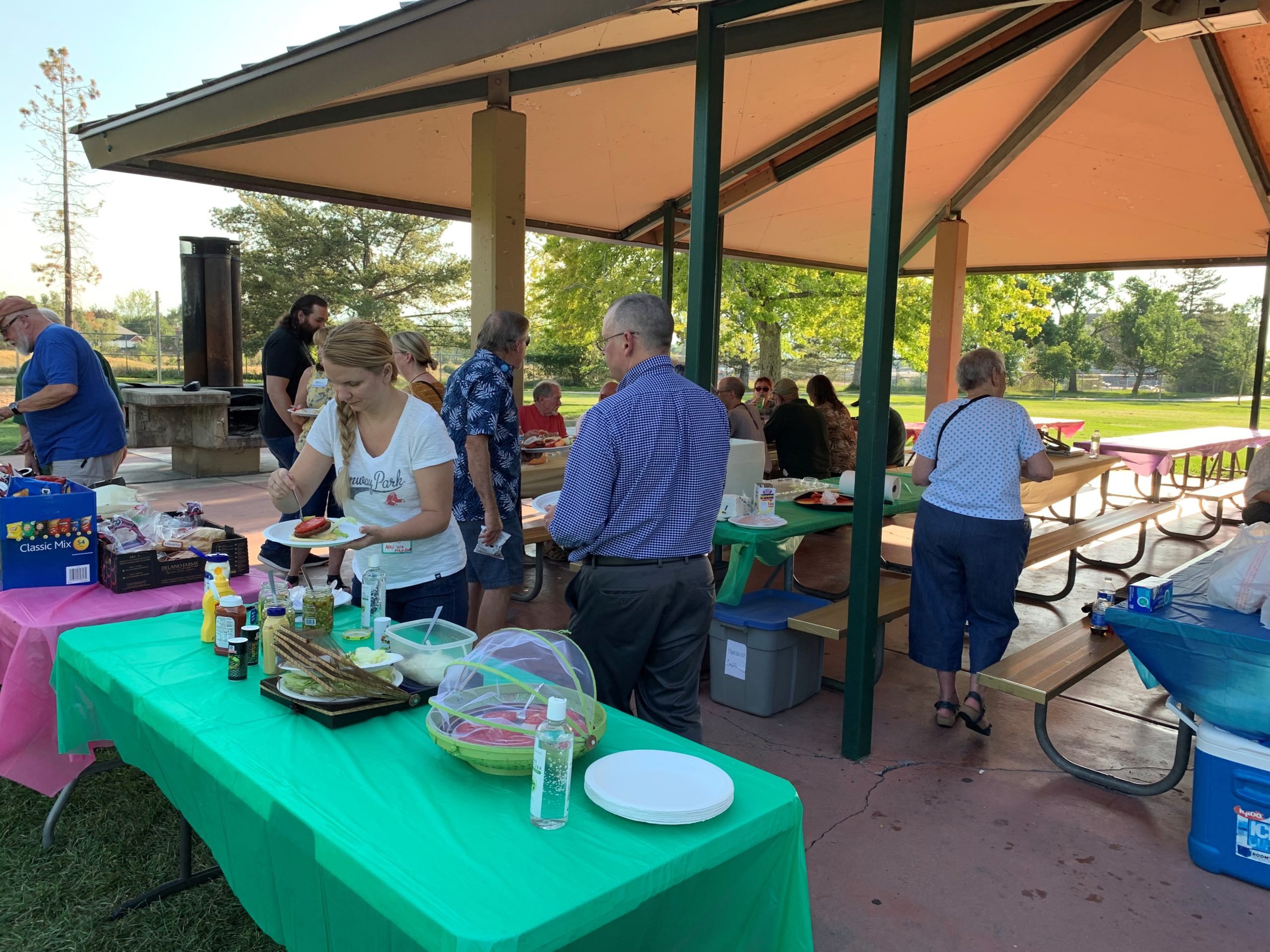
I hope this finds you well and happy. We want to thank everyone who was able to come to the annual BBQ picnic earlier this month. We had a great time. It was intended to be our big launch back into the world of a bit of normalcy. We have plans of future events, meetings, and such. But due to the ever-changing nature of this pandemic, it is not to be yet. We, as a board, are watching very closely to the CDC recommendations and to our state health officials and what is happening here in our own communities. Currently, we are hesitant to “re-open” too quickly and risk putting folks in harm’s way. But, the good news is, we are not going dormant like happened last year. With all the heavy things we are witnessing and experiencing right now, as a people, it is hard sometimes to find bright spots, moments of happiness and clarity, and peace. So, instead of being able to congregate together in person, for now, we are going to be providing many different avenues for engagement. Lots of safe interaction, happy thoughts, good reading, and many virtual activities and speakers for you to connect with. We also have plans for safe activities in the near or not so near future. Again, we will be adhering to the guidelines presented to us and as always, you are free to use your best judgment, as well.
Friends, there is so much to be grateful for in these times of chaos and uncertainty. We are fighting a good fight. We are all in this together. We have strong values and morals to guide us. We have each other and this wonderful organization to lean to and draw strength from.
Humanist Philosophy in Perspective
Many have expressed interest in learning more about humanism, what it is and perhaps some of the history that got us where we are today. A great starting place is an article, “The Humanist Philosophy in Perspective,” from the American Humanist Association written by Fred Edwords who has been active in national humanism since at least 1990. https://americanhumanist.org/what-is-humanism/humanist-philosophy-perspective/
Our own HoU Website also has wealth of information and history surrounding humanism’s roots, core beliefs, and actions.
I wish you: health, safety, and peace. I also am very excited to see you in all of the good news that is coming. Watch for it and plug into our FB page for daily goodies and information.
Kindest regards Melanie White-Curtis
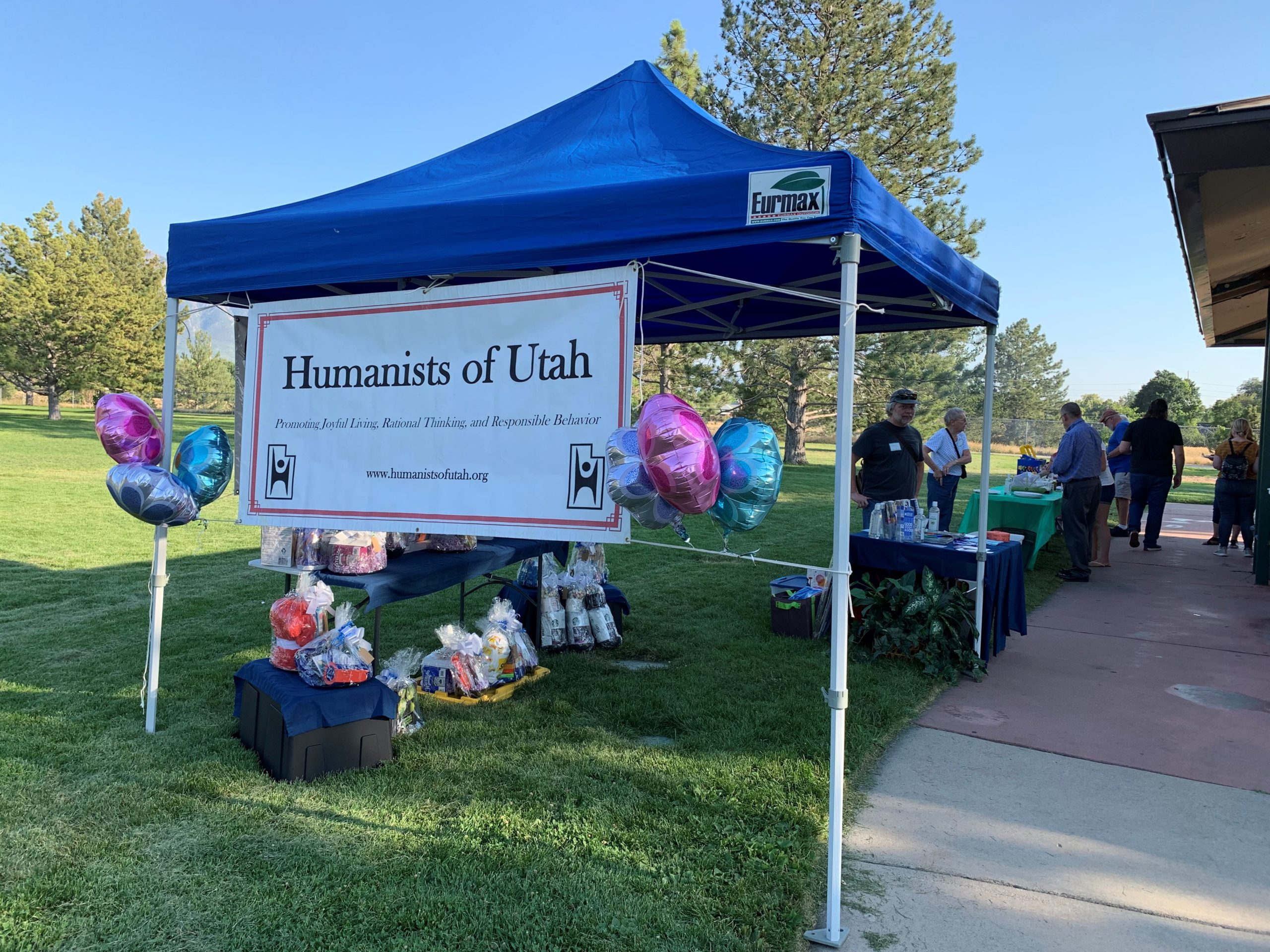
Pictures from the Picnic
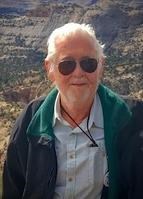
Robert Frahm
In Memoriam
1936~ 2021
Robert Ray Frahm passed away peacefully Saturday, August 7, 2021, in the home he shared with Sally Jo Fuller in Sandy.
He was born March 4, 1936, in Granger, Utah to Stella Petersen and William Frahm.
After attending Cypress High School, he spent two years in the US Army during the Cold War, stationed in Greenland. Robert was employed for 45 years by Kennecott-Rio Tinto. His occupation is listed as Powerplant Control Room Operator. Robert was always fascinated with the large machinery and operations at the plant. Robert’s passion was watching Formula One and motorcycle racing events and TV shows where older model cars were rebuilt to their original design. Classical music was always on his mind.
Robert was preceded in death by both of his parents and his “best cook” sister, Bette Barton.
He leaves behind a daughter, Kimberly Mitchell of SanTan Valley, Arizona and the following nieces and nephews: Richard G. Barton, Julie B. Rasmussen, Tina B. Aramaki, and Michael Barton. Robert also leaves behind his most caring friend and domestic partner, Sally Jo Fuller.
We wish to thank Bruce Bailey, our neighbor, who came to his assistance many times these past few months. Also, we wish to thank the George E. Wahlen VA Medical staff and Superior Home Care and Hospice for their care over the past few years.
Robert was a lifelong Atheist and Democrat and proud of it.
—Sally Jo Fuller
John Barnes
In Memoriam
1931 ~ 2021
John Barnes was born in Kansas City, Missouri, September 15, 1931, but he grew up in Cheyenne, Wyoming. In about 1950 he was called into the National Guard.
In 1956 on to the University of Wyoming where he majored in Business Management attaining his Bachelor of Science Degree after four years. During this time, he met and married Joyce who was attending the University of Colorado’s State Teachers College. They have two daughters who live in California and Montana.
After college, John was employed as a Data System Analyst for The Martin Company in Littleton, Colorado, for five years. Then moved to the Salt Lake area where he worked for Hercules Aerospace as a Data System Analyst for the next thirty years until retirement in 1989.
John and Joyce have done some traveling, but mostly enjoy the local cultural events in Salt Lake City by regularly attending the symphonies, ballets, operas, and theater productions. A great pastime in reading magazine publications, such as; Discover Magazine, National Geographic, The New Yorker, and The Bloomberg News Newspaper.
John has been a member of the Humanists of Utah for twenty years and a Board Member for three years. He says that joining HoU, he has enjoyed the company of developing intelligence of the members. As to his sense of humor which he shares liberally, he believes that he acquired it mostly on his own.
—Sally Jo Fuller
Addendum – obit published in the Salt Lake Tribune:
John passed away August 25, 2021, in Salt Lake City, Utah of complications from COVID-19. Even though he was vaccinated, a combination of an underlying aspiration pneumonia and waiting too long to seek care proved too much for his body to recover. John was born to Leona and Sam Barnes in Jackson, Missouri. When he was around five years old, his parents moved him and his younger brother, Sam Jr. to Cheyenne, Wyoming. The boys grew up in Cheyenne, getting into brotherly mischief involving late night escapades, firecrackers and general rowdiness befitting two best friends, born exactly five years apart. John met the love of his life, Joyce Colburn in the late 1940’s while they were both in college. After getting married, they moved to Portales, New Mexico where John served as a mechanic in the Air National Guard, repairing planes used in the Korean War. Sidenote: he fudged his age in order to join the Guard! In Portales their first daughter, Ariel was born in 1952. After returning to Laramie to finish his degree, John and his family moved to Littleton, Colorado where he worked for Thiokol. In 1958, during a terrible blizzard, his second daughter Barb was born. Barb had a birth defect and needed to be rushed to a Denver hospital, but all the ambulances were out in the storm. So, John rushed his newborn baby, incubator and all, and the pediatrician to the hospital in his car for her to have emergency surgery. In 1961 John and his family moved to Salt Lake City, Utah after a job transfer to Hercules. He and Joyce proceeded to put down deep roots in Holladay, a suburb of Salt Lake. John enjoyed a long career as a systems analyst with Hercules. He was very involved in Toastmasters, was an avid skier, and competed in handball well into his late 70’s. John also became an accomplished private pilot, and enjoyed his time at Skypark in Bountiful, Utah as well as flying his family to visit relatives in Wyoming and Michigan. He also supported Ariel in obtaining her student pilot license before she could legally drive a car by herself. He also taught both daughters how to drive a manual shift on the floor or column, as well as how to change tires, oil and spark plugs. John and Joyce were devoted patrons of Salt Lake’s performing arts, supporting Ballet West, JazzSLC (GAM), Pioneer Theatre and the SL Acting Company. They were founding members of the Shakespeare Festival in Cedar City, only missing when illness prevented them from attending. Additionally, John was a member of the Humanist Society and the Unitarian Church. John also had a strong artistic streak, including painting, photography, woodwork, carpentry and stained glass. A devoted reader of anything to do with history or politics, John remained informed and able to converse about anything from European issues to local history, national events and politics. (Thank you Frost’s Books and Wellers). Following a terribly botched hip replacement surgery resulting in the loss of use of his right foot and ankle, John had to give up his home and connections with his valued wonderful neighbors. The silver lining was being able to move to Parklane independent living apartments where he made many friends and enjoyed all aspects of the community. To the dismay of many, he continued to drive, with his left leg and foot, however he did so without ever having a serious accident! (Don’t try this at home folks) While he did drive through the “old neighborhood” almost daily, he also found new ways to socialize, including stopping in at his local mechanic’s shop almost daily (thank you Slaugh’s Car Care) and being the liquor store runner for friends at Parklane. Preceding John into the greater realms of Love were his wife Joyce, his parents, brother Sam, and granddaughter Renee. He is survived by daughters Ariel Owen a retired educator (Walnut Creek, CA), Barb Barnes a conflict resolution facilitator (Helena, MT) Granddaughter Autumn Barnes, a podcast producer (Missoula, MT), Sister in-law Anita Barnes, Nephew John Barnes (Glore), Brother/Sister in-law Frank and Charlotte Colburn, Nephew Mark Colburn (Brenda), Nieces Cate Colburn-Smith (Chris) and Anne Colburn-Ehrhart (Tim) and de facto cousin Malin Foster (Cody, WY). The family wishes to extend deeply heartfelt appreciation to: The wonderful people living in and working at the Parklane community, Wendy Flath P.T. extraordinaire, Amanda Lambert now a family friend and our “boots on the ground” in SLC, Envision Home Health, Fred Gotleib MD a practical and wise physician, the amazing physicians and nurses at Salt Lake Regional Medical Center ICU who made this dreadful time one of healing, compassion and above and beyond care, especially Dr. Sara Scott, Dr. Justine Ly, Nurses Chad, Nick, Cheyenne, Jamie and Emily. We also are incredibly grateful to all of his friends including Sue and David, Margo and Bob, Chad and Mu, Cosette and Barb, Janet, Jud and Adele, Brad and Ryan, Scott, and their wonderful neighborhood family in Holladay. In his last days, John was full of gratitude and the grace of final farewells. Truly it can be said that his tender heart was fully restored as his last words were “Thank you, Thank you, Thank you.” Please be sure to tell a corny joke in his honor and consider making a donation to: The Junior League of SLC: 526 East 300 South SLC, UT 84102.
Published by The Salt Lake Tribune from Sep. 1 to Sep. 6, 2021.
Today, the American Humanist Association (AHA) announced scientist and immunologist Anthony S. Fauci, M.D. as the 2021 Humanist of the Year. AHA Executive Director Roy Speckhardt said, “We are honored that Dr. Fauci will receive our highest award at the AHA’s 80th Annual Conference. His unwavering commitment to accessible, evidence-based information and his robust communication to people about public health issues is commendable and necessary, especially in this critical time.”
Dr. Anthony S. Fauci is the director of the National Institute of Allergy and Infectious Diseases (NIAID) at the U.S. National Institutes of Health, where he oversees an extensive research portfolio focused on infectious and immune-mediated diseases. As the long-time chief of the NIAID Laboratory of Immunoregulation, Dr. Fauci has made many pivotal contributions in basic and clinical research and is one of the world’s most-cited biomedical scientists.
In the US and throughout the world, he is respected for his efforts to address COVID-19. Throughout the global pandemic, his push for evidence-based solutions and emphasis on the importance of science and reason has been a guiding light in difficult times.
Dr. Fauci has identified as a humanist and mentions that he aligns with humanist values. He has said in recent interviews: “I look upon myself as a humanist. I have faith in the goodness of mankind.” and “I’m less enamored of organized religion than I am with the principles of humanity and goodness to mankind and doing the best that you can.”
Dr. Fauci is the recipient of numerous prestigious awards, including the Presidential Medal of Freedom, the National Medal of Science, the George M. Kober Medal of the Association of American Physicians, the Mary Woodard Lasker Award for Public Service, the Albany Medical Center Prize in Medicine and Biomedical Research, among others. He also served as the trusted advisor of seven U.S. Presidents.
Dr. Fauci’s remarks will wrap up the American Humanist Association’s 80th Annual Conference on the afternoon (EST) of July 25th. The Annual Conference will be held virtually on July 24th-25th, 2021 and, in addition to Dr. Fauci’s remarks, will feature interactive sessions, inspiring speakers, and opportunities to connect with fellow humanists.
—American Humanist Association
President’ Message
There are so many exciting things coming during this very hot summer! I hope you are staying cool, staying safe and enjoying your summer days. Our annual BBQ is coming on evening of the 12th at Sugarhouse Park. It is a free event with games, raffle prizes and lots of delicious food. We hope to see you and your families there. Bring a friend, we would love to meet them. We are taking count, so we can be prepared with plenty of food. Hop on to the FB page or group and let us know you are coming. I appreciate it. As a quick FYI, we will be starting our speaker series again and coming into the holiday season, we will have our traditional events too. I hope you are as excited as the board and I are, it is going to be a great way to round this year out.
We are witnessing many things in the political climate, as well. There is much hope and work to be done. I admonish you all to stay open minded and aware of what is happening and to vote the way you believe. It is truly important and is very helpful in furthering ideals that you believe in. Recently, I attended the American Humanist Organization Conference and was part of a wonderful group of folks that align in the same way that we do. It was awesome to hear of the work being done nationwide in helping support humanistic ideals, principles and fighting the good fight. I will be sharing many of these with you over the next few months too.
As always, I send my hope for happiness to you all. I am excited to see you at the BBQ and look forward to seeing you all in person again.
Kindest regards, Melanie White-Curtis
A Plea For Peace
This letter to the editor was printed 20 years ago. Tawna Skousen is still an active HoU Chapter member.
We are moved by the alarming news and crisis our country is facing. This is a great nation founded in the belief that “all men are created equal” and that we are the “land of the free.” May each of us have the strength to assist in every way possible to help and comfort those who are suffering, hurting, and in fear.
Our nation is one of justice and due process and we seek humbly for wisdom, constraint, and patience as we search to bring to justice those responsible for these acts of terrorism.
May we reach out to all those affected by this tragedy, providing refuge for those who lost security, strength to those who have been weakened, and peace to those in turmoil.
In peace, Tawna Skousen October 2001
Summer BBQ
Note that Facebook RSVPs are appreciated but NOT necessary for attendance
Collective Failure
In a article by Leonard Pitts published by the Salt Lake Tribune about deaths from firearms, when I came to the point where he used the term “collective failure.” A simple two-word phrase, but a good one. It got me thinking about how it fits so many problems confronting humanity, and more specifically our society here in the U.S.
Collective failure is an apt term and a fitting description for my thoughts this month, which speak to the unfathomable number of human deaths and suffering caused by tobacco.
Using myself as an example, I can say that no relative, or friend has been killed by a firearm. Whereas at least five relatives in my parents’ generation, including my father, at age 60, died from smoking tobacco. I don’t mean to trivialize firearms deaths, it is a terrible problem, but by comparison, tobacco kills over 12 times as many people yearly than firearms do.
I also understand that shootings get more press coverage because they are terribly traumatic incidents and are newsworthy, especially when a mass shooting or a police shooting happens. Whereas the statistics about the deaths of over 1,300 people PER DAY in the U.S. from smoking tobacco doesn’t get the media very excited.
To paraphrase some statistics from the CDC, the leading cause of preventable deaths in the U.S. is tobacco smoking, which kills over 480,000 people per year. Which is more than the deaths from car accidents, alcohol, illegal drugs, AIDS, murder, and suicide combined.
It costs the U.S. over 225 billion in health care expenditures and more than 180 billion in lost productivity each year. In addition, smokers lose on average a decade of life, not to mention the pain and suffering they endure; such as one of my uncles struggling with emphysema for several years before it dragged him to his death.
We can understand how this continues to happen when we see that the tobacco industry spends 8.2 billion annually, which is 22.5 million per day on marketing.
We can nod in agreement when we hear the adage “money talks and bullshit walks,” when applied to tobacco. We can agree that there is collective failure here, both in society to deal with this problem as well as collective failure from the tobacco industry to own up to the fact that the purpose of their product is to extract money from their victims. These victims get addicted to their product – basically a poison that kills 480,000 people annually in the U.S., and 7,000,000 annually worldwide. Yet this industry cares nothing about the death and suffering their product causes.
I understand that a lot of jobs are at stake if we were to abolish tobacco, and I am always leery of banning anything, but, if a foreign country was somehow killing 1,300 U.S. citizens daily, we would be at war with them.
What I don’t understand is how anyone can consider themselves moral, ethical or a religious individual and still work for an industry that produces a product that causes pain, suffering and death.