Newsletter Blogs

September 2018

The Moth Snowstorm: Nature and Joy
~Book Review~

The Moth Snowstorm: Nature and Joy by Michael McCarthy presents a compelling picture why we love the natural world. With a little nudge towards broadening our rational thought processes due to the overwhelming majesty of the wildness around us, he encourages us to dwell for at least a moment beyond what we can understand through our senses and then take care of that wildness.

He says, “We think of ourselves, especially since the decline of Christianity in the West, and its replacement by our current creed, liberal secular humanism, as rational beings entirely; we pride ourselves that, faced with a Problem, with a capital P, we may employ Reason, with a capital R, and naturally find a Solution, with a capital S. We believe that this will deliver, every time. Rationality is ingrained in a million mindsets. Yet the world does not always work like that (as those who lived through the two world wars, mired in chaos and evil, knew only too well). And there is another way of going about things in dealing with the mortal threats that our planet now faces, which is to consider, not what we do, but who we are.

“Most of us probably think we know. We do not give it a second thought. But in the last thirty years or so, a new understanding, by no means yet widespread or popularized, has begun to dawn of what it means to be human, based on a simple but monumental perception: the fifty thousand generations through which we evolved as hunter-gatherers are more important to our psychological make-up, even today, than the five hundred generations we have spent since agriculture began and with it, civilization. We possess the culture of the farmers, the subduers of nature, and the citizens who came after with their settled lives and their writing and law and architecture and money, yes of course we do, but deep down, beneath culture in the realms of instinct, at the profoundest levels of our psyche—the new vision has it—we remain the children of the Pleistocene, the world that was not subdued, where we lived as an integral part of it, in coming to be what we are. The legacy inside us has not been lost, and in many ways is controlling….

“Surveys have demonstrated that, shown different landscape images, people overwhelming favor one form in particular, one of open grassland interspersed with trees and a view to the horizon, and if possible water, and animal and bird life….

“The profounder implication…[is] that there persists, deep inside us, deep in our genes, an immensely powerful innate bond with the natural world…

I believe the bond is at the very heart of what it means to be human; that the natural world where we evolved is no mere neutral background, but at the deepest psychological level it remains our home, with all the intense emotional attachment which that implies—passionate feelings of belonging, of yearning, and of love…

“And there, at last, is the possibility of a new defense of nature, one more robust and all-encompassing than either the hopeful idealism of sustainable development or the hard-faced calculation of ecosystem services; there, may be the beginnings of a belief and an argument with which to shield the natural world in the terrible century to come. The natural world is not separate from us, it is part of us…

“[We must] register the true degree of the planet’s predicament and the real magnitude of the processes we have set in train which may bring about our ruin…If loss of nature becomes a sort of essay subject,…we may lose sight of…the great wounding that it really is.”

Michael McCarthy then discusses the beauty of the earth and the losses that have and will ensue. He encourages us to become the kind of people who stay in touch with our own love of the earth, as difficult as that may be.

But isn’t that what being a humanist is? Thoughtful contact with our own home for the joy of it? And through that joy, we are made whole.

—Lauren Florence, MD


June/July 2018

The Honorable Governor Culbert L. Olson

HoU Board member Craig Wilkinson, M.D. is the author of a biography of Culbert L. Olson, titled: The Honorable Culbert Levy Olson, Governor of California from 1939 to 1943. He summarized the work at our May general meeting. The book is available on Amazon. com.

Culbert Olson is remembered, when he is remembered at all, as an outlier. He was the only Democrat to serve as governor of California between 1896 and 1958, and he lasted just one term—elected in 1938 and ousted in 1942. And he was that rarest of birds among American politicians elected to high office, an avowed atheist, who refused to say the words “so help me God” as he took the oath of office.

But he was much more than that, he was a progressive who was far ahead of his time, perhaps too far for his own good. I believe now would be a very good time for a reappraisal, and deeper understanding of Governor Olson. He proved prescient about the threats to American society—from economic inequality, war, racism, and the dangers of fatalism—that are all too much with us today.

“No deity will save us,” he liked to say. “We must save ourselves.”

Olson was raised in Fillmore, Utah in the Mormon faith but left the church as a young man after deciding Joseph Smith was an imposter and that his revelations didn’t make any rational sense. He eventually came to atheism after listening to lectures of a, then famous, American atheist, Robert Green Ingersoll while he was serving as Congressman William H. King’s secretary in Washington, D.C. He would argue that the Founding Fathers were deists, believing in a creator but rejecting the notion of a supernatural deity that continued to interfere in men’s lives or answered personal prayers. Olson, before and during his political career, would urge people to become “humanists,” which meant avoiding the bigotry and tribalism associated with organized religions.

Olson was a state senator in Utah from 1916 to 1920 where he supported a progressive agenda and wrote the first child labor laws in Utah’s history. He moved to California after losing the Democratic nomination for U.S. Senate to Milton Welling who was a Mormon Stake President. He decided to move to California and won a seat in the State Senate in 1934. In that era, Democrats had little chance at winning statewide office. But the Great Depression changed that and Olson was nominated by his party for governor in 1938. He had the good fortune to oppose a highly unpopular and corrupt incumbent, Republican Frank Merriam at a moment when the Depression was taking another turn for a worst. With support from FDR, whose campaign he had supported, Olson, an urbane, handsome, and well-dressed public presence, with thick white hair, won an enormous upset victory.

No governor has faced so many obstacles to pursuing his program called a “New Deal for California.” Not only was the legislature and political establishment dominated by Republicans opposed to his progressive views, but there was an “economy bloc” of Democrats whose main focus was no new taxes, who helped stall his plans.

Olson did what he could. He was the first governor to appoint an African American, a woman and a Latino to the judiciary. He cut state subsidies to corporations, especially powerful interests, he reformed California’s harsh and brutal prison system, he kept the State Relief Authority funded, but the legislature defeated most of his programs, which included: “production for use” which would have solved California’s unemployment problems; compulsory universal health insurance for every Californian; stricter legislation on banks; raising taxes on banks and large corporations; and strict new regulations on lobbyists.

These defeats along with preparations for World War II, which dramatically improved employment in California, ended his plans for a New Deal in California. The governor made many enemies in the pursuit, especially Standard Oil, with his Atkinson Oil Bill which broke its monopoly on oil in California. He made enemies with owners of large corporations who were upset with his support of the “production for use” concept championed by Upton Sinclair and his strong support of labor unions. He made enemies with the Roman Catholic Church (with whom he tangled over its outsized influence in education). He sought to handle his defeats with humor. He said, “but if you want to know where hell is, try and be the governor of California.”

Olson’s criticism of corrupt interests was not welcome in Sacramento. He was unapologetically progressive in demanding government control over industry. In 1939, he said: “To my way of thinking, it is the social responsibility of government in promoting the general welfare to exercise control and stabilization of the national economy, to plan and provide for full employment when private industry fails; to prevent business cycles which result in industrial depressions; to provide the ways and means of making available to all the people health protection, and the utmost in educational services; to protect the national resources against wasteful exploitation for private greed.”

Up for re-election in 1942, Olson at first opposed the Japanese internment, which had been supported and defended by the state Attorney General, Earl Warren. In public statements and in a letter to FDR, he pointed out many of the interred Japanese were American citizens and that Japanese students and farmers were just as American as everyone else in America. In a San Francisco speech, he warned, “Anyone who generates racial hatred and social misunderstanding is a demagogue of the most subversive type. He becomes an enemy of society, just as truly as a tax evader, an embezzler, or a murderer. In fact, he does infinitely more harm.”

But Governor Olson went along with the internment after a military order from General John DeWitt, a fervent advocate of incarcerating Japanese Americans. And in the fall, he lost his re-election badly to Warren. In an irony, Warren proved more effective than Olson had been at pushing through some progressive aspects of Olson’s program, including in corporate regulation, political reform, and investment in public infrastructure.

After he left office, Culbert Olson became President of the United Secularists of America, a body of secularists, atheists and free thinkers. This work included defending separation of church and state, promoting taxation of church property, and opposing religion in public schools. He foresaw corporations using appeals to religion, and alliances with conservative evangelicals, to promote their self-interest.

You can still hear Olson’s humanitarian views in the conversation about income inequality, which is as bad now as it was when he served as governor in the 1930s. About inequality, he warned: “Social problems are created by economic maladjustments, poverty in the midst of plenty…continued concentration of wealth control of the national economy in the hands of a small percentage of the population opposing every effort of the government to interpose controls for the economic stabilization and for the general welfare.”

In this, Culbert Olson represented an American democratic tradition of politics that original from basic human needs and not from monied interests and individual privilege, that deserves more attention today.

His support of non-belief in a supernatural God, despite its unpopularity at the time is becoming more relevant as we see organized religion losing support around the world. Even in the United States those who enter “none” when asked about their religion has increased to near 25% of the population and is projected to be the majority view by 2032 as predicted by the Pew Foundation that studies such matters.

Culbert L. Olson was truly a statesman and humanist ahead of his time.

—Craig Wilkinson, MD


AHA Conference and Chapter Direction

I want to thank HoU for mostly subsidizing my recent participation in the AHA annual convention that was held in Las Vegas May 17-20.

There were some amazing presentations and many enthusiastic hard working people there. The most enjoyable presentation to me was by the 2018 AHA Lifetime Achievement Awardee David Suzuki. David Suzuki’s career as a scientist, writer, and television host/producer spans decades, during which time he has tirelessly fought for environmental literacy and policy change. The most moving presentation to me was given by Jennifer Ouellette, the 2018 Humanist of the Year. She spoke of her brother’s recent death. A physical exam found an unexpected tumor that after several missteps turned out to be a life ending aggressive cancer. His last few months of life were filled with pain, he and his family did not receive complete information about his situation in a timely manner. His pain management was largely unsuccessful and he died an unexpected, poorly explained death. Ouellette made several points including patients and their families deserve and need to know their conditions, pain management is not always done well, and finally, and most importantly, death with dignity is an important concept. This final point was highlighted on my drive home when I stopped in St. George to see my friend, mentor, and second father, Flo Wineriter. He is 93, mostly deaf and blind, requires assistance to bathe and dress. He is being cared for by his daughter who a couple of years ago was in a devastating car accident and hospitalized of several months. During that time he moved in with his son who last fall suffered a massive stroke—so now Flo is back with his daughter. The three of us had a pointed conversation about Flo. He noted how difficult it is caring for him on his children. And all agreed that their spouses should not be responsible for Flo. I think that they are looking for an assisted living facility for Flo now. Mentally Flo is very sharp, he has some trouble with short term memory but his intellectual skills are still amazing. If Utah had a Death With Dignity statute he would have ended his life at least two years ago.

Over the years Humanists of Utah has had a number of members let their memberships lapse because we did a lot of talking but very little acting. I’m reminded of a reported conversation between Henry David Thoreau and Ralph Waldo Emerson that took place in a local jail where Thoreau was detained. Emmerson asked his friend why he was incarcerated to which Thoreau responded “why aren’t you in here too?”

Our Bylaws first section reads:

The purpose of the Humanists of Utah is to offer an affirmative non-theistic educational program based on developing one’s human talents in order to practice the art of living; to promote meaningful activities and compassionate services that exemplify humanism; and to be an association where humanists can have a sense of belonging to a larger community that supports a positive philosophy of reason, integrity, and dignity.

Education about humanism is important but the winds have changed; learning is no longer sufficient. Activism is where it is today. I suspect that this may be a major reason why our chapter is having so much trouble attracting new members.

We also have a Board of Directors that hasn’t changed much in years. Many of us have trouble traveling at night, etc., etc. Jeff Curtis recently joined HoU and has attended a couple of our Board Meetings; he is interested in heading a Social Justice committee. He has a lot of great ideas.

Humanists of Utah was organized in 1991, nearly 30 years ago. I have high hopes to see it continue to be a positive force in our community; Promoting Joyful Living with Rational Thinking and Rational Behavior. If you can contribute please contact me.

—Wayne Wilson


White Privilege

George Pyle, of the Salt Lake Tribune, wrote in his April 22 editorial that his father taught him, “Never attribute to evil that which can be explained to stupidity.

“Whether it’s the manager of a coffee bar or a police officer with his gun drawn, we are clearly dealing with white people acting, not of a thought-through feeling of racial superiority, but out of a reptile-brain fear that the black person standing before them is a threat. A feeling they would not have if it were a white person there doing the same thing.

“A quick count of of arrests and shootings would make it clear that it is the black folks, not the white ones, who have cause to be afraid.”


April/May 2018

Darwin: Great Benefactor to the Scientific World

Time was, people believed that a perfect earth was created and would never change. In their old-world view, no change was needed nor would occur since perfection could not be bettered.

But Darwin, that heretic, changed the scope and breadth of science by making the conceptual leap to grasp that things could change. He saw that change had occurred in the past and would continue to change from now into the future. Moreover, Darwin was courageous enough to say the heresy out loud; even if it put him in danger.

Once he was able to transcend the idea of a static earth, which included life unchanging on that earth, Darwin gifted the world with an understanding of how the enormous variation in all life came to exist. Thus arrived Darwin’s theory of evolution by natural selection.

Science reigns in Darwin’s world, not supernatural, immutable perfection, and for this we, humanists, honor him.

For our 11th annual celebration of Darwin, the Humanists of Utah met at the Utah Department of Natural Resources auditorium. We listened to Dr. Randall B. Irmis, Chief Curator at the Natural History Museum of Utah, which is currently hosting a new exhibit, “Nature’s Ultimate Machines.”

Dr. Irmis is also an Associate Professor at the University of Utah in the Department of Geology and Geophysics. He has done field work all around the world studying early dinosaurs and has published major articles in prominent journals such as Nature and Science.

In keeping with Darwin’s monumental idea of evolution, Dr. Irmis spoke on “The Rise of the Dinosaurs: Evolutionary Success Through Competition or Luck?” His writings are based on his hands-on study of the fossil record.

An extinction event about 252 million years ago, thought to be a massive release of greenhouse gases and lots of big rocks hitting the earth, defines the boundary between the end of the Permian Age and the beginning of the Triassic Age. In the late Triassic, the first dinosaurs are found in the fossil record. On first appearance, dinosaurs are not important parts of their ecosystems.

But the end-Permian event which had wiped out many species left ecosystem holes into which dinosaurs could radiate and even thrive.

During the course of the next 140 million years the dinosaurs began to increase in numbers of species and individuals and became the dominant species on our earth. The family tree of dinosaurs split into two, the Ornithischians and the Sauropodomorphs. Later, the Sauropods gave rise to the Theropods which have evolved in modern times to be the birds in our back yards and on our tables.

In the environment of the early Triassic, tiny meat eaters were more successful than the plant eaters. Floral growth was more varied and inconsistent, offering vegetarians variable famine that would have overtaken and dispensed with many plant eaters, especially the large ones.

Associated with low numbers of plants, the percentage of oxygen in the atmosphere was low. Low oxygen tension was less of a challenge to the dinosaurs if a bird-like lung is theorized for them. Current birds’ lungs are more efficient at extracting oxygen from the air than the lungs of other animals, giving the Theropods a physical advantage in the Triassic Age.

Cold blooded reptiles, fish and amphibians would also have had mobility and functional challenges. Posited to be warm-blooded, dinosaurs would have had superior ability to move and function. The fossil record also indicates another reason for more efficient mobility in dinosaurs compared to reptiles. A complete hole in the leg socket of the pelvic bone where the femur articulates is thought to make them more mobile with better locomotion. More efficient mobility is assumed to be an advantageous evolutionary strategy allowing the Theropods to more successfully radiate and fill empty ecological niches.

Even though the luck of surviving one or more extinction events is shared by more than dinosaurs, it is dinosaurs who better adapted to the environment and who thrived while reptile numbers shrank.

In the fossil record, about 1000 species of dinosaurs have been found.

Dr. Irmis thinks Darwin thought both a superior ability to compete as well as luck were involved as he devised his laws of Natural Selection. Thus, from the Divergence of Character and the Extinction of Less Improved Forms “evolve the current species.”

Thank you, Dr. Irmis and Mr. Darwin.

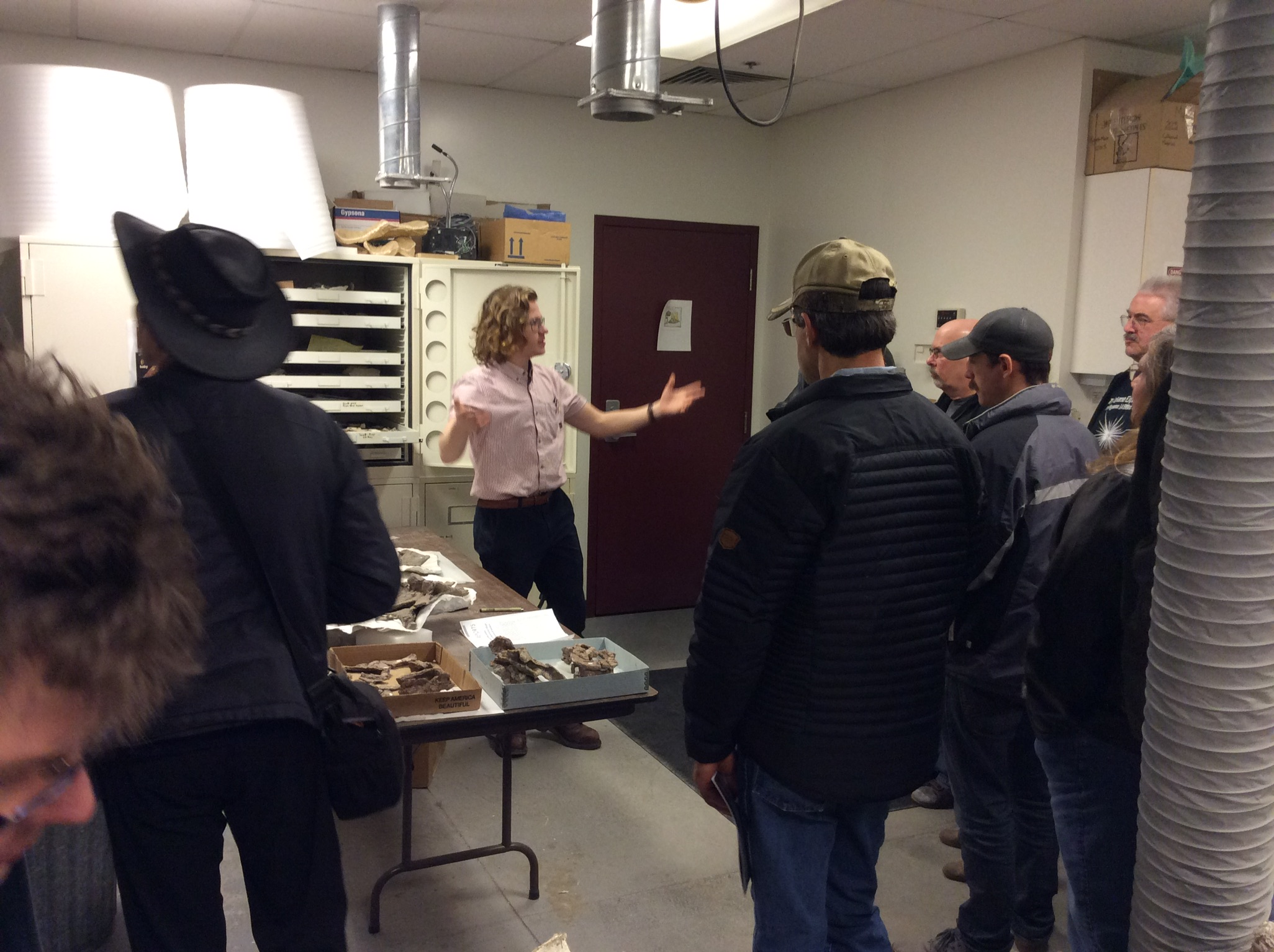
Thank you also, to Dr. James Kirkland and Dr. Evan Cowgill for tours of the Utah Geological Survey paleontology preparation lab where we saw pneumaticity in the bones of Theropods in the forms of grooves and air cells. Removal of bone makes the bones lighter, thereby more like the birds we know and love today.

Pneumaticity In Theropod Fossil


—Lauren Florence, MD


Pictures from Darwin Day taken by Dr. Florence:

Discussion of raptor “kill claw”

Discussion of raptor “kill claw”

Therapod born with “kill claw”. It gets larger as the animal grows.

Unearthed specimen of Therapod spinal column with attached ribs being cleaned and processed

Discussion of raptor “kill claw“

Discussion of raptor “kill claw“

Utahraptors

Another photo of the grooved, and thus less weighty, pelvic bone next to the paper by Dr. James Kirkland, one of our local experts.

Utahraptors

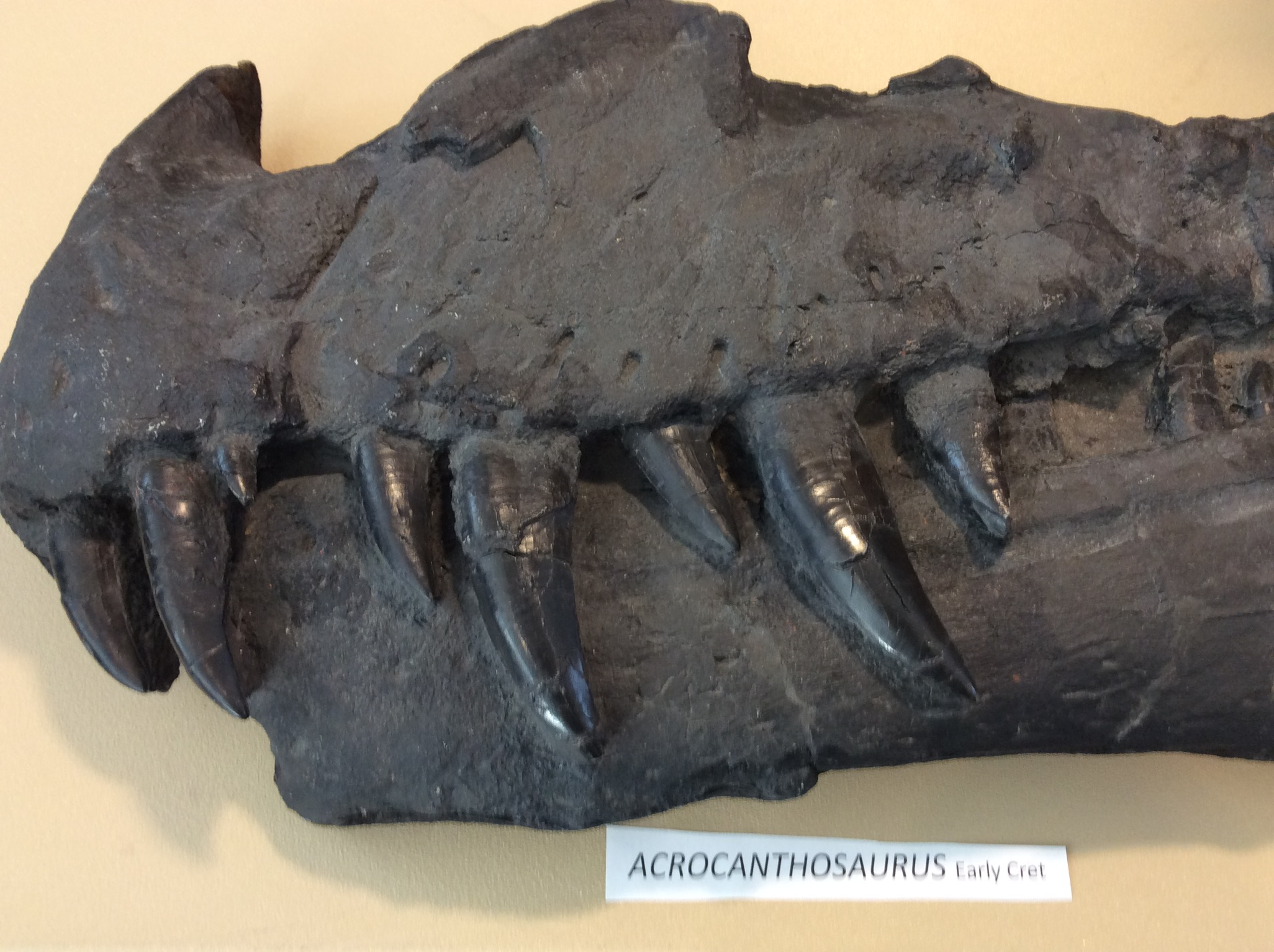
Acrocanthosaurus

Tenontosaurus

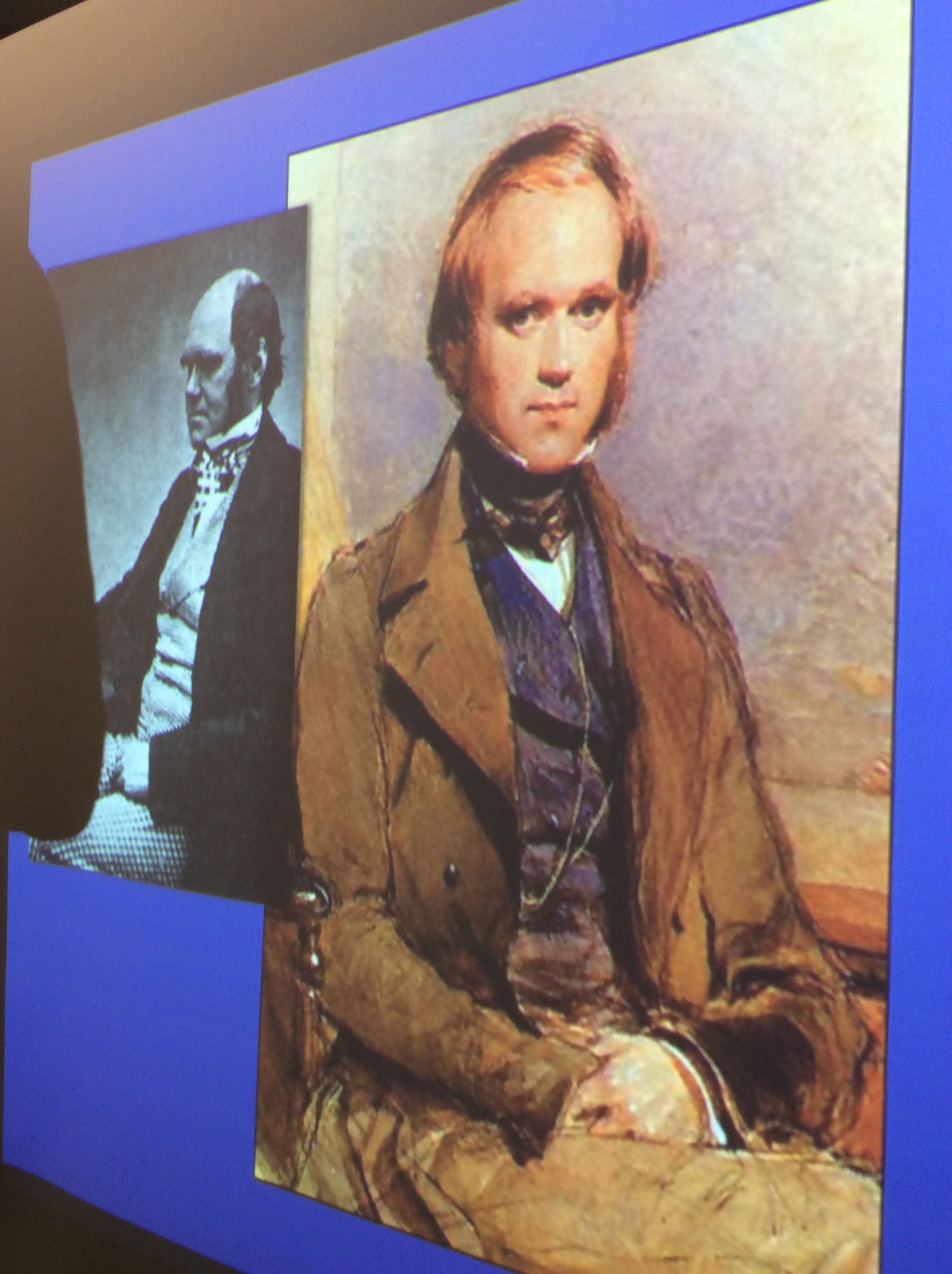
Two pictures of Charles Darwin The man we are celebrating


Stardust

Inspire passion for science and wonder with this children’s STEM book exploring the Big Bang, the Solar System, and our place in space!

My name is Douglas Harris and me and my daughter Bailey (age 12) released a book called My Name is Stardust in 2017. The book has done very well with secular families and was supported by prominent activists such as Michael Shermer and Dale McGowan.

We are launching a Kickstarter campaign for the next book in the Stardust Series, Stardust Explores the Solar System.

You can contribute to the campaign here: https://goo.gl/SWSYD6

—Douglas Harris


President’s Message

I hope you are enjoying the spring weather as much as I am. It is my favorite time of the year as I think I have mentioned every spring that I have been writing these messages. All my life I have enjoyed growing things to eat. And nothing is fresher than what is growing right outside your back door.

Speaking of back doors, some of you may know I am moving into my deceased mother’s house. It is a bit strange, as this is where I grew up. But my mother didn’t grow much food, so I’m having to eek out some spots among the bushes. But I love putting seeds in the ground early. Planting things like carrots, peas, lettuce, spinach, onions, dill, etc. I’m also going to grow some herbs in quantities to be able to give some away to friends and neighbors. There is already lavender, sage, rosemary, thyme and oregano and I plan to plant more. But enough of my gardening zeal.

By now I hope you know that we are going to a bimonthly schedule and to also move the venue around to a variety of places on different times and days of the week. With that in mind, I hope you will give some thought to places you think would be a good place as a venue for a meeting or event. This February’s Darwin Day Celebration at the Utah Division of Natural Resources facility was an excellent venue. And if they are willing, I think we should have Darwin Day there often. I would also ask you to think about what you want us to schedule. With only six dates to plan for, do we want more socials, more speakers, an advocacy project? The Board of Directors would love to hear from you.

Speaking of Darwin Day, it was a great success this year with the work of Craig Wilkinson, MD, Utah Friends of Paleontology, Atheists of Utah, and all the other participating groups making it happen. There were exhibits to check out, a tour given by UFoP members. There was an excellent presentation with birthday cake after.

It is never too soon to start planning next year’s event, so I want to suggest that we think about the theme and subject. Though we have had Climate Change as the subject recently, the threat it presents seems even more pressing with Trump as President. Unfortunately, with this man in the Oval Office, much that has been accomplished environmentally in the past is being attacked and undone. It will make a good theme again as well as an opportunity to advocate for the environment.

With that said I think I’m going to close and go do the environment a little good by getting some seeds planted.

—Robert Lane
President, HoU


February 2018

Getting Ready for Darwin Day 2018

Click on image for a larger rendering


The Other Side of the Story

The Israeli Occupation of the West Bank has gone on for over fifty years and has become the status-quo. Peace talks are not happening, and Israel is satisfied to keep millions of Palestinians living under military law. This Occupation could not happen without US approval. We are protecting the Israelis both by giving them over 3 billion a year in tax payer money and by vetoing measures in the UN Security Council meant to censure Israel. The US government and the media are not telling the public the whole story. The death rate in the Occupied territories is 96% Palestinian and 4% Israelis killed. Genocide, racial profiling and ethnic cleansing are War Crimes.

—Barbara Taylor


The Law of Survival of a Species

I was pretty stressed when I saw both of my daughters use the metoo# hash tag when it began circulating; there were also too many lady friends and acquaintances for my comfort. I wondered what I could have done differently, what I could have taught them while they were growing up? It occurs to me that the simplest answer might be found in basic biology.

I traveled to Denver with a booster club in 1975 to watch the Salt Lake Golden Eagles hockey team clinch their division. We stayed in a hotel with the team; we had an entire floor and there was a huge victory celebration after the game. I witnessed four or five females, who were in committed relationships, offer their own special congratulations to Eagles players. I saw firsthand the mechanism of Survival of a Species. The concept is that female animals are attracted to Alpha males, the females instinctively believe that it is likely that genetic material from alphas makes their own progeny more likely to survive than would with regular males’ offspring.

Another example is Monica Lewinski, she stated that she was “madly in love” with Bill Clinton; it is more likely that the animal in her madly coveted sperm from the most powerful male in the world. She acted as a female animal instead of a woman (human) just as Clinton acted as a male animal rather than a man (human.)

Society is currently grappling with the concept of respect for women; I haven’t heard evolutionary biology mentioned in any discussions yet and I think that this is a very important consideration. I believe that we can and should realize that there is a distinction between animals and humans—it is what makes us human. Humans are, on a basic level, animals but I like to think that humans have grown beyond our simple, basic animal instincts. However, ignoring our inherent animal nature is foolish and may be an important root of the problem everyone is trying to solve now. Powerful (alpha) males exist and they attract more females that average males. When we do not acknowledge this fact the human part of our makeup does not bubble to the surface. I believe that this concept of the distinction between (man/male) and (woman/female) is very important to the way we prepare our children to enter society.

Young people venturing away from the family hearth experience one of the most exciting times in life; they feel unfettered freedom and make their own choices for the first times in their lives. Young women need to understand that the primitive females in their bodies can mask the human qualities of some males that they are attracted to. Analogously, strong males need to realize that just because many females are attracted to them, they do not have intimate physical rights to any woman they are attracted to. If young people are aware of these forces they have a chance to push a pause button, yes that other person is amazing and the feelings going on inside me are exciting and feel so good; but am I sure that this is the right person for me? Maybe, but could it hurt to wait until tomorrow and meet for lunch? If everything is genuine then things will progress, and this really could be the right person for me. The human part of me should have input into this decision and have the authority to overrule my animal component within.

It is not easy to override powerful biological instincts, but I think if we all work on preferring to use our human traits whenever there is a conflict with primitive animal choices that the world will be a better place for everybody.

—Wayne Wilson


President’s Message

Because there was no newsletter last month, this is my first opportunity to say happy new year. So, happy new year. Now that it is February, that means that instead of a general meeting, it is time for or annual Darwin Day celebration. This year board member Dr. Craig Wilkinson has taken the lead in planning the event and we thank him for that. I won’t say much about the event as there will be an announcement elsewhere in the newsletter. But please do attend and bring a friend.

This month my message will be mostly about chapter business. For quite some time now the board of directors has been concerned with the slow decline in membership and a drop off in attendance at meetings. The board is considering various ways to address the chapters problems or needs. There were a couple of problems we have known for a while, Thursday meetings and evening meetings. I know driving at night is a problem that some have told me keep them from coming to our meetings. So, we have decided to start the process of change by switching to a weekend afternoon schedule. This means that we will not be meeting at the Unitarian much anymore, being that the church itself has the weekend use of the facilities understandably tied up. Also, we will be going to a bi-monthly schedule. No meeting January, March, May, July, September, November. If attendance improves or we decide to add something to the schedule like a bus excursion or the like, events can be easily added. This schedule change also means that the newsletter will be bi-monthly. Finding venues will be the biggest new challenge for the chapter, but I think moving it around a little won’t be a problem. Perhaps we can find a venue more centrally located in the valley. If anyone has suggestions as to venues please let us know and we would also love to hear from chapter members with suggestion for improving Humanists of Utah.

The voice of humanism and its aspirations need to be broadened in this trying political times and not allowed to decline or be weakened. I hope our efforts to improve Humanists of Utah will help us to be part of the humanist voice which is very much needed.

This year is the last year of my presidency of the Humanists of Utah. I’ve been the president for a lot of years, and it’s time for a change. Its been an honor to be president and I plan to stay on as a regular board member. But I want to be free of “running things” so to speak. Plus, becoming a regular member will allow me to do what I would like to do, and that is to concentrate on the planning of our special events like Darwin Day, our BBC, possible bus excursions and so on. One last thing, the American Humanist Association is holding its Annual Conference in May this year at the Flamingo Hotel in Las Vegas. Board Member Wayne Wilson and myself will be attending and it would be great if some of you attended also. This will be my fourth conference, once in Amhurst, New York, once in Portland, Oregon and once in Las Angeles, California. They were all excellent with interesting speakers and sessions and a lot of likeminded people to meet. Plus being as close as Las Vegas eliminates the high cost of flying back east or elsewhere. So please give it some thought.

That’s about it for now. Hope to see you at our Darwin Day celebration.

—Robert Lane
President, HoU


December 2017


Don’t Worry–Everything is Made of Chemicals

Chuck and John Welle gave our monthly meeting presentation a witty sense of academia. Chuck, a chemist from the pharmaceutical and medical industries, and his son, John, who has a background in economics and computers, both elevated the science in our discussion in a light-hearted and jovial way.

They started with a reference to Neil de Grasse Tyson, who said, “Before the Big Bang, there was hydrogen. All the other [chemical] elements were made from hydrogen by dying stars.”

These chemical elements were organized into the Periodic Table of the Elements by Mendelov when he noted that some elements behave chemically in the same general manner. Some elements are inert, and some are highly reactive. For instance, oxygen and sulfur are placed into the same column in the Periodic Table. They are both destructive due to both elements being so reactive.

The destruction that oxygen does we have named “oxidation.” A fast burn, i.e. quick oxidation, has been named “an explosion.” A slow oxidation of iron, goes by the name “rust.”

The Periodic Table is a little more complicated than Mendelov imagined. Elements can be different masses and still be the same element due to different numbers of neutrons. The masses of different forms of the same element are averaged in order to identify a box in the Table for it. You’ve heard of “heavy water,” It’s still oxygen and hydrogen (H2O) but with more neutrons.

Our speakers recommended YouTube videos about the Periodic Table put together by the University of Birmingham.

The discussion then took a big leap into DNA from the Periodic Table. As all chemistry starts with the periodic table, so then does the chemical compound, DNA, evoke the most interest from human beings since it is our foundational map. We were referred to the CRISPR site, www.origene.com, where a complicated discussion of CRISPR/Cas9, an RNA-guided targeted genome editing tool, ensues. The CRISPR/Cas9 allows researchers to do gene knockout, knocking SNPs, insertions and deletions in cell lines and animals. I was reminded of how long it has been since I was in school.

DNA determines how an animal carries oxygen to the cells of an organism by providing the blue-prints of the proteins that carry the oxygen in the blood. Humans have hemoglobin, which is red when the iron in the center of the molecule is oxygenated. BTW, this iron does not make blood magnetic. If it did, getting an MRI would kill the patient since the magnet is so powerful it could pull all the iron out of your body and stick it to the sides of the machine.

Hemocyanin is blue and is based on copper instead of iron. Some spiders, crustaceans (notably the horseshoe crab), some mollusks, octopuses and squid have blue blood. This blood is medically useful to use to make a chemical reagent that can be used to assess if a newly developed drug is loaded with toxins or pure. (At this point, how that works was a graduate level discussion. Again, I have been a long time out of school.)

Chlorocruorin, present in many annelids, has a weaker affinity for oxygen than most hemoglobins, by about one fourth. Since it is a dichromatic compound, it appears green when in dilute solutions and red when more concentrated.

As a final point, the Welle team encouraged us to be scientific and to look at evidence. For instance, CaCl2 is a de-icing agent in ice melt. Is also is a pickle crisper. Your first thought might be to avoid pickles. On the other hand, you’ve surely eaten them and not died. The idea that “if something is a chemical, it must be bad” is not always true. The Welle duo encouraged us to mistrust rumor and speculation and fend off scare tactics with scientific information.

The scientific consensus around GMO foods is as strong as the scientific consensus around climate change. GMO foods are subjected to more testing than other food and the tests tell us that GMO foods are generally safe. GMO’s also allow larger yields, so we can feed more of the earth’s 7 billion (and projected to get to 11 billion in the next decade.)

Chuck and John Welle want us to wake up, check facts, be aware and make decisions based on science. Isn’t that what humanists do?

—Lauren Florence, MD


Facts

Fewer than half of Americans inhabit a fact-based reality. Until the 1960’s most American’s shared common sources for their view of reality, with governmental, institutional, corporate and major media serving as reliable sources for a reasonably factual view of current issues. What has happened since then to create the fictional view of reality held now by a majority of Americans? For me this story is at the heart of our dysfunctional political system and incisively explains the election of a president rooted in fantasy.

The link I am sharing to an article published in The Atlantic magazine provides an extensive and brilliant account of the circumstances that led us to this point. Remember the Federal Fairness Doctrine that applied to our airways until 1988? Any outlet broadcasting a political point of view was required by the FCC to give equal time to the opposing view. At the time this served us well because it encouraged legitimacy of view. Anyone advocating fictional viewpoints would be readily corrected by an opponent utilizing recognizable factual data, and exposed as a fool if the viewpoint was at the fringe. Now the fools not only go unpunished but find reward through the mob-like mentality of adherents.

This account cuts both ways; I do believe you will find it thoroughly informative: How America Lost Its Mind.

—Clark Layton


Put Civics 101 Back in High School

An Immodest Proposal
By Timothy Egan

Excerpted from “We’re With Stupid”, on The New York Times OpEd page, 11/17/2017

It would be much easier to sleep at night if you could believe that we’re in such a mess of misinformation simply because Russian agents disseminated inflammatory posts that reached 126 million people on Facebook.

But the problem is not the Russians — it’s us. We’re getting played because too many Americans are ill equipped to perform the basic functions of citizenship. If the point of the Russian campaign, aided domestically by right-wing media, was to get people to think there is no such thing as knowable truth, the bad guys have won.

We have a White House of lies because a huge percentage of the population can’t tell fact from fiction. But a huge percentage is also clueless about the basic laws of the land. In a democracy, we the people are supposed to understand our role in this power-sharing thing.

Nearly one in three Americans cannot name a single branch of government. When NPR tweeted out sections of the Declaration of Independence last year, many people were outraged. They mistook Thomas Jefferson’s words for anti-Trump propaganda.

For that you have to blame all of us: we have allowed the educational system to become negligent in teaching the owner’s manual of citizenship.

Suppose we treated citizenship like getting a driver’s license. People would have to pass a simple test on American values, history and geography before they were allowed to have a say in the system. We do that for immigrants, and 97 percent of them pass, according to one study.

Yet one in three Americans fail the immigrant citizenship test. This is not an elitist barrier. The test includes questions like, “What major event happened on 9/11?” and “What ocean is on the West Coast of the United States?”

One reason that public schools were established across the land was to produce an informed citizenry. And up until the 1960s, it was common for students to take three separate courses in civics and government before they got out of high school. Now only a handful of states require proficiency in civics as a condition of high school graduation. Students are hungry, in this turbulent era, for discussion of politics and government. But the educators are failing them. Civics has fallen to the side, in part because of the standardized test mania.

A related concern is historical ignorance. By a 48 percent to 38 percent margin Americans think states’ rights, rather than slavery, caused the Civil War. So Trump’s chief of staff, John F. Kelly, can say something false about the war, because most people are just as clueless as he is.

There’s hope — and there are many ways — to shed light on the cave of American democracy. More than a dozen states now require high school students to pass the immigrant citizenship test. We should also teach kids how to tell fake news from real, as schools in Europe are doing.

—PIQUE
Newsletter of the Secular Humanist Society of New York
December 2017


Inspiring Donations

Humanists of Utah is enrolled in Smith’s Inspiring Donations program. If you have a Smith’s Fresh Value card, you can register it to benefit Humanists of Utah. Simply visit www.smithsfoodanddrug.com/inspire , create an account, associate it with your Fresh Values card number, and then enter NPO Number: KQ330 within your “account summary.” All future purchases will now benefit HoU.

—Leona Blackbird


President’s Message

Hi All, hope you are enjoying the holidays. In recent months I have often noted and talked about some recent disaster or shooting that has occurred. But this time I just want to wish you all happy holidays and talk about my cookie mill. That’s what Amy and I call the process. I’m mentioning this partly because I have been moving into my mother’s home and have a much larger kitchen to use. So, I have spread out the mill and it makes me chuckle how much stuff I have. Imagine twelve cookie sheets, six wire racks, two stand mixers, a hand mixer and on and on.

At our meetings when individuals find out that I bake the cookies they get somewhat amazed when I tell them that I bake two or three thousand cookies this time of year. But it really isn’t that amazing when you think about the fact that just doubling a batch will give you over two hundred, so that’s a good start. I’ve been baking cookies for over thirty years now. It started when I got tired of trying to shop for gifts this time of year. Plus, cookies freeze well, and I’ve been happy to bake enough to have them available year-round.

After this year though, I plan to cut back on cookies a bit and start trying my hand at baking breads and some pastries I use to make but haven’t tried for a while. I enjoy all kinds of cooking and watch a fair amount of the chef shows and try new things as often as possible. The culinary arts are one of the ways to make life much more enjoyable.

Next week is our Winter Social and I hope you will join us and like I always say, Come and enjoy some good food and good conversation.

—Robert Lane
President, HoU