Newsletter Blogs

November 2017

Origin ~ Book Report

Dan Brown’s most recent book is Origin, it is also the next in the series of the Robert Langdon novels; preceded by The Da Vinci Code, Angels & Demons, Inferno, and The Lost Symbol. The common theme among these books is a questioning of organized religion, mostly Christianity, and especially Catholicism. Origin goes much further than the previous titles in what may be Brown’s personal search to ascertain the role of religion in life. Like previous titles Origin is constructed as a mystery where a renegade group tries to prevent new knowledge from displacing religious dogma in explaining the world we experience.

That said, Origin goes much further than previous efforts to present religion as a largely outdated way of thinking. Edmond Kirsch, the main character of this story is an outspoken atheist and a pioneer in technology. His hardware and software skills have made him a fortune via a company he built. We find out that Kirsch was a student in one of Professor Langdon’s classes and was heavily influenced by Langdon’s ideas.

The now wealthy and influential, Kirsch makes an announcement that he has discovered the answers to the two most important questions facing humanity: “Where did we come from?” and “Where are we going.” He arranged to make a live announcement of the “answers” that will be broadcast worldwide at a black tie, invitation only event. He begins the announcement with footage from a Professor Langdon lecture about the importance and meaning of symbols. As he prepares to launch his saved presentation he is struck between the eyes with a bullet and killed. The shot was fired by the classic Langdon-esque religious fanatic villain. So yes, the main character is killed early in the book, but this is a mystery that Langdon needs to solve.

Nobody else has access to the details of Kirsch’s discoveries; but Langdon is able to lift the custom made cellphone from the Kirsch’s lifeless body. With this device he can communicate with Winston, an artificial intelligence personal assistant that Kirsch created. We learn that Kirsch was heavily influenced by freethinkers like Richard Dawkins, Margaret Downey, and Daniel Dennett. The point is made that even though evolution has been demonstrated countless times that the real issue is “First Cause,”…the term Darwin used to describe this elusive moment of creation. Darwin proved that life has continuously evolved, but he could not figure out how the process started. In other words, Darwin’s theory describes the survival of the fittest, but not the arrival of the fittest. The legendary 1950s experiment by Stanley Miller and Harold Urey who tried to simulate earth conditions a few million years ago where a soup of chemicals was subjected to heat, and electrical shocks did not produce life, maybe a few amino acids, which are the building blocks of proteins, but not the hoped for appearance of life.

Like previous Dan Brown mysteries, the setting grabbed my attention. The action takes place in Barcelona, Spain and explores the work of architect Antoni Gaudi whose most famous work is the Sagrada Familia, a cathedral that was begun in 1882 and is still a work in progress to this day. There is also intrigue and romance because Edmond Kirsch is engaged to marry the crown prince of Spain and the king is on his death bed.

Unlike previous Langdon stories the villain is something less than superhuman and is thwarted relatively early in the story. The part of this novel I was most intrigued by is the resolution of the second question: Where are we going? It involves Darwinian evolution, Kirsch argues that an extremely rapid change in humans is coming. If he is correct, and it seems plausible to me that he might be, the possibility that our children and certainly our grandchildren will not be homo sapiens as we know them today.

I found this an intriguing novel and highly recommend it.

—Wayne Wilson

Here are some pictures of the cathedral that I took in 2013:
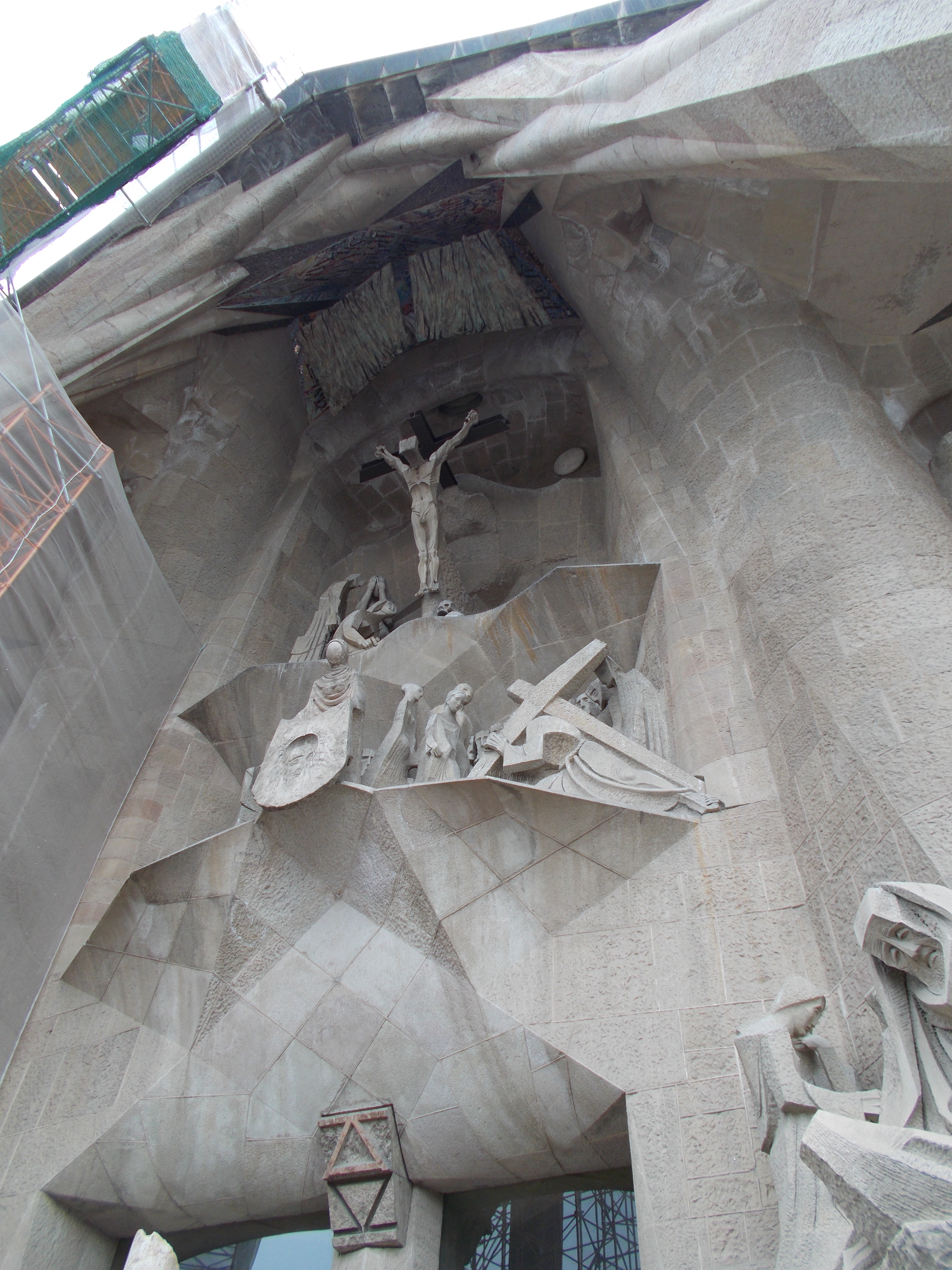
Exterior facade

Colorful interior columns and ceiling

Jesus seems to be parachuting towards the podium


On Past Judgements

Don’t it always seem to go, that you don’t know what you’ve got ‘till it’s gone
—Joni Mitchell

In the 1976 Presidential election, I voted for John Anderson. I was then, and still am, a liberal. So, Gerald Ford was not a consideration, especially after he pardoned Nixon, which was unforgivable. But I didn’t trust Jimmy Carter, who claimed to be honest. I didn’t know much about the Sothern Baptist Convention but what I did know was that they opposed almost everything I supported. Carter was a Southern Baptist, so Carter was out. Four years later and I had changed my mind. I enthusiastically supporter Carter against Ronald Reagan, and over the years I have grown to appreciate Jimmy Carter more and more.

Carter turned out to be much more honest and thoughtful than the average politician. And he was open to change. He recently left the Southern Baptist Convention after 60 years because of their belief that women should be subservient to men.

Here are some examples of some prescient thoughts from then-President Jimmy Carter’s speeches:

  1. Too many of us now tend to worship self-indulgence and consumption. Human identity is no longer defined by what one does, but by what one owns. But we’ve discovered that owning things and consuming things does not satisfy our longing for meaning.
  2. You see every extreme position defended to the last vote, almost to the last breath by one unyielding group after another. You often see a balanced and fair approach that demands sacrifice, a little sacrifice from everyone, abandoned like an orphan without support and without friends…
  3. Carter warned the nation against following the “path that leads to fragmentation and self-interest,” for “down that road lies a mistaken idea of freedom, the right to grasp for ourselves some advantage over others”
  4. We have lost our way…because we have exalted “a mistaken idea of freedom”; our self-indulgence has led us to assert every right as absolute, every form of compromise or regulation as inimical to freedom, and…to elevate the very avatar of self-absorption to the highest office in the land.

—Pete Barkett
Northwest Humanist Monthly
October 2017


Editor’s Note: I too voted for Anderson in 1976 and switched to Carter in 1980. I think Carter will go down in history as one of the most moral politicians to ever serve; anywhere, anytime.


Traveling Local Humanist Leader

Chapter Treasurer Leona Blackbird traveled to Dayton, Tennessee this summer. She posed in front of a new statue of Clarence Darrow that was erected 7/17/17 at the Rhea County Courthouse where the (in)famous Scopes Monkey Trial took place.


President’s Message

I was thinking how it was odd that for the last several months, when I finally force myself to write my President’s message, there is a disaster of some sorts happening. First with Hurricanes, fires, the Las Vegas shooting, and now on Halloween a terrorist attach with a truck running down people in a bike and pedestrian lane in New York City. But I had to use skepticism to remind myself that what I’m doing in my life here in SLC has very little to do with what happening on the streets of New York. It has, however, been distracting and makes it hard to focus and changes my mood. But I really don’t want to talk about disasters.

What I was thinking about, before the Halloween incident was to say a few words about pejoratives and censorship.

Our previous President and co-founder Flo Winewriter advised us to always try to communicate with those we may disagree with a civil tongue. It’s good advice, if for no other reason than the fact that yelling and name calling rarely accomplish anything. But what do you do when your opponent uses your desire to be nice in conversation against you. Making it look like they won the argument because they are more aggressive and a louder mouth. I’ve heard it said that conservatives are fist pumpers and liberals are hand wringers.

This has become particularly common in our political discourse with President Trump constantly using pejoratives of the derogatory and belittling type. He seems to be unable to engage anyone who disagrees with him without turning it adversarial.

As a rather black humored joke I asked if the list of pejoratives that fit Trump was a big as the list of his lies. But I saw the folly in that as I realized that, while the list of pejoratives that fit Donald Trump is a long one, his lies create a tome that I suspect goes back to when he first uttered a sentence as a toddler.

On the somewhat related subject of censorship, I kind of chuckle and groan when I see the media censor a word like bullshit. With all the horror and coarse language, we see and hear in movies and on TV, it seems rather hypocritical to think we are protecting the public from something shocking by writing bullshit, bulls—t. Its more than hypocritical, it’s quite silly.

One more thing before I sign off. The idea that we should be in some way forced to honor or salute the flag, the pledge of allegiance to the flag or stand for the national anthem is absurd. I didn’t serve four years in the U.S. Air Force for a flag or a song or a pledge. I served for our country and its freedoms which include sitting or kneeling or any other form of protest including burning the flag.

For two of the four years I served I was a Security Police law enforcement Sargent who raised and lowered the base flag with pride. But I also understand that the flag means different things to our diverse population. I believe it was Malcolm X who said “We didn’t land on Plymouth Rock, Plymouth Rock landed on us.” And I remember seeing a Native American on TV say that the only salute he had for the U.S. flag was a middle finger. Pointing out that the U.S. government robbed them of their lands and attempted genocide, somewhat successfully, on Native Americans who were here first.

That’s all for now freethinkers. Let’s hope there’s no disasters for a while.

—Robert Lane
President, HoU


October 2017

Gerrymandering

Gina Eborn, President and one of the founding members of The Fair Redistricting Caucus of Utah (FRCU) was the featured speaker at our September general meeting The FRCU is a non-partisan organization that started in November 2016 with the goal of educating the public on the practice of gerrymandering and how it negatively affects all constituents regardless of political affiliation.

 According to Webster’s Dictionary Gerrymandering is:

  • Manipulate the boundaries of (an electoral constituency) so as to favor one party or class.
  • Achieve a result by manipulating the boundaries of an electoral constituency:

Another definition of gerrymandering is that it “allows politicians to choose their voters rather than the voters choosing their politicians.”

Historically gerrymandering has been around for centuries, but came to prominence under its current coined phrase in 1812, as governor of Massachusetts, Elbridge Gerry signed a bill authorizing the revision of voting districts in his state. Members of Gerry’s party redrew them in order to secure their representation in the state senate. They carved an unlikely-looking district with the shape of a salamander. According to one version of the coining of gerrymander, the shape of the district attracted the eye of the painter Gilbert Stuart, who noticed it on a map in a newspaper editor’s office. Stuart decorated the outline of the district with a head, wings, and claws and then said to the editor, “That will do for a salamander!” “Gerrymander!” came the reply. The image created by Stuart first appeared in the March 26, 1812, edition of the Boston Gazette, where it was accompanied by the following title: The Gerrymander. A New Species of Monster.

The new word gerrymander caught on instantly—within the same year gerrymander is also recorded as a verb. (Gerry’s name, incidentally, was pronounced with a hard (g) sound, although the word which has immortalized him is now commonly pronounced with a soft (j) sound.) Gerry ran for reelection in 1812, but was defeated, although his party went on to win the majority.

With every Census, all 50 state legislatures are required to redraw the borders of their congressional districts to accord with the Supreme Court’s “one person, one vote” rule and to make the districts as equally populous as possible. While the exercise is premised on equality, it presents an irresistible opportunity for political parties to tilt the playing field to their advantage. The party that controls the state legislature inevitably redraws the districts, with patchworks and shapes so bizarre that their creators nearly join the pantheon of postmodern art. The retooling of these boundaries boils down to one purpose: to maximize the number of seats their party can capture in the upcoming election. Bewildered by the complexity of other options, the Supreme Court has mostly upheld this arrangement.

The common misconception is to assume that gerrymandering allows parties to engineer safe districts for their incumbents, ensuring easy reelection. But the exact opposite is true. Redistricting’s real purpose is engineering safe districts for your opponent—to pack as many of them into as few districts as possible. It’s like Patton’s infamous maxim on war: you make the other poor bastard die for his country. If anything, redistricting by conservatives would make Republican House districts slightly less conservative in order to include Republican voters in districts where their votes are needed to win seats. The most common methods used to minimize the impact of a voting block are packing and cracking and there are two types of gerrymandering, racial and political. Racial is a protected class, however political is currently not.Packing concentrates members of a group in a  single district, thereby allowing the other party to win the remainder of the districts.

Cracking splits a bloc among multiple districts, so as to dilute their impact and to prevent them from constituting a majority. These methods are frequently used in conjunction with each other.

Racial

The term racial gerrymandering initially designated the post-Reconstruction practice which, like poll taxes and literacy tests, was designed to disenfranchise African-Americans. Legislative district boundaries were drawn with the aim of diluting the electoral power of newly registered voters from ethnic minority groups.

Following the passage of the Voting Rights Act of 1965, this practice was prohibited; indeed, in many circumstances, the statute in fact requires the creation of majority-minority districts. The practice of drawing districts that would afford racial and ethnic minorities the opportunity for elected representation has come be known as affirmative gerrymandering or—in a somewhat ironic reversal—racial gerrymandering.

Political

Partisan gerrymander is typically conducted by the majority party to strengthen or maintain their electoral advantage. In a 5-4 decision in Vieth v. Jubelirer the Supreme Court rejected a challenge to politically gerrymandered districts due to a lack of justiciable standards, meaning that political gerrymandering can be conducted legally. Partisan gerrymandering is a serious problem in our democracy. In jurisdictions nationwide, legislators have drawn legislative maps so that they can choose their voters, instead of voters being able to choose their representatives. This is usually done in a secret office – away from the Capitol, the public, and the press – and then passage of their plan is rushed through the Assembly.

REDMAP

The idea behind REDMAP was to hit the Democrats at their weakest point. In several state legislatures, Democratic majorities were thin. If the Republicans commissioned polls, brought in high-powered consultants, and flooded out-of-the-way districts with ads, it might be possible to flip enough seats to take charge of them. Then, when it came time to draw the new lines, the G.O.P. would be in control.

The Increasing Need For A Legal Standard

It is clear the current redistricting process is undermining our democracy and partisan gerrymandering has become the political weapon of choice for legislators to maintain political power. The U.S. Supreme Court held that it has the authority and responsibility to decide partisan gerrymandering claims, and in 2006, a majority of justices agreed that excessive partisan gerrymandering violates the Constitution.

However, the Court has yet to adopt a standard for determining whether a redistricting plan constitutes a partisan gerrymander. Every proposed test to date has been deemed unworkable by the courts – too ambiguous and subjective to reliably identify the most objectionable plans. Without a legal standard, voters are free to challenge politically motivated maps in court, but judges, without clear guidance, ordinarily dismiss these cases out of hand. The result is voters are unable to hold their representatives accountable and reign in extreme partisan gerrymanders.

A Legal Challenge To Stop Partisan Gerrymanders Nationwide

CLC is part of a litigation team representing 12 Wisconsin voters who have challenged the state’s Assembly district lines as an unconstitutional partisan gerrymander in Gill v. Whitford. Our case is the first purely partisan gerrymandering case to go to trial in 30 years. Through this litigation, the plaintiffs seek to establish for the first time a manageable standard by which courts nationwide can analyze partisan gerrymandering claims.

Efficiency Gap

Wasted votes are ballots that don’t contribute to victory for candidates, and they come in two forms: lost votes cast for candidates who are defeated, and surplus votes for winning candidates, but in excess of what they needed to prevail. When a party gerrymanders a state, it tries to maximize the wasted votes for the opposing party while minimizing its own, thus producing a large efficiency gap. In a state with perfect partisan symmetry, both parties would have the same number of wasted votes.

Suppose, for example, that a state has five districts with 100 voters each, and two parties, Party A and Party B. Suppose also that Party A wins four of the seats 53 to 47, and Party B wins one of them 85 to 15. Then in each of the four seats that Party A wins, it has 2 surplus votes (53 minus the 51 needed to win), and Party B has 47 lost votes. And in the lone district that Party A loses, it has 15 lost votes, and Party B has 34 surplus votes (85 minus the 51 needed to win). In sum, Party A wastes 23 votes and Party B wastes 222 votes. Subtracting one figure from the other and dividing by the 500 votes cast produces an efficiency gap of 40 percent in Party A’s favor.

On to the Supreme Court

On November 21, 2016, a three-judge panel in the U.S. District Court for the Western District of Wisconsin struck down Wisconsin’s state assembly district map. With this decision, plaintiffs have successfully alleged and proven that a state legislative redistricting plan is an unconstitutional partisan gerrymander for the first time in 30 years.

The ruling issued by the court stated the following: “We find that Act 43 was intended to burden the representational rights of Democratic voters throughout the decennial period by impeding their ability to translate their votes into legislative seats. Moreover, as demonstrated by the results of the 2012 and 2014 elections, among other evidence, we conclude that Act 43 has had its intended effect.”

The plaintiffs’ three-part test, which was adopted in this case, can now be used across the country to fight back against unfair partisan gerrymandering.

The state of Wisconsin filed their notice of appeal on Feb. 24, 2017 and their opposition to CLC’s motion to affirm on May 18, 2017.On June 19, 2017, the Supreme Court decided to hear oral arguments in Gill v. Whitford. The case is set for oral arguments before the Supreme Court on Oct. 3, 2017.

Utah Ballot Initiative

Better Boundaries intends to address the problem of gerrymandering in Utah through a redistricting ballot initiative for the 2018 election.

The initiative will modify the current system of redistricting by establishing an independent redistricting commission and prescribing redistricting standards and requirements. This improved system will reinforce our democracy by making our elected officials more accountable, increasing the competitiveness of our elections, reducing polarization, and strengthening voter participation and civic engagement.

However…In 2000, Arizona voters opted to turn redistricting over to a board made up of two Democrats, two Republicans, and one independent. The commission’s maiden effort, in 2001, was generally regarded as an improvement over previous plans. But by 2011 both Democrats and Republicans had figured out how to game the system, and Arizona’s experiment in bipartisanship devolved into ever more devious forms of ratfucking. One of the commissioners was accused of lying about contacts with Democratic Party officials. A group that claimed to be working for “fair” districts turned out to be funded by a Koch-brothers-linked conservative network. The Republican governor tried to oust the commission’s chairwoman, charging her with “gross misconduct.” The only basis for the charge seemed to be that the governor did not care for the way the new districts had been drawn.

Racial Gerrymandering–Utah

San Juan County has been ordered to redraw political boundaries, following a lawsuit by the Navajo Nation. San Juan County is Utah’s largest county and Native Americans make up about 50% of the population compared to 47% whites. The judge in this case is appointing an independent monitor in this case. San Juan County has been opposed to this option in the past, but says they welcome it.

There is also a second lawsuit over Navajo voting issues that the ACLU is taking on over “mail in” elections as Navajo is an unwritten language. Also there are limited polling places and limited people available to provide translation services.

 —Gina Eborn

As this newsletter is going to print the Wisconsin case of Gill v. Whitford


President’s Message

I’ve always been a procrastinator, so I nearly always submit my message for the newsletter late. But this month Wayne needs it to be done early, (or at least not late). So, being a night person, I decided to start this message late Sunday night/early Monday morning, after finishing some domestic chores. I sat down with a snack and my Laptop. But first I turned on the TV to catch the news and the horror of the Las Vegas shooting was unfolding right in front of me on my 60-inch screen. At that point I knew I couldn’t word process anything. All I could do was watch. So now it’s the day after and I need to write my message and all I can think about is this incident which is being called the worst mass shooting in modern history. So, I’ll just have to write about it.

While I watched I took a few notes. First was that this killer was in a group the FBI call, “rare, random, and unpredictable.” He was 64, which is older than usual. He was wealthy. He left no note or manifesto, nor was he part of a group of any kind that they know of so far and he wasn’t religious. And in that sense that he is that rare uncharacteristic terrorist killer seems to have the media baffled. To think that it was just a common man who became insane at some point and quietly proceeded to plan and execute that plan is hard to fathom. He may well be one of the scariest kinds of killers, the ones who are normal all their life until they snap.

I also noted that as soon as I saw footage with sound, it was obvious that he had full auto weapons. At first, I thought “where did he get full auto,” then said to myself “duh, it’s really not that hard actually. “So far, they have found four or five dozen weapons and explosive material. So, it could be he was thinking about doing some bombings also.

Of course, there is already gun control talk immediately and rightly so. There is much that could be done to tighten up access and the prohibition of weapons and accessories that civilians should not own. At least not without strict licensing.

But I often say, in discussing gun control, that those who want to kill will find a way. Restrict guns somehow and the killers will get better at making bombs, or creating toxins, or just ramming a large vehicle into a crowd and of course as we are aware of, planes into buildings. Unfortunately, we have seen these other means to kill used throughout the world. One commentator said something about how sad it was that as startling and horrible these acts are, they are becoming almost routine.

As I write this message there are 59 confirmed dead and over 500 injured, some critically. I don’t really have much else to say. At a time like this, the often-invoked cliché, “we have to move on” is inadequate but somewhat true. And we’ll be left with another infamous date.

—Bob Lane
President, HoU


September 2017

Gerrymandering

The Salt Lake Tribune published the following letter to the editor on June 20, 2011. I wrote the letter in response to how our legislature dealt with their redistricting duty following the 2010 Census. Utah would have a fourth district for the first time! As I recall there were several publicly discussed options on the table. The most popular, at least in my circle of friends, had a “donut hole” of Salt Lake County for one district with the rest of the state pretty much divided into thirds. Just when it looked like reason might prevail, the legislature stepped in and created our districts the way they are today; protecting and amplifying Republican majorities across the board:

Re “Incumbent favoritism alters map”

Give our legislative leaders credit—they warned us. One of the first “message” bills of the 2011 Utah Legislature let everyone know that our form of government is not a democracy. The current redistricting process is prima facie evidence of that fact.

Utah Senate President Michael Waddoups says his first attempt at redistricting did a good job of keeping communities together, but it did not protect the entrenched Republican leadership, forcing a third of all incumbent senators to run against another one. So, he drew another set of boundaries to please the politicians instead of the people.

Apparently, defending the franchise of communities smacks too much of democracy. Yes, they told us Utah isn’t a democracy, and they are following through by disenfranchising both urban and rural populations.

—Wayne Wilson


President’s Message

This month my part of my message is personal; my life has changed significantly recently with my mother’s recent death. Many of you are aware that I have been a fulltime caregiver for my mother, but the caregiving goes back further in that Amy and I have been doing it for several years, first with her father and then, with some overlap, my mother. So, for the first time in a while there is no caregiving for someone in need. I’ve been telling people, that while there is plenty to do, it kind of feels like I’ve been leaning into an 80-mph wind and then suddenly, the wind is gone and you feel like your falling into a void of sorts. I could leave when I want and didn’t have to sleep with waking every time I heard something at night.

My Mom lived a long life, she was 96, with the resources to do what she loved to do and that is to travel. AT 85 she went to China and then to Mexico for the umpteenth time just a few months later. And she still traveled to U of U football game out of state until just a couple years age. The last month or so was very difficult, but she is through suffering.

When I moved back home with my mother to give full time care I had access to cable television for the first time in decades. Seeing too much of this disgraceful joke of a president is sickening and discouraging to say the least. So, you just have to stop watching at some point.

On the other hand, I’ve been watching The Weather Channel almost constantly since the beginning of Hurricane Harvey in Texas. That event became the biggest flood disaster in history. Now we have Category. 5 Hurricane Irma. And remember, a category 5 hurricane is not just 5 times bigger than a category 1 hurricane but rather 500 times stronger. Now as I write this message Hurricane Irma has been a category 5 for days and is breaking records as it goes. It is very potent and likely to impact Florida in a big way statewide. If that’s not bad enough, there is another hurricane named Jose that is a category 3 heading across the Atlantic. This will be a Hurricane season for the books, in a bad way.

Watching these storms also got me thinking about climate change. I have often cautioned people when they point to specific weather events as proof of climate change or global warming. But it is hard, as a geographer not to notice that this global warming makes for warmer waters, and warmer water is where almost all the energy for these Hurricanes comes from. It is not just a warmer climate with rising sea levels that global warming brings but also changing weather patterns.

Watching all this destruction found me admitting to myself that I’m not all that ready to evacuate if necessary for an earthquake or whatever. Preparedness is something we need to pay attention to. Perhaps we can discuss it as part of a meeting or at our book club.

Now that I will have more free time, I look forward to getting more involved in our chapter. I hope to see you at our next meeting. I might even find time to bake a cookie or two by then.

—Bob Lane
President, HoU


July 2017

Live Long and Prosper

Elaine Stehel joined Humanists of Utah in 2009. She came to us from SHIFT, the University of Utah freethought group. She has been one of the most active people in our group; and that is an understatement!

Late last year her wife accepted a professional position in Vermont. July first Elaine packed up her car and drove across the country to be with her family. Significantly, she hosted an HoU event on June 30, the evening before she left.

At first as a student, Elaine recruited other young people to our chapter and attended meetings and events as time permitted. After graduating she became a regular and soon joined our Board of Directors. She has headed up our discussion groups, hikes, support of the Homeless Youth Resource Center, populated our booths at Pride and neighborhood fairs, wrote advice columns for our newsletter, earned credentials to be a Humanist Celebrant, and the list goes on.

Elaine has been active in a lot of other local and national organizations too. If you were watching local TV news stations around Christmas time a few years ago when gay marriage was legalized by the courts you probably saw her. She was one of the first couples to legally tie the knot here in Utah.

She reports that we may have been wrong all along; there is a Heaven and its name is “Vermont.” They to not clutter their highways with billboards, there are beautiful forests, and she says that she is very happy. Lucky Vermont, I’m sure it will become a better place with Elaine’s help.

In short, we miss her already but wish her long life, success, and happiness. We were fortunate to have her as long as we did.

—Wayne Wilson
on behalf of the
HoU Board of Directors


Plot Against America
~Book Review~

The Plot Against America by Philip Roth is an alarming story. In real life Charles Lindberg ran against FDR for President of the United States. Lindberg’s campaign was based on “America First,” which meant keep the USA out of World War II.

In the novel Lindberg wins the election by a landslide. He has a close personal relationship with Hitler that grows into a treaty that that the Axis Powers will not attack the USA and in return we will not supply Europe with any aid, domestic or especially military; isolationism.

The story is told from the point of view of Jewish families living in New Jersey. There are programs try to split up the families ranging encouraging young Jews to visit other areas of the country to a Homestead program where families are spread out and kept away from other Jewish communities. The Ku Klux Klan is there to prevent mixing.

It is a chilling tale, especially in light of the current administration’s nationalistic policies and goals. An interesting reading to say the least. And the appendices note how close to reality this really was.

—Wayne Wilson


Air Pollution = Alzheimer’s?

I think I may safely say that many of us in the humanist community have been dismayed at the federal government’s radical shift away from environmentally conscious and data driven policy since January. The administration has paradoxically said that the EPA’s essential mission is to “keep our air and water clean and safe”, and then appointed climate-change denier and petroleum industry firebrand Scott Pruitt as head of the agency.

This obvious double-talk compels us to ask what “clean and safe air” means. Do those of us who really care actually know? With that question in mind, for the June 8th meeting our chapter’s book club discussed an article from the January 27th, 2017 issue of Science magazine, “The Polluted Brain” by Emily Underwood. The article summarizes some 11 studies correlating very fine particulate air pollution, PM2.5, with Alzheimer’s Disease and other forms of dementia.

Alzheimer’s disease and dementia have become major public health issues, costing the United States an estimated $259 billion in 2017 and expected to increase to $570 billion by 2050. If pollution accounts for, say, 20% of these cases, it is already costing us at least $50 billion a year.

(See http://act.alz.org/site/DocServer/2012_Costs_Fact_Sheet_version_2.pdf?docID=7161)

The article lists eleven different studies that link air pollution in general with increased chances of developing dementia, and describes some recent experiments that correlate PM 2.5 levels with brain inflammation and accumulation of amyloid b in mouse brains. It also mentions data that show an almost 1.8 times incidence of dementia in cigarette smokers over non-smokers. It lists other studies that show a sizable increase in dementia and cognitive problems in people who live close to major highways over those over live a few hundred meters away. There is, in short, a clear correlation between dementia and air pollution, much like the clear correlation between cigarette smoking and lung cancer that was published in 1959. The exact mechanism of how smoking caused cancer wasn’t known then, but the relationship was undeniable.

The article also gives an enlightening view of the modern scientific method with its multi-disciplinary approach to data collection and analysis, the mining of large existing data sets to answer questions that weren’t asked when the data were originally gathered, and how simple observations by a curious scientist can blossom into an unexpected and surprising conclusion. This area of inquiry was started by a neuroscientist observing the demented behavior of aging dogs living in badly polluted areas of Mexico City. Her initial studies led to recent research in Los Angeles collecting PM2.5 particles from air near freeways in Los Angeles and giving the collected particles to mice, then examining the brains of the mice microscopically. The mice breathing the pollutants show brain inflammation and amyloid b, a protein associated with Alzheimer’s Disease, accumulation over mice breathing unpolluted air.

After I read a condensed version of the article aloud to our group of 16, the floor was opened for discussion. Art King, a member who worked in measuring air pollution during his professional career, described the techniques used to collect and separate the different particle sizes, and pointed out that we haven’t even been able to measure PM2.5 until relatively recently. It is expensive and difficult, using Teflon filters that only came into existence in the 1990s (check this).

Other members spoke with dismay about their own experiences with pollution in their neighborhoods and how the political leadership in Utah seems beholden to the executives of polluting businesses, and dismissive of even examining thee threats to public health that dirty air and water bring. Bob Lane’s very colorful and humorous description of simple things like leaf blowers with their smoky 2-cycle engines blowing noxious clouds of dirt and dust into the air just to save a little labor in sweeping lawn clippings from sidewalks made us all laugh.

I think we all understood at the end that we as a society don’t know what “clean and safe” means. We don’t invest in understanding it, and we haven’t even had the means to measure and understand it until recently. The national political will to do study it was uncertain at best before the advent of Donald Trump, and is virtually non-existent since he took office. In Utah the fossil fuel industry only comprises a small percentage of the state’s economy, but possesses enormous political influence.

I hope we all left the meeting with a little more appreciation of the costs of pollution and the fact that we really don’t know what keeping our “air and water clean and safe” means. The closing sentence of the article states that with air pollution, perhaps “there is no safe threshold”.

—Steve Hanka


President’s Message

Greetings freethinkers, I hope that your summer is going well. The temperature here in Holiday, Utah was 101 yesterday.

But, first off, I must give a heartfelt thanks to board member Elaine Stehel who has by the time you read this message moved back East. For Me personally she made sure that our Tenth Annual Darwin Day and our participation in the “Pride Festival” were big success, at a time when I could not be much help. And I personally thank her for that. Elaine has put a lot of her time and energy (I don’t know where she gets it) into Humanists of Utah and I know the rest of the board members join in thanking Elaine for all she has done for the chapter. Good luck Elaine in your new life and we hope we can stay in touch.

Getting back to how hot it is, I was going to say that having moved back in with my mother to care for her does have some perks in that it is large enough and cool enough and has a swimming pool out back. So, I can’t complain about the heat. I mention this about my mother’s home to put into perspective how different one’s situation can be regarding healthcare. While my mother is fortunate to have Medicare, a supplemental insurance policy and personal assets that assure she get all the best care, there are many in our society who have little or none of that. As I have been watching more of what is going on with the Affordable Care Act I worry about all those individuals out there who must rely on Medicaid. I sure hope that our society can someday soon find a way to cover everyone. I personally think everyone should have something resembling Medicare from birth throughout their life.

I won’t be able to attend our movie night, but I think you will be seeing a weird little movie called Rubin and Ed, It is really funny. I am looking forward to seeing you all at our August BBQ.

—Robert Lane
President, HoU


June 2017

Science is a Verb

Justin Morath, assistant professor of psychology at Salt Lake Community College and the Associate Director at the SLCC Creative Writing Center, was Humanists of Utah guest speaker at our May general meeting. His training was in animal behavior and human/animal cognition. He was also a co-organizer of the SLC March for Science. He is a social activist in other circles; LGBT+ rights, homeless youth advocacy, animal welfare etc.

As a teacher of the scientific method he became more and more interested in scientific literacy. Especially in the community. And the current Director of the CWC ultimately offered him the AD position. Because they were interested in expanding out of English. And it fit in perfectly with his goals.

He said that if a school board tried to require me to present my art as equally valid as the well refined works of Klimt in a classroom, we would all rightfully cry foul. But the point is, that budding process of the aspiring artist is important to nurture, as is the aspiring scientist.

The originating force behind the CWC is the work of Paulo Freire. Whose main contribution was the book Pedagogy of the Oppressed. Freire was an educator in rural Brazil in the 1960s. Looking through the lens of a Post-Marxist liberation theology, he saw that the education system mirrored the other oppressive systems in place to maintain class hierarchy. And that education was part of the problem, what he termed the “Banking Education” model. Where the teacher holds (or owns) the objective information and the pupil passively accepts this from the teacher as she dumps it into their head. Teacher owns the truth and “gives” it to the pupil to graciously accept. “This is art.” “This is fact” Or to quote the rapper Nelly “I know something you don’t know. And I’ve got something to tell ya…”

He argued that the act of learning does not need to be this way and that education can be a liberating force and does need to come from these gatekeepers of knowledge. Therefore, the CWC’s motto is “Everyone Can Write.”

What does this have to do with science? Because they fall from the same process. A process of discovery and of asking the questions and finding answers.

Science is not a noun; a person place or thing. But a verb. Here’s the thing: once we make it a thing, a noun then it becomes something we can possess. We can own nouns, not verbs. Even in the abstract. A process or an action is a participatory event that all can do- it’s radical and revolutionary. But a noun, can be held by a gatekeeper.

Which is why we have such ridiculous arguments going on in the scientific community about whether Bill Nye is a “scientist” or not. Bill Nye MadLibs. Insert noun here. Arguing whether Bill Nye is a scientist based on his degrees and career is arguing about nouns for the purpose of being a gatekeeper to knowledge. I’m not saying definitions don’t matter, but in this case, it’s a clear example if it being used for the purpose of withholding knowledge in order to “bank” it to the privileged few. “I hold the knowledge that I may grant to you about what is deserving of the scientist nomenclature.”

Whether you are a kid playing in the backyard admiring your sample in a jar, a disheveled post doc, a R01 holding pharmacology P.I. you are doing science. Again, to varying degrees. But that’s fine. We likely all agree.

Here is where the piranhas might come out to get us. Even someone with a blatantly false understanding about something, like an anti-vaxxer is engaging in the same process. They are asking questions and making connections about their world.

We are an inquisitive species. We want to learn and figure out our world just for the sake of it. He went to a Sherlock Holmes immersive exhibit at the Denver Museum of Nature and Science over the holiday break with my family. As a scientist, most interested in our social world, instead of participating in the activity where each person would mill between stations and try to figure out Whodunnit, I sat back and watched the participants. Everyday people were paying very good money to learn and figure out something. They know it is fiction, but they wanted to figure it out and know the ultimate answer.

Of course, the ultimate answers that are found may be completely wrong. So, what do we do in a situation like this…where villains are apparently injecting our vegies with food coloring? Seriously this is like a whole trope—vegies getting injected with scary needles. A google image search for GMOs and half of what pops up is this. There’s clearly an anti-vaxxers undercurrent going on here. But by pitting “science” (as a noun) from the “anti-GMO” or whatever, we are imposing this well entrenched banking model of education onto the debate. We are now claiming to be gatekeepers that simply need to bestow upon the ill-informed the necessary information to fix the problem. This deficiency re: banking model has been shown for the last 40 plus years in psychological research to not work that well. So not only are there implicit issues of class and power in this model (as per Freire) but it’s also not very effective. And in many cases, will actually backfire on you.

This isn’t a controversial statement, but here is a claim that is: Someone who believes in a crackpot conspiracy or bad pseudoscientific claim is also doing just this. They share the same desire to know as the most rigorous scientist. And that’s ok, so long as it is the starting point—not the end point to the question they ask. Because face it; thoughts are cheap and most things we first believe are wrong regardless of your title, status, or expertise.

Most of the time scientists are wrong too. We fail to reject the null hypothesis for a myriad of reasons, and it’s all set up this way on purpose. The difference between science and junk it that the process is set up to tease out the bad and refine the brush strokes to get closer to an objective truth, like a well-trained artist. And ultimately let go of the bad answers.

Because we all do use critical thinking, when it is to our advantage in protecting our preconceived beliefs. We can all do it. It’s not something that can be “banked” onto us. Yes, like art it takes practice and guidance to get better at it. But ….

There are a myriad of ways that we as humans protect ourselves from the fact we have bad answers. Such as to quote Upton Sinclair here or Jim Carrey in Dumb and Dumber when…Science ideally is a systematic set of check and balances to tease these out. But it is still an ultimately human endeavor.

  • Understanding how we prevent change matters:
  • Content is second to process.
  • If you want the facts to matter, don’t worry about them so much.
  • Accept that we are all wrong most of the time.
  • No one should be a gatekeeper.

Banking, or the deficiency model, is problematic and doesn’t really work anyway.

Know that we all have the same reasoning/critical thinking capabilities and we all use them.

—Justice Morath
Salt Lake Community College


What Science Tells Us About Religion

Sharon Nichols wrote a conclusion from her article titled, “What Science Tells Us About Religion.”

I live in the South. Here, the first question people ask you upon meeting you is, “What church do you go to?” I have decided that my blow-away answer is, “Oh, we don’t go to church much,” which lets the asker of the hook without committing me to something I don’t believe in (weddings and funerals are still in churches, after all!” I try not to close the door on the discussion unless someone is being rude. Don’t be afraid to engage the religious in discussion. Don’t debate though, because that only tends to harden already held beliefs on both sides. Prepare a few points ahead of time that you can state in nonjudgmental terms, such as: “I am a naturalist” (and/or humanist, atheist, agnostic, etc.) reflecting your true stance. “I follow science rather than believe in religion” or “I find much greater mystery in science than in religion. “Be true to yourself—without going so far as to place yourself in danger.

How do thinking people who rely on reason counter anti-intellectualism and anti-science, and anti-modernity trends? It is incredibly frustrating to attempt to deal with anti-intellectualism and anti-science; they are so contrary to common sense and reason. A strategy that is less fraught with frustration is that of “planting seeds.” Exploit an opening and use communication skills to plants seeds of reason and doubt. Seeds can crack boulders; surely, they can root out unreason. Have you ever seen a blade of grass growing in concrete? It is the same with doubt. Think of religion as a differential terrain: some of it will “wash away” in the same way that weaker rock layers rode before stronger rock layers will. This can eventually lead to canyons of doubt. Every drop of doubt that is added erodes religion further, until religious belief is no longer tenable.

The more books and articles revealing religions weaknesses, pious lies, and evils, the more likely someone teetering on the edge of doubt will eschew religion, and step into the light of reason. It may happen gradually, much more too slowly for some of us, but it will happen. It is already happening. The spate of religion protection laws in the United States are part of the backlash caused by the religious realizing they are losing ground. Let us hope that we may see the end of religious privilege in American in our lifetimes.

I believe we must be in the real world, and not that of make-believe, wishful thinking and unreason. The alternative is to turn the corner on knowledge itself and I for one do not intend to sit idly by while the human cultural world slides into the abyss of willful ignorance and chaos.

—Craig Wilkinson, MD
Board Member, Humanists of Utah


A Better Life – Film Screening and Discussion

On Friday, June 30, The Humanists of Utah are pleased to invite filmmaker and photographer Chris Johnson, creator of the film, A Better Life: An Exploration of Joy and Meaning in a World Without God, based on the interviews found in his book, A Better Life: 100 Atheists Speak Out on Joy and Meaning in a World Without God. There is no God. Now what? If this is the only life we have, how does that affect how we lives our lives, how we treat each other, and cope with death?

As a follow-up to one of Kickstarter’s most successful publishing projects, photographer and filmmaker Chris Johnson introduces us to some of the many voices from his book. In this fascinating documentary—learn the stories behind the book in interviews with some of our greatest thinkers.

Join Chris as he explores issues of joy and meaning and travels around the globe meeting people from all walks of life and backgrounds who challenge the false stereotypes of atheists as immoral and evil.

From Daniel Dennett and A.C. Grayling, to Julia Sweeney and Robert Llewellyn —learn the various ways many atheists have left religion to a better life filled with love, compassion, hope, and wonder!

Learn about Chris’ project and purchase your copy here:

https://www.theatheistbook.com/

Friday June 30 6:00 PM to 10:00 PM
Salt Lake City Public Library
210 E 400 S, Salt Lake City

— Elaine Stehel


Robert Lane’s President’s Report will resume next month