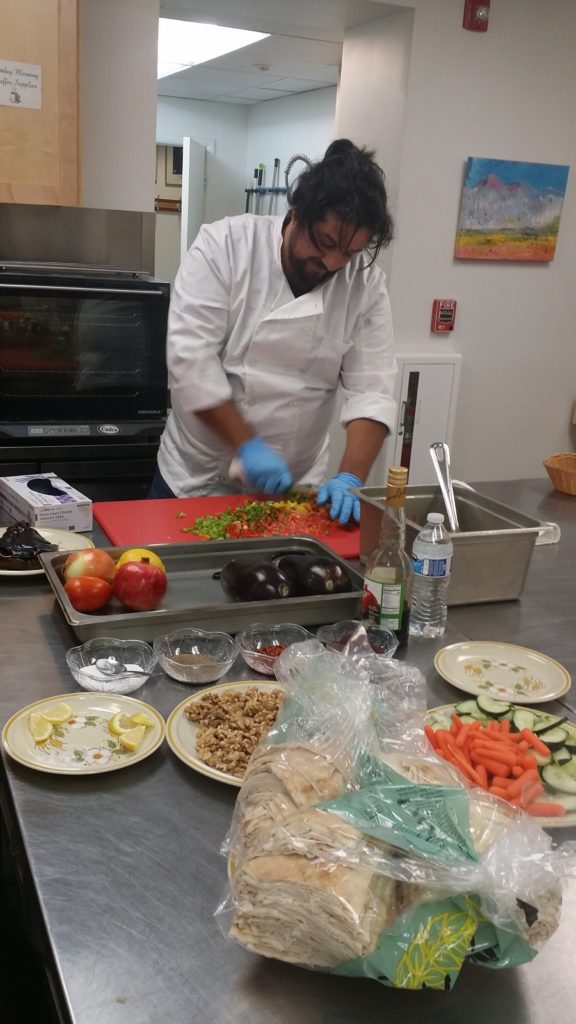
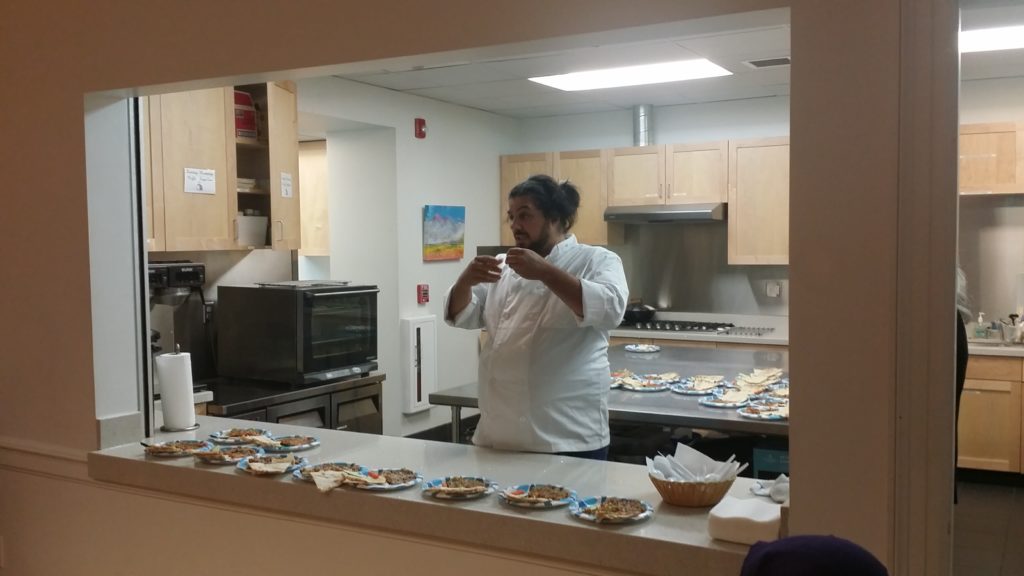
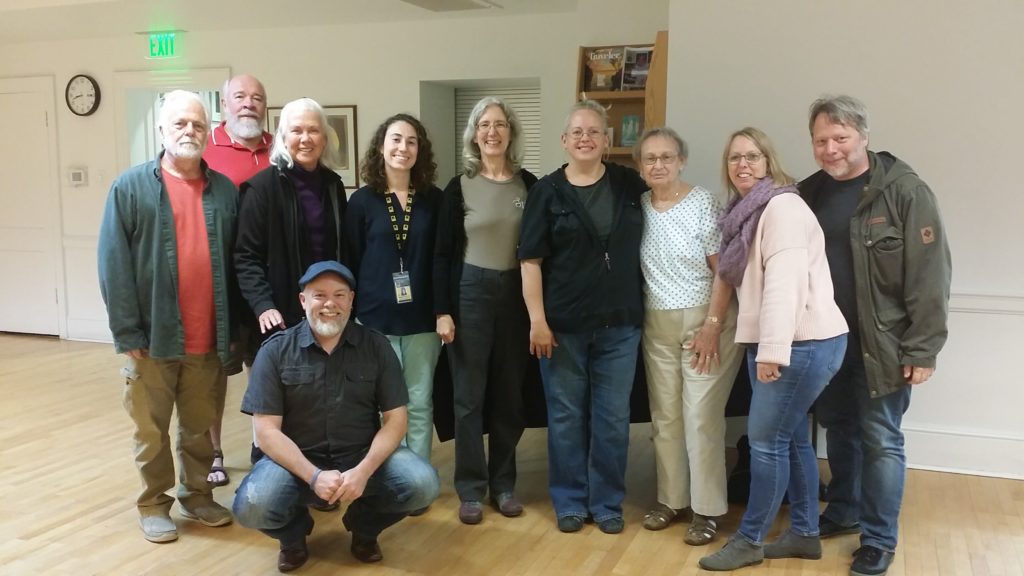
Our May meeting featured Chef Noor and owner of Noor Al Sham restaurant and members of the International Rescue Committee (IRC) in Salt Lake City. The presentation focused on the IRC’s work with refugees in the area and highlighted the Spice Kitchen Incubator program, which helps international refugees with food backgrounds to come to Salt Lake City and to make a living off those skills, whether it be opening a restaurant, a food truck or catering. Successful programs all over the valley are up and running and support these entrepreneurial families in making their transition to America. Chef Noor afterwards treated us to on-site prepared Syrian baba ganouche and HoU provided a flavored fruit water bar. We had a great experience eating and empathizing with the refugee community by learning about the process and struggles they have had in trying to better their lives against tremendous odds and violence. You can order delicious international cuisine from a variety of countries and support the Spice Kitchen Incubator refugees at https://spicekitchenincubator.org
—Melanie Curtis Vice President, HoU
Pride Celebration
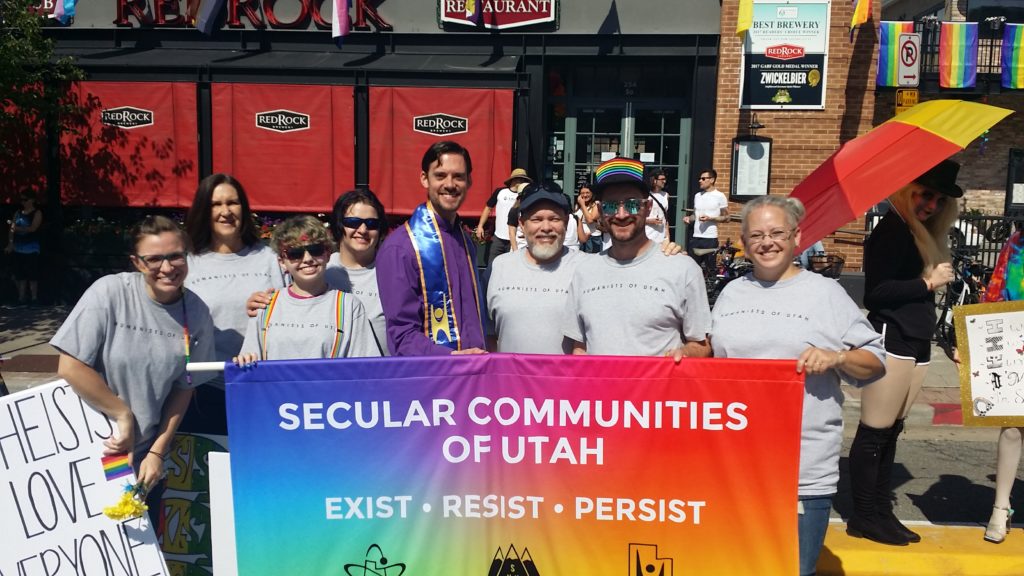
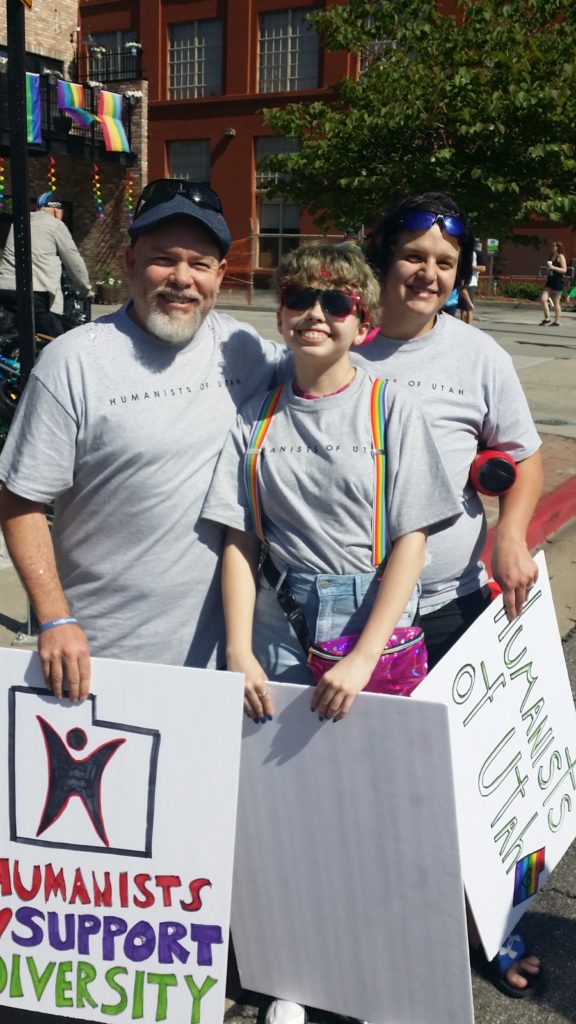
June is LGBTQ+ Pride month and HOU participated in the Utah Pride parade as part of a secular alliance with our friends at Atheists of Utah and Sunday Assembly. There is indeed strength in numbers and the opportunity to band together to let over 100,000 people know that there exists in Utah a place for freethinkers, rationalists and do-gooders without God is invaluable. We had several people show up from our Facebook group and from the local HoU group to march in the parade, where we debuted our new Humanists of Utah t-shirts (purchase yours for only $20 at HoU meetings or at our Facebook group site). This cooperation reinforces the value of allies and community in promoting a philosophy and lifestyle that many people don’t understand yet by the word “humanism” and is a tradition that we plan to continue in the future.
—Melanie Curtis Vice President, HoU
Chapter Direction
Humanists of Utah has had a very busy—yet exciting—last couple of months! This has been part of our 2019 goal for extending our reach in the community as well as offering a large variety of humanist subjects and interactions at our monthly meetups. We have worked to boost public awareness and appearances as well as grow our relationships with allies and other groups in the state and it is paying off. This mix has enabled us to interact with more people than ever before and meet potential HoU members as well as members of our Facebook group online. If you haven’t been to our monthly meetings in a while (or have never been to one), you will be surprised—come on out and socialize and learn with other humanists in northern Utah!
—Melanie Curtis Vice President, HoU
Podcasts
Are you a fan of podcasts? I’m almost 100% podcasts on the daily commute these days. It’s so much more fun to listen to something specifically tailored to your interests (they’re also a great insomnia companion). Here are a few rock-solid favorites to check out.
Ologies by Alie Ward. Alie interviews experts in the ‘ologies’ fields – subjects like Teuthology, Phonology, Selenology, Malacology. It’s thoroughly fascinating and very well done! The main problem I have is wanting to start a hobby of almost everything I hear about—hiving my own bees, brewing beer, sponsoring a dinosaur dig.
This Podcast Will Kill You. Hosted by an ecologist and epidemiologist, they take on diseases and explain them from a historical side and biology side – how diseases ‘work’, how our bodies ‘work’, how cures are found/discovered/imagined. I must admit that the range from “oh, that’s so gross”, to “oh, that’s so cool” makes this a lot of fun to listen to.
Levar Burton Reads. Levar Burton reads short stories—mostly in the SciFi/Fantasy realm. From Ursula Le Guin to Haruki Murakami. It’s like snuggling down with a cozy blanket and warm mug of something. Many of the stories hold powers to stay banging around in your head for months to come.
—Lisa Miller
Solstice
This piece was originally published in the January 1996 edition of this newsletter. I consider it to be one of my better pieces and it is the month of the Summer Solstice.
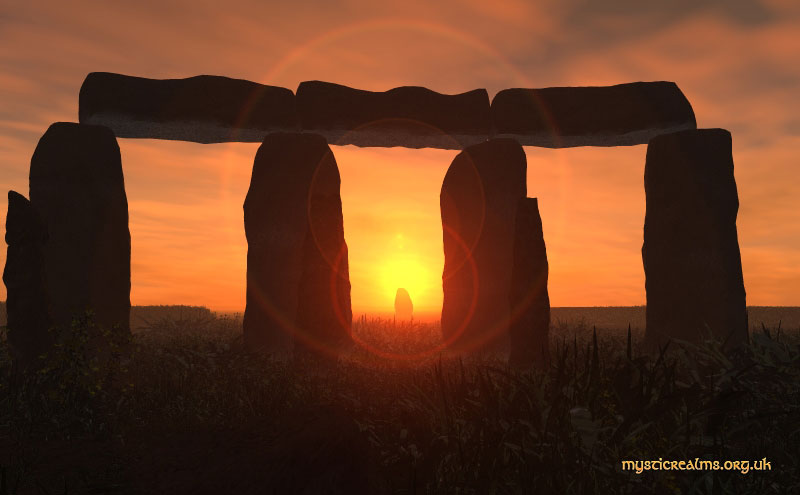
Imagine our ancestors sometime between 30,000 and 200,000 years ago gazing at the sky considering the solstice. Then, as now, there must have been two basic approaches to nature: fear and wonder. Unfortunately, fear is the stronger emotion. Its legacies include myth, superstition, religion, and authoritarian governments and rulers.
Those who stood in wonder were able, through empirical observations, to explain the natural phenomenon of the solstice. The progeny of wonder are the arts, the sciences, and the humanities.
It is unlikely that most people approach the unknown exclusively with either fear or wonder. We all have a different mixture of these two basic emotions. Our challenge is to try to suppress the fears, and then experience and explain the wonders.
On April 11 Bill Barron and Tom Moyer, Citizens’ Climate Lobby Leaders in Utah, spoke with the Humanists of Utah on “Solving the Climate Challenge.” Here is some background information on the challenge of climate change and some key points from their talk.
Skiers and water managers loved our 2018-2019 winter. According to hydrologists quoted in a recent Salt Lake Tribune article, “It’s official: Utah’s snowpack is fantastic this year!” Does this mean we can ignore the longer-term trends of warming temperatures and less snowfall?
The answer is a resounding NO! We easily forget that 2018 was the driest year ever recorded in Utah and wildfires burned a near-record number of acres in the West. Lake Powell sits at 37% of capacity. Globally the last four years were the warmest in human history. Add to this the extensive lag between the time we stop adding greenhouse gasses to the atmosphere and the time that global warming diminishes, and you see the scope of the problem.
Why is there such inertia in our climate system? At the risk of oversimplifying, I’ll highlight two processes. The first concerns the ocean, which absorbs 93% of excess heat trapped from human-derived greenhouse gasses. It takes years or even decades for this heat to equilibrate with the atmosphere. The second is feedback loops, which play out over decades or centuries. For instance, bright white arctic sea ice reflects energy back into space, but as our climate warms and sea ice melts, the dark ocean water absorbs heat and adds to the warming caused by greenhouse gasses.
Unfortunately, there is also a stubborn lag in the political process that will bring about energy transition; this lag is much more obvious. Beyond the time needed to create the political will for a policy, it takes time for a new law to take effect, for it to stimulate innovations, and for our behavior to change. Also, an enormous infrastructure is already in place to support the use of fossil fuel energy.
So what can one do? Action must occur at all levels of society. As President Obama’s Science Advisor John Holdren has said, “There is no silver bullet. We need silver buckshot-we need to do a lot of thins at once.” On an individual basis, perhaps no clearer direction exists than that given in the Provo Clean Air Toolkit, created under the direction of Representative John Curtis when he was mayor. Check out https://provocleanair.org to learn what individuals, business, and cities can do. From walking or riding a bike for short trips to adopting “Meatless Mondays”, many personal actions will be healthier for you and for the air we breathe.
While we must all take personal responsibility, the scale of this problem demands federal and international action. This is where citizen advocacy like Citizens’ Climate Lobby (CCL) comes in. CCL is a non-partisan, non-profit, volunteer-based group that supports individual actions. As they describe, “we exist to create the political will for climate solutions by enabling individual breakthroughs in personal and political power.” CCL accomplishes this through the volunteer work of over 124,000 U.S. supporters in 449 local chapters (543 worldwide), including seven in Utah. (St. George, Utah Valley, Moab, Salt Lake City, Park City-Wasatch Back, Ogden, and Logan). This is a values-driven organization whose members whose members flourish through Focus, Optimism, Relationships, Integrity, Personal Power, and Being Nonpartisan.
For nine of the ten years that CCL has been in existence, they have sought passage of a carbon fee and dividend policy in Congress. We are convinced that for such a policy to endure, it must be bipartisan, so we welcome members throughout the political spectrum. CCL members have exerted their political power by developing relationships with members of Congress and stakeholders in their communities, and educating the public. They call, write to, and meet with members of Congress and their staff, speak to community groups, table at various events, seek endorsements from community leaders, write letters-to-the editor and op-eds, meet with editorial boards, and travel to Washington DC to lobby. 23 Utah members including 14 students will travel to the nation’s capitol to lobby this June. They will meet with all six Utah members of Congress or their aides.
CCL members are fond of saying “we bet the farm on relationships.” CCL assigns a Liaison to each member of Congress. He or she gets to know the Congressmen and women and their staff and find common ground to start discussions. Tom Moyer, former Liaison to Mia Love, tells of a town hall where almost all of the constituents had gone home and the staff was left to put the chairs away. Tom joined them in this task and connected in a personal way that couldn’t have happened in the formal meeting.
These energetic efforts have born fruit. With an issue that is among the most politically divisive of any, we have brought Republicans and Democrats together. In the 115th Congress Republican Carlos Curbelo and Democrat Ted Deutsch formed the Climate Solutions Caucus with the support of CCL. The rule for admission to the caucus was that members had to join with someone from the opposite party. By the end of the Congressional session 45 Democrats and 45 Republicans were meeting together to explore climate policy. Members of this caucus had a significant role is voting down some bad climate policy and introducing good climate legislation.
In the 116th Congress CCL’s bipartisan work bore fruit with introduction of the Energy Innovation and Carbon Dividend Act. This legislation will put a steadily rising fee on fossil fuels such as coal, oil, and gas. It will return the proceeds equally to Americans with a monthly dividend to spend as they see fit. The Republican cosponsor, Francis Rooney affirmed “When you think about a carbon tax, that’s the most free-market, least intrusive way to price carbon.
This policy will be effective, reducing greenhouse gas production by 40% over the first 12 years. It will be good for people, as it improves health by reducing air pollution. It will protect those with lower incomes, as most will receive more in the dividend than they pay from increased costs. It will be good for the economy by creating 2.1 million jobs, thanks to economic growth in local communities across America. It will be revenue neutral, meaning the government will not keep any of the fees collected, so the size of government won’t grow.
Here’s where we all have an opportunity for Responsible Behavior. Our elected officials work for us. Call and/or write to you members of Congress. Ask Senators Lee and Romney, and your Representative, Bishop, Steward, Curtis, or McAdams, to support the Energy Innovation and Carbon Dividend Act now. Only by responding to the challenge of climate change, can we create healthier and more resilient communities.
Greetings freethinkers, it has been several months since I last submitted a President’s Message to the newsletter. As I am no longer President, I have decided to start a column that will focus on science. Wayne Wilson suggested that we call it “The Soap Box,” and ask that other members and readers get involved and make contributions. I think that’s a good idea. I plan to make submissions bimonthly for the most part. So, I hope you will all consider submitting your ideas to help make this new science column informative and interesting.
But first I want to recognize the good work being done by the Board of Directors. Our new President, Jeff Curtis, along with new board members Melanie Curtis, Lisa Miller, and Brian Trick have brought new energy and ideas to the chapter. Their efforts and dedication along with the continuing work of long-standing board members, Leona Blackbird, Dr. Craig Wilkinson, Dr. Lauren Florence, Wayne Wilson and myself, make me confident in the future of our chapter. This confidence was reinforced with the success of our Darwin Day celebration. Dr. Wilkinson’s presentation was excellent, and the board did a great job promoting and running the event. Special thanks to the Atheists of Utah for partnering with us and providing the birthday cake.
Focusing on science makes for a wide variety of subjects. I have some insight on some disciplines such as climate change and issues concerning the state of Utah’s water resources. Other subjects such as medical science, astronomy, and a wide variety of scientific inquiry are all worthy of discussion.
So where do we begin? In the medical science area, I would like to discuss the ethics of growing tobacco. Tobacco is a plant that is basically a poison, grown and manufactured into addictive products which kill approximately 480,000 people per year in the U.S. Also, for me, issues concerning the environment are at the top of the list. And the list for the environment is huge on its own.
I think a good place to start is climate change. We got a good start with last month’s presentation by the Utah Citizen’s Climate Lobby, where they advocated fighting climate change with democracy.
Many of my subjects will be about the environment, from my perspective as a Geomorphologist and as a citizen and inhabitant of this planet. For example, my studies took me to the High Uinta Mountains where I studied the Alpine and Periglacial environments. These are areas where the transition between the two approximates the edge of the cryosphere or the continuous frozen areas of the planet.
I’m excited to do this and I hope some of you will also participate with your own submissions, suggestions, links, etc.
P.S. Speaking of links, you should look at this web site; nsidc.org (national snow and ice data center), they have a huge data center for research but also a lot of things for the average person to check out.
—Bob Lane
Irene Fryer
1928 ~ 2019
Irene Fryer died March 22, 2019 in Salt Lake City, Utah. She was born December 8, 1928 in Tremonton, Utah to Ira and Doris Merrell Fridal, the youngest of their 5 children. She grew up alongside her sister Mary and brothers Ed, Dave, Jim. She attended schools in Tremonton and graduated from Bear River High School in 1947. Irene met and married Don Fryer in 1947. Together they began married life on their farm in Riverside, later moving their young family to Salt Lake City. Irene graduated from Stevens-Henager Business College and began working for the state of Utah in the Purchasing Department. She retired from the Department of Transportation.
Over the years, Irene enjoyed traveling, hiking, skiing, golfing, reading, and sewing. Being a remarkable seamstress, she found great joy in tying quilts for family, friends, and those in need. Irene was a true humanitarian, joining and participating in organizations that focused on human rights for all. She was a member of the First Unitarian Church which provided opportunities to exercise her commitment to making the world a better place. Irene was a founding member of Humanists of Utah and served as Treasurer for several years. In keeping with her commitment to others, Irene donated her body to the University of Utah School of Medicine.
A celebration of Irene’s life will be held on Friday, May 24 at the First Unitarian Church, 569 South 1300 East Salt Lake City Utah from 5 to 8 in the evening.
Florien Wineriter December 31, 1924 ~ March 24, 2019 In Memoriam
Flo was one of my heroes, in fact I often thought of him as second father. He was also the father of institutional humanism in Utah and was our longtime chapter president.
Flo Wineriter
Like many of us he was raised in the LDS Church and came to humanism as a philosophical reaction to religion in general and to Mormonism in particular. His trigger service in World War II, he had real difficulty in killing fellow humans and especially other Mormons.
In 2012 he wrote a summary of his life philosophy, “We celebrate the diversities of the human mind and the variety of acceptable life styles those minds have developed.
“Like the diverse colors of a rainbow that exist separately but blend together in a glorious array of beauty, we celebrate our human individuality, and our independent beliefs that blend together to make our community a glorious array of beauty. humanism believes that our very existence depends upon the web of life and that our place in nature must be in harmony with all of life.
“Humanist ethics, based on love and compassion for humankind and nature, place responsibility on humans for shaping our destiny and the future direction of the world.”
I’ve seen Flo one or two times a year for several years since he moved to St. George and he was ready to die; legally blind, nearly deaf, and no longer able to care for his body himself. He is missed but should be celebrated as a fine human being.
–Wayne Wilson
President’s Message
Happy April, fellow humanists! As we enter spring finish the first quarter of 2019, the Humanists of Utah have been quite busy implementing many ideas and strategies that we deemed priorities for the year. I feel confident in our ability to provide you with a top-notch experience with fellow Humanists as well as an environment of learning, activity and camaraderie.
In looking forward this year, one of the first needs we identified for HoU was increasing our visibility to potential members and the public. Without knowing HoU exists and what it stands for, potential humanists will not be able to find the information, support and social bonding that aligns them with our organization. An improved marketing framework for our organization and its offerings is under way and we are seeing improvements so far. I wanted to share a few highlights:
Facebook—Our Facebook group (https://www.facebook.com/groups/humanistsofutah/) currently sits at 1062 members and has shown growth for each of the last 4 months. Member interaction has increased, and we have used the group to heavily advertise our events and meetings with great success. In a digital era, Facebook presence is ubiquitous, and we will continue to use this as a platform for reaching many current and potential members. If you use Facebook and are not a member of the Humanists of Utah group, please join.
Formal events—Darwin Day in February was a great success. Dr. Craig Wilkinson spoke on evolution and molecular biology at the Eccles Dinosaur Park in Ogden. We had attendance of 82 people and were assisted by the Atheists of Utah, who helped promote the event and brought the cake. A highlight was having 14 students from the anthropology department at Weber State show up to earn extra credit for writing a report on Dr. Wilkinson’s presentation.
In June we will be attending Pride Festival in Salt Lake City to support LGBTQ causes and awareness in Utah. We will have a booth to disseminate HoU materials and information, answer questions, encourage people to join our organization and sell Humanist items. If you are interested in helping us with the booth or planning, please contact us.
Website — The HoU board is currently looking into upgrading our existing website to gain more flexibility, functionality and design options while still preserving existing data. The hope is that by integrating stronger social media links, digital payment options, graphics and security, we can reach more people and promote the humanist lifestyle more effectively.
Meetings — Our monthly meetings have a full schedule this year with very interesting guests on a variety of subjects. Attendance so far is over double our previous autumn average and we hope to make that increase permanent. Increased promotion, engaging subject matter, and guests from members and HoU Facebook group have contributed to this. We are still meeting at Elliott Hall on the second Thursday of each month at 7:30.
Upcoming Meetings
April 11 — Citizen’s Climate Lobby : “Fighting Climate Change with Democracy”
May 9 — International Rescue Committee on the plight of refugees in SLC
June 15 — Jason Torpy, president of Military Association of Atheists and Freethinkers (MAAF): There Are Atheists in Foxholes, and how to make sure that your community knows it.
Hopefully you are feeling as excited as we are this early into the year. We are counting on each and every one of you to attend our events, contribute online and consider bringing friends and family to events with you. We are passionate about enhancing our visibility and we are seeing early success. But we still have a long way to go and any ideas or thoughts on this will be considered, so we would like to see you involved!
—Jeff Curtis
President, HoU
Meditation Improves Humanism
As humanists, we try to live a thoughtful, joyful, and rational life based in human experience. This type of life is a process of discovery. Meditation can function as an exploration tool to discover how best to live as a human being and can be a part of traveling the path to successful Humanism.
Investigating how meditation can benefit us in the Utah chapter of the American Humanists Association, we invited Mary Ellen Seien Sloan Sensei to speak to us this March.
Seien Sensei is a Zen Teacher and certified Big Mind Facilitator. She has studied with Zen Master Genpo Roshi since 2001, was ordained in 2005, and received acknowledgment as a Sensei (Zen Teacher) September 2017. Mary Ellen is a lawyer. She was formerly counsel to the Salt Lake County District Attorney’s Office, as well as having practiced privately.
Speaking with us, Seien Sensei asked if we wanted to meditate and what had stopped us from that practice. The discussion led to many saying that they were distracted by their own thoughts about what they were doing, what they were going to do later, what they did earlier, were they wasting their time, and all the other disrupting thoughts that had arisen unbidden as people had tried to meditate. Her description was of us being controlled by our “thinking minds”.
Seien Sensei then asked us to get comfortably relaxed in our chairs with our hands on our knees or in our laps. We could keep our eyes open or closed. Sensei asked us to think whatever we wanted to think and give the “thinking mind” full control. My mind went empty when I had permission to think whatever I wanted. I was no longer distracted by the myriad of thoughts swirling in my mind.
An empty and quiet mind is a state that allows the meditator to receive the most benefits.
“Clarity” is the one-word response that a different teacher, Lama Surya Das, gives when asked about the benefits of meditation. He then offers a longer list and calls the benefits amazing. He says:
Meditation helps our minds empty themselves of clutter and confusion.
It makes us feel calm, peaceful, and more aware of our inner resources.
It brings a sense of being centered, grounded, and balanced.
It makes our senses and perceptions more vivid.
It helps us see how everything in life fits together.
Meditation helps us become more skilled at navigating life and, consequently, less likely to be buffeted about by the winds of fate.
It helps us gain greater insight into our personal issues and hang-ups.
It helps us become less egotistical and self-centered.
It helps us increase our capacity and ability to love.
It helps us gain greater insight into the nature of reality.
It helps us become more mindful and able to lead our lives with greater awareness and understanding.
Meditation, it seems, can help us become better humanists. Our visit with Seien Sensei cracked open a door through which shone a very bright light.
—Lauren Florence, MD
Death: Celebrate Life
Flo contributed a great deal to this newsletter over the years. This article from December 1994 seems appropriate now.
This past month I spoke at a memorial service for a life-long, close friend. As I looked over the group of people attending the service, I realized how many of them had suffered the grief caused by the death of a loved one in the past few years. Many had experienced the death of a spouse, a parent, or a child and I thought how our coming together to celebrate the life of a friend helps us to understand our own grief, have compassion for the grief of others and generates a sense of community.
Celebrating life as we grieve reminds us how short and how precious are the bonds we develop with just a few other humans during this experience we call life. It reminds us of the very short time we have to share the beauty of a sunrise, the serenity of a sunset, a refreshing breeze, and a cleansing rain.
It reminds us that we, too, are drifting toward the end of life and we should take advantage of every opportunity to make life meaningful for our selves and meaningful for those with whom we share this experience. The human condition is precarious and chaotic. Let us celebrate its uncertainty frequently.
—Flo Wineriter
December 1994
Writings by or about Flo gathered from our Website
This is only a sampling, In no particular order, I just spent a couple of hours looking for information on this website…enjoy.
September 1999
Philosophy to rock and roll and
Hiroshima to Barbados exemplify the broad interests and experience of Flo
Wineriter. With his deep, resonant voice, Flo developed an interest in
broadcasting at Granite High School, doing odd jobs and a little announcing in the
evenings at a local radio station. But after graduation in 1943, during World
War II, he enlisted with the Airforce as a cadet, trained at Texas A&M,
Kelly Field in San Antonio, and Lowry Field in Denver, and was discharged in
1946.
While at Henniger’s Business School,
he worked part-time at KDYL, and after completing Henniger’s was hired as an
announcer and copywriter. He moved on as a disk jockey in Ogden where he sang
with a western band, did a stint in Colorado and California, and finally
returned to Salt Lake to work for KALL, where he also became a disk jockey for
rock and roll at its very beginning in the mid-50’s. With his notoriety, he ran
for and won a seat in the state legislature in 1956. Because of an intervening
divorce, which in those days could wreck a political career, he moved back into
journalism, building a career as a political broadcaster covering the state
legislature and city hall. In 1968, KSL hired him as a political specialist and
immediately sent him to cover the celebrated Democratic Convention in Chicago
featuring the Chicago 7, as well as the Republican Convention in Miami. He
retired in 1986 after 18 years at KSL as a newscaster and political analyst.
He has been active in civic and
social organizations, including the Mental Health Board, the Juvenile Court
Advisory Committee, the Salt Lake Planning and Zoning Commission, the first
Utah Hospice program, the Ethics Committee at St. Mark’s Hospital and the IHC
Home Health Care, the Utah Lion’s Club, and, most importantly, as a founder and
president of Humanists of Utah. Flo completed the three-year Humanist Institute
in New York City, becoming certified as a humanist counselor with authority to
preside over marriages, funerals, and other such events. One of his main
interests since retiring is studying history, philosophy, politics, and
religion, reading at least one book a week in these areas. He also enjoys golf,
bridge, bowling, and traveling. His favorite island in the Caribbean is
Barbados, and he remembers a poignant visit to the rebuilt Hiroshima.
He came to humanism via the LDS
church, becoming disillusioned with it intellectually in his twenties, when he
became an active Unitarian. Now, having assembled and catalogued a significant
humanist library, his dream is to build a Humanist Center and donate his
library to it.
–Earl Wunderli
The following article was published
in the Daily Herald of Provo, Utah on
Sunday, November 22, 1992.
“Humanism’s basic message is
that man alone is responsible for the world and its dreams, and moral values
derive their source from human experience,” said Florien J. Wineriter,
President of the Utah Chapter of the American Humanist Association.
Wineriter spoke at a recent
Unitarian meeting where he discussed humanism and its message. The former radio
journalist said humanism is a quest for life’s values, and a belief that we can
solve our own problems without having to ask for supernatural guidance. He has
observed that religion attempts to teach moral values through fear of
punishment, whereas humanism teaches moral values through caring.
Wineriter’s own journey into
humanism was triggered by the events of World War II. As a religious young man he
felt a concern about the ethics of killing another human being on the other
side of the world who might believe in the same religion as he. After studying
the many religious wars of the past, Wineriter concluded, “If beliefs in
God create so much bloodshed, even among those who share the same religion,
then I want and need a basic belief that holds more hope for the future of the
human race, and for peaceful resolutions of conflicts.”
The Humanist Counselor believes we
must have freedom of choice and experience a wide range of full liberties.
“There is no area of thought that we are unwilling to explore, to
challenge, to question, or to doubt,” as our philosophy tells us.
Humanists want to maintain a
separation of church and state. “Our founders were fearful of religious
domination because of past experiences when countries mingled faith and
government.” Wineriter believes that churches should continue to have the
freedom to lobby and take positions on issues, however the fault lies when
individual lawmakers make decisions based on the belief that church should be
the final authority because their leaders are spokespersons for God. “The
authoritarian mentality is not conducive to democratic governments. This nation
is politically and economically secular, and we must not equate religious
affiliation with patriotism. Our Constitution provides that there shall be no
religious test of any kind,” says Wineriter.
Prayer in public meetings should not
be allowed because, in rural Utah especially, it becomes an extension of
theocracy. “Prayer in civic meetings continues the mood of yesterday’s
priesthood meeting,” as Wineriter put it. He believes humanists should
take an active role in their communities by helping others recognize the
difference between secular authority and religious authority.
Many religions are threatened by
humanistic thoughts, says Wineriter. Garth Brooks’ recent song “We Shall
Be Free” is presently being censored by radio stations in Tennessee
because of its apparent secular message. The following lyrics appear to be the
most controversial.
When we’re free to love anyone we choose,
When this world’s big enough for all different views,
When all can worship from our own kind of pew,
Then we shall be free.
“Brooks has summed up humanism
in just a few simple words, and it has upset the traditional religious ideas of
country music,” says Wineriter.
Being a humanist does not lead to
immoral behavior, as some people believe. “Humanism teaches us to be
responsible, caring people and to continually search for the highest human
ideals” he emphasized.
As a Humanist Counselor, Wineriter
performs marriages, memorial services, and child naming celebrations.
–Nancy Moore
Florien Wineriter Receives Utah Humanities Council Award
December 2000
The Utah Humanities Council recognized our chapter president, Florien
Wineriter, with a Friend of the Humanities Award at their annual Governor’s
Awards ceremony, Saturday, October 14th.
In presenting the certificate for outstanding support of the humanities at
the Memorial House, in Memorial Grove, the UHC Executive Director, Cynthia
Buckingham, mentioned that during his years in the broadcasting industry, Flo
had been the producer of “Vital Issues” at KALL, and “Public
Pulse” at KSL, discussion programs that addressed important social and
political issues pertaining to the humanities. He was also praised for inviting
several Utah Humanities Council representatives to speak at the Humanists of
Utah monthly meetings. Director Buckingham remarked that the Humanities represent
the bridge of balance between religion and science
Receiving certificates of recognition along with Flo were Wally Cooper and
Allen Roberts, architects, Anne and Sandy Dolowitiz, leaders of the Utah Jewish
community, Michael Zimmerman, former Chief Justice of the Utah Supreme Court,
and Bonnie Stephens, Director of the Utah Arts Council.
Congratulations, Flo!
Celebrating Diversity
January 2012
The basic humanist statement of belief clearly and plainly exemplifies our
devotion to respecting and celebrating the diversity of human beliefs, human
practices and human life-styles.
Humanists trace their views to the ancient Greek philosopher Protagoras and
his dictum, “Man is the measure of all things.” The preciousness and dignity
of the individual is a central humanist value. We work closely with people from
a wide spectrum of faiths and philosophies for civil liberties, a healthy
ecology, and social justice.
Humanism is a worldview which believes that reason and science are the best
ways to understand the world around us, and that dignity and compassion should
be the basis for how we act toward one another. Humanism recognizes the moral
and ethical values of all religions, and every race. We respect all adult
sexual preferences whether genetically determined or chosen by personal
preference. We encourage every human to develop the courage of their
convictions, to study moral and ethical issues, to question and to defend their
conclusions vigorously but develop the willingness to change when new evidence
is convincing and to celebrate the diversity of opinions arrived at by critical
thinking.
We recognize the brave men and women who have spearheaded the historical
events that have dramatically changed society. Changes that gave women the
right to vote, the right to decide when to have a child, the women who demanded
that children be free of religious indoctrination in the public classroom and
that the wall of separation be maintained between religion and government.
We celebrate those who demanded civil rights for all in our diverse society,
who removed children from assembly lines, gave us the 8-hour work day and the
right to receive adequate compensation for our human labor.
We celebrate the diversities of the human mind and the variety of acceptable
life styles those minds have developed.
Like the diverse colors of a rainbow that exist separately but blend
together in a glorious array of beauty, we celebrate our human individuality,
and our independent beliefs that blend together to make our community a
glorious array of beauty. Humanism believes that our very existence depends
upon the web of life and that our place in nature must be in harmony with all
of life.
Humanist ethics, based on love and compassion for humankind and nature,
place responsibility on humans for shaping our destiny and the future direction
of the world.
We recognize the moral dilemmas and the need to be very careful in every
moral decision because every decision and action has a consequence. We find
spirituality in using our intelligence and creativity to leave the world a
better place than we found it.
–Flo Wineriter
Asher Jace Martinez
August 2011
I am a fortunate 86-year old man sitting on the couch holding my three-week
old great-great-grandson admiring this beautiful child and wondering what magic
chemical actions of nature created this gazing human who ten months ago did not
exist.
I notice the perfect shape of his head displaying thin strands of hair, the
perfectly proportioned facial characteristics, forehead, eyebrows, eyes, nose,
mouth and chin in perfect relationship. His tiny tongue curling up between his
parted lips tasting the air of my home. His eyes not yet focusing but already
distinguishing the shadows between lightness and darkness of my living room.
His beautifully shaped ears already alert and responding to the differences of
frightening loudness and soothing quietness.
His tiny perfect arms testing the air around him. His chest encasing lungs
that gently expand and contract to balance the oxygen and blood that nourish
and sustain his beautiful body. The muscles of his firm legs strengthened by
thrashing within his mother bosom for several months now released and pressing
lightly against my hand.
The tiny film of nails that protect the tips his delicate fingers and toes. This perfect human being barely released from a womb that nurtured and protected the minuscule sperm and cell that united just a few months ago and agreed to form this beautiful person.
I believe he senses the love I feel for him and the safety we will provide
him as he experiences growing up in a testing world.
I hope he will enjoy the fullness of life that will enable him 86-years from
now to hold his great-great-grandchild and marvel at the magic mindfulness of
nature.
–Florien J. Wineriter
June 24, 2011
Father of Susan
Grandfather of Angel
Great-grandfather of Cassie
Great-great grandfather of Asher
Humanist Motivation
November 1998
One of the most frequently asked questions when I give talks on the history
and philosophy of humanism is, “If you don’t believe in God and life after
death, what’s your incentive for leading a moral life?” My answer is,
“My respect for others and respect for myself.”
One of the basic teachings of humanism is recognizing the dignity of every
human being and taking responsibility for how we treat every person we
encounter. The daily acts of road rage, the gang shootings, and school yard
fights; the political character assassinations, abuse of family members and the
brawls in professional sports are not caused by a lack of belief in God, but by
a lack of belief in the rights of people.
When people in positions of power and influence demand sexual favors from
associates, it’s not because they don’t believe in a supernatural power, it’s
because they lack a sense of responsibility that goes with leadership. The
ethical teachings of the world’s leading religions use the fear of a
supernatural power as the enforcer of moral values. Humanism suggests that
ethics can and should be based on knowledge and reason, respect for human
values that have been outlined by such documents as the Hammurabi Code, the
Magna Carta, the U.S. Declaration of Independence, the French Declaration of
the Rights of Man, the U.S. Bill of Rights, and numbers six through ten of the
Ten Commandments.
Humanists may not believe there is life after death, but we do believe in
honoring this life. We conclude that the moral problems of this world are not
the result of people having lost their religion, but the result of people
having lost their humanism.
–Flo Wineriter
Published in The Salt Lake Tribune 10/5/98
My Belief System
March 1992
Developing a personal belief system after giving up the LDS ideology has
been an evolutionary process for me. At some point in my intellectual
development, I discovered that the concept of an anthropomorphic god who
created universes and intervened in the lives of human beings was not logical.
I really had nothing to replace the certainty provided by the LDS gospel, and began
the search of a philosophy that would make sense of the nonsense we call life.
The search has been long, and at times painful. The longing for certainty and
meaning at times make a return to the LDS faith almost desirable. But today, at
age 67, I feel comfortable with the knowledge that uncertainty is the only
certainty, and that honest relationships with people is rewarding. Sharing my
feelings, being of service, and giving others opportunities to develop their
talents are some of the rewarding spiritual aspects of life. The philosophies
expressed in Humanist Manifestos I and II are excellent guidelines for the
continuing development of my personal belief system.
I continue to admire the social and community ideals of the LDS church. The
concepts of freedom of choice, personal responsibility, concern for the poor,
community involvement, and the many individual and social concerns of the LDS
religious philosophy are secular ideals that I support. But I endorse such
ideals because they will result in a better life on this earth, not some reward
after death in another sphere.
I believe it is unfortunate that the religious fears of punishment, rather
than intrinsic rewards of self-realization, are major motivators of many
peoples.
–Flo Wineriter
The Essence of Humanism
November 1998
Defining Humanism
I was challenged to quickly define Humanism during a Humanist conference in
Columbia, Maryland, a few years ago. A passenger on an elevator noticed my
convention name tag and said to me, “What’s Humanism?”; before I
could think of a 30-second sound-bite definition the elevator stopped and the
person left. That incident made me realize that we need to clarify for
ourselves and for others just what we are all about.
Let me remind you of a familiar story that may illustrate basic Humanism.
It’s the story of the man who bought a piece of ground overgrown with weeds and
filled with debris. He spent a lot of time, effort and money in clearing the
land, constructing a nice home and landscaping the yard. One morning while he
was weeding his flower garden a local minister walked by and commented,
“What a beautiful place you and God have created.” The man replied,
“You should have seen it when God was taking care of it alone.”
That story indicates the main thrust of Humanism—Humans are responsible
for the state of the world, we created the beauty and the ugliness of the human
condition. We can take credit for the things that go right and we must take
responsibility for the things that go wrong.
In 1933 a group of men put their signatures to a document defining human
responsibilities and possibilities. They said the document was the result of
much study and discussion, that it was representative of a large number of
people who were forging a new philosophy about the human condition. They called
the document “A Humanist Manifesto.”
The introduction says, “The time has come for widespread recognition of
the radical changes in religious beliefs throughout the modern world. Science
and economic changes have disrupted old beliefs. Religions of the world are
under the necessity of coming to terms with new conditions created by vastly
increased knowledge and experience.” They defined religion as “the
quest for life’s highest values and life’s abiding values.” They proposed
their manifesto as a new statement of the means and purposes of religion. They
set forth fifteen principles defining what they called Religious Humanism. Let
me summarize those principles.
Religious Humanism regards the universe as self-existing and not created.
Asserts that the nature of the universe depicted by modern science makes
unacceptable any supernatural origination of human values.
Considers the complete realization of human personality to be the goal of
life.
In place of the old attitudes involved in worship and prayer, the humanist
finds religious emotions expressed in a heightened sense of personal life and
in a cooperative effort to promote social well-being.
Believing that we must work continuously to define the virtuous life,
humanist seek to explore the possibilities of life, aim to foster human
creativeness, and encourage conditions that add to the satisfactions of life.
The manifesto concluded with:
“Though we consider the religious forms and ideas of our fathers no
longer adequate, the quest for the good life is still the central task for
mankind. Man is at last becoming aware that he alone is responsible for the
realization of the world of his dreams, that he has within himself the power
for its achievement.”
(Parenthetically, I should point out that in that period of time the use of
the male pronoun was an acceptable reference to both sexes!)
Forty years later the manifesto was revised and published as Humanist
Manifesto II. The preamble to the 1973 document recognizes the tremendous progress
of the preceding 40-years noting: “We have virtually conquered the planet,
explored the moon, overcome the natural limits of travel and communication; we
stand at the dawn of a new age, ready to move farther into space and perhaps
inhabit other planets. Using technology wisely, we can control our environment,
conquer poverty, reduce disease, extend our life-span, significantly modify our
behavior, alter the course of human evolution and cultural development, unlock
vast new powers, and provide humankind with unparalleled opportunity for
achieving an abundant and meaningful life. Humanity, to survive, requires bold
and daring measures. We need to extend the uses of the scientific method, and
to fuse reason with compassion in order to build constructive social and moral
values.”
The second Manifesto is organized into six major sections. The first section
restates the humanist attitude toward religion concluding with the statement,
“We appreciate the need to preserve the best ethical teachings in the religious
traditions, but we reject those features of traditional religious morality that
deny humans a full appreciation of their own potentialities and
responsibilities. No deity will save us, we must save ourselves.”
The second section deals with ethics and says “We affirm that moral
values derive their source from human experience. Ethics stem from human need
and interest. Reason and intelligence are the most effective instruments that
humans possess.”
Section three deals with the individual, saying “The preciousness and
dignity of the individual is central to humanist values. Individuals should be
encouraged to realize their own creative talents and desires and freedom of
choice should be increased.”
The fourth section supports the Democratic Society, saying “To enhance
freedom and dignity the individual must experience a full range of civil
liberties in all societies. This includes freedom of speech and the press,
political democracy, the legal right of opposition to governmental policies,
fair judicial process, religious liberty, freedom of association, and artistic,
scientific, and cultural freedom.
We would safeguard, extend, and implement the principles of human freedom
evolved from the Magna Carta to the Bill of Rights, the Rights of Man, and the
Universal Declaration of Human Rights.”
The fifth section expands to the world community and deplores the division
of humankind on nationalistic grounds. Quoting from Manifesto Two: “We
have reached a turning point in human history where the best option is to transcend
the limits of national sovereignty and to move toward the building of a world
community in which all sectors of the human family can participate. This world
community must renounce violence and force as a method of solving international
disputes…and must engage in cooperative planning concerning the use of
rapidly depleting resources. The cultivation and conservation of nature is a
moral value.”
The sixth and concluding section says “At the present juncture of
history, commitment to all humankind is the highest commitment of which we are
capable; it transcends the narrow allegiances of church, state, party, class,
or race in moving toward a wider vision of human potentiality. What more daring
a goal for humankind than for each person to become in ideal as well as
practice, a citizen of a world community. We believe that humankind has the
potential intelligence, goodwill, and cooperative skill to implement this
commitment in the decades ahead.”
Conversion to Humanism
So much for the history and the philosophy of Humanism, now I would like to
spend a few minutes explaining how I came to be an advocate for Humanism. I
believe my first conscious awareness of my need to find an acceptable
philosophy was triggered by events of the Second World War. During a furlough
home I was asked to speak to the Sacrament meeting of my Ward. The focus of my
talk was my concern about the ethics and morality of a Mormon from Salt Lake
City being required to kill a Mormon from Berlin, Rome, or Tokyo. I was deeply
bothered by the conflict of loyalty to God and loyalty to country. To this day,
I continue to believe that members of all religions must wrestle with that
conflict.
My concern about ultimate loyalty led me to do a great deal of reading about
wars, their causes and resolutions. I discovered that the Old Testament
contains a great deal of history about religious wars, that the history of
Europe is filled with religious wars; the history of relations between the Jews
and the Arabs is a continuous religious war that has lasted thousands of years.
I eventually came to the conclusion that if beliefs in God created so much
bloodshed, even among those who share the same basic religious concept, then I
needed to find a basic belief that holds more hope for the future of the human
race and for peaceful resolutions of conflicts. I believed then, and I believe
now, that humans are more capable of coming to terms with conflict when they
have a deep respect for life and for one another than when their highest
allegiance is to a supreme being.
My personal experiences as a member of the Utah State legislature and as a
political reporter for several years made me acutely conscious of the need to
be alert to religious pressures in state politics. One example occurred when I
was a member of the House of Representatives in 1957. A bill that required an
appropriation of several thousand dollars for a project favored by the LDS
church failed to get the two-thirds vote required for passage. The Speaker of
the House, Jerry Jones, said he wasn’t posing as a prophet but he was
predicting that the bill would eventually pass. The next day several
legislators announced that they had received telephone calls during the night
“explaining the bill in more detail” and they moved for reconsideration
of the defeated measure. As you might have guessed those “explanation
phone calls” came from Church lobbyists and, just as Speaker Jones had
prophesied, the bill passed with votes to spare!
I only need to remind you of the LDS Church involvement in State liquor laws,
a State lottery proposal, the Equal Rights Amendment, and horse racing
legislation to point out how effectively the Church influences politics in
Utah.
Now I don’t take the position that the Church should be silent on
legislative and political matters. Religious leaders have the same freedom of
expression that every citizen enjoys. Churches have the same right as all other
organizations to take positions on social and political issues. The problem is
not religious involvement, the problem lies with individuals who, because of
authoritarian religious indoctrination, accept their authoritarian religious
leaders as also being their authoritarian political leaders.
Religion is rooted in authoritarianism. All religions accept the concept of
an infallible God, the word of God as the final authority, the ultimate truth.
Anything attributed to God is absolute truth: the Bible, the Koran, the Talmud.
And to question anyone accepted and recognized as a spokesperson for God is
considered to be grounds for excommunication in many religions. It is this
“authoritarian mind-set”, encouraged by religions, that makes
religious involvement in politics a dangerous problem. Religious leaders
speaking on political matters poses a danger of theocracy replacing democracy.
I am also upset with the tendency in our political system to equate being
religious with being patriotic and the converse of not being religious with
being unpatriotic. George Bush said during the 1982 presidential campaign that
he didn’t think it possible to be President and not be religious. Such
intertwining of religion and politics is in violation of the U.S. Constitution
and the Utah Constitution (Article 4, paragraph 3, of the U. S. Constitution
and Article 4, sec. 4, of the Utah Constitution). Even with these
constitutional restrictions George Bush made his statement about the Presidency
and religion and many candidates continue to cite their religious activities as
evidence of their qualification for office. Such statements I believe are an
inferred “religious test” imposed indirectly and contribute to a
public tolerance of theocracy.
This nation is politically and economically secular. In 1833, U. S.
Representative Rufus Choate of Massachusetts said, “We have built no
temple but the Capitol, we consult no common oracle but the Constitution.”
That quotation is engraved over a doorway in the U.S. House of Representatives.
Maintaining the independence of religion and politics and the separation of
Church and State is a major principle of Humanism and is one of the reasons I
have become an advocate of Humanism.
The Challenge
So far, I’ve discussed the philosophy of Humanism, the historical
development of Humanism and my conversion to Humanism. I’d like to now spend a
few minutes discussing what I think are the challenges to the Humanist
movement.
If Humanism is to become a major part of the human enterprise, I believe we
must recognize the need to develop the attributes of community. We must
increase our awareness of the role religions play in the lives of humans and
position ourselves as an alternative to religion rather than an esoteric
philosophy.
We must make an effort to recognize the important role emotions play in
life. Humans are more than just cerebral beings, we are feeling animals as well
as thinking animals. Feeling has been the primary appeal of religions; they
call it spiritual, it’s really emotional. We are more than rugged individuals,
we are also social animals; we are more than independent and something more
than dependent, we are interdependent. We are not loners, we are joiners; we
have a need to belong, to share, to care with and about each other. Human
relations and human involvement are a vital part of life and Humanism must find
ways to recognize this and develop ways of bringing humanness into Humanism.
Kahlil Gibran speaks on Reason and Passion in The Prophet saying:
“Your soul is oftentimes a battlefield, upon which your reason and your
judgment wage war against your passion and your appetite. Would that I could be
the peacemaker in your soul, that I might turn the discord and the rivalry of
your elements into oneness and melody. But how shall I, unless you yourselves
be also the peacemakers, nay, the lovers of all your elements? Your reason and
your passion are the rudder and the sails of your seafaring soul. If either
your sails or your rudder be broken, you can but toss and drift, or else beheld
at a standstill in mid-seas. For reason, ruling alone, is a force confining;
and passion, unattended, is a flame that burns to its own destruction.
Therefore let your soul exalt your reason to the height of passion, that it may
sing; And let it direct your passion with reason, that your passion may live
through its own daily resurrection, and like the phoenix rise above it’s own
ashes. I would have you consider your judgment and your appetite even as you
would two loved guests in your house. Surely you would not honor one guest
above the other; for he who is more mindful of one loses the love and the faith
of both.”
Symbolism, rituals, poetry, moving prose, they are all important aspects of
community and the big challenge for the Humanist movement is to recognize this
and find ways to involve the finest aspects of the human intellect and human
emotions. Ed Wilson knew the importance of this. In 1986, writing for Volume
Two of the publication Humanism Today, said: “The whole field of
secular art, poetry, literature, drama, music is ours to claim and use
selectively for inspiration and renewal, for the enrichment of the heart.”
For many years I thought the Unitarian Church was the religion of Humanism,
but I’ve come to the conclusion that there remains a very strong element of
Deism and Theism in Unitarian Universalism and therefore Humanism must find its
own distinctive and distinguished ways to appeal to the whole human
personality. Humanism must talk about morality, the values and the standards
that are vital to an effective and worthwhile human community. We must talk
about ethics, reasonable and acceptable ways of treating each other.
If we are to become a major player in the struggle for human allegiance,
Humanism must find ways to speak to, in the words of Gibran, “Reason and
Passion.”
–Flo Wineriter
About Religion
December 2004
Early in November I was invited by the Three R’s Project to participate in a
panel discussion about religions for a Jordan School District teachers
conference. In addition to my representing humanism, there were six other
panelists representing Judaism, Catholicism, Buddhism, Hinduism, Islam, and
Mormonism. Each panelist was asked to present the highlights of their religious
beliefs and practices. I was surprised when the spokesperson for Judaism said
after my presentation, “Every time I hear Flo speak I think humanism
sounds like Judasim without rituals!”
At the conclusion of the seven formal presentations each panelist was asked
to respond to questions from the moderator. One of the most interesting
requests she made was, “describe how Utah would be if 70% of the
population were members of your conviction.” For the first time in my
humanist experience I had the chance to visualize what a dramatic difference
society would be if humanism was the dominant culture.
I want to explore this fantasy with you at our December Holiday Season
Social. Think about the challenge and let us create a rewarding delusion
together December 9th.
Here is the script of my conference presentation.
Thank you for this opportunity to discuss and endorse teaching about
religions in public schools. Some people are still opposed to this for a
variety of reasons. In the humanist community which I represent here today
there is strong disagreement as well. Many of our local and national members
and officers are divided on the question. Humanists fear that teaching about
religions in the public classroom will lead to evangelizing for the particular
religion of the teacher.
I don’t share their fears. I recognize it is possible but I am confident
that with adequate training and your professional teaching skills, your
students will gain a greater understanding of the various religious beliefs and
a much deeper knowledge of the different ways people respond to the basic
questions of life:
From
whence we came,
Why we are
here,
What
happens when we die.
Understanding that the human race has found a variety of answers to these
questions will eventually result in a more tolerant, acceptable community.
Hopefully your students will become adults who can discuss religious difference
in a civil manner recognizing that religion is a very personal matter and that
we don’t need to agree on the answers to religious questions to be cooperative
friends and neighbors.
I was pleased this past week when President Bush at his election victory
press conference, responding to a reporter’s question regarding the influence
of the religious right, said, in very strong language, that Americans of all
faiths, Christian, Jew, Muslim, Buddhist, Theists, Agnostics, and Atheists, are
all good citizens, that the believer and the non-believer, the religious and
the non-religious all enjoy equality in this nation.
That’s why I support the program of the Three R’s Project and why I
appreciate being a humanist member of their advisory council.
Humanism officially represents a very small minority of the U.S.
population, numbering only about ten-thousand members. Philosophically we
probably speak for ten times that number, perhaps around one-hundred thousand
people. In the classrooms of our nation there very few children from humanist
homes but hopefully those numbers will change significantly when students are
made aware that humanism is an acceptable alternative to orthodox religions.
Regarding the three basic questions about life that religions ponder here
are the humanist answers:
We believe
life in general began through a natural process of the universe.
Our individual
lives began when a male sperm and female ovum united.
Each
person determines the purpose of their life.
Our
individual life ceases at death.
Our philosophy of life is based on confidence that each person has the
capacity for goodness, even greatness, that everyone can learn to think
critically and reasonably well, that the chaos and uncertainty are acceptable,
and we learn to deal with life’s problems by the consequences of our actions in
the various situations of living.
We recognize that life is sometimes unfair, that nature is not concerned
with our individual destiny, that we receive rewards and punishments for our
actions while we are alive, not after we die.
Socially and politically we are progressives. We believe we have an
individual responsibility for the welfare of the community. We encourage
sharing equitably the burdens and the rewards of community building, help
ensure justice, equality, and a good life for everyone. The roots of humanism
are connected to the European Enlightenment period that sought an end to
religious authoritarianism and promoted critical thinking to solve human
problems. The philosopher Immanuel Kant coined the battle cry of the Enlightenment:
“Dare to use your own intelligence!”
We believe this nation was founded on the Enlightenment principles of
individual rights, worth, and responsibilities and we cite the 6th article of
the U.S. Constitution to substantiate this assertion. It reads: “….no
religious test shall ever be required as a qualification to any office or
public trust under the United States.”
While humanism does not profess a belief in supernatural powers nor practice
rituals seeking non-human intervention in life, we do consider ourselves
“religious beings” with a strong conviction that cooperatively we can
solve the problems of existence.
Canadians are pretty much like us, aren’t they? Well, more hockey and less NFL, then. But we share pretty much the same socio-economic levels, strong middle class, some poor, some rich. We eat almost the same, give or take a hamburger or two. Really, we both hail from European stock for the most part which should indicate a parallel health status. Granted, they have more Native American peoples. We have more descendants from slaves.
But maintaining the health status of both countries should be pretty much the same job and should cost about the same. But the truth is that the US Health System limps along compared to Canadian Health System and needs treatment
Why then, do they spend around half as much per capita as we do on health care and get better outcomes?
Could it be the 28 million people in the United States with no health insurance? That’s 9% of our population completely uncovered, either because they don’t have a job with health care benefits, or they don’t have enough money to buy it themselves. Get sick in the US, and risk bankruptcy.
Or, stave off seeking care due to fear of the gigantic expense, allow the disease to progress, present in extremis to some emergency room, run up a huge bill, and still die of a disease that’s treatable in the early stages.
On the other hand, even having “health insurance” in the US is no guarantee of one’s ability to absorb the cost of health care because the co-pays, deductibles and co-insurance could still be unaffordable. A patient could “cap-out” and still have a large bill after the insurance stops paying. This state of underinsurance plagues 85 million US citizens. For that 26%, who don’t have enough coverage, seeking care for sickness is still to risk bankruptcy.
Not so in Canada, where at birth a health card is simply issued. Every health card is honored by any doctor or any hospital. There is no denial of care from inadvertent arrival to the wrong network. There is no co-pay, co-insurance or deductible. In fact, Canadians never see a bill. They’ve already paid.
The Canadian health care system is funded by income, sales and corporate taxes. The tax payments are moderately progressive. The 20% of people in lowest economic level pay 6% of their income into the system while the top 20% pay 8%.
Canadians spend 10% of their GDP on their health care system. We spend 17.9%.
Canadians love their health care system and the social solidarity that ensues. Everybody in. Nobody out. Some studies show an 80% approval. Only about 30% in the US approve of their health care system.
The people who could fix this, our elected officials, are trying but we need to let them know what we want. They think we are fine with paying our taxes so they can get wonderful health insurance.
Yep, we pay for theirs.
They think we are fine with people dying every day as a result of lack of health insurance. I am ashamed of the health care system that allows those deaths.
Our elected officials have the power to save lives.
The Capitol Switchboard (202-224-3121) will connect you to each of your two Senators and to any of the people in the House of Representatives from our state (one of these represents your district). Their work is to do what benefits all of us. I do not think it is too annoying for our elected officials to briefly hear what we want. Pick one sentence. Call them and deliver it.
What is a representative democracy anyway?
—Lauren Florence, MD
This is a summary of her presentation to HoU on January 10. Another version was also published in the Opinion section of the Salt Lake Tribune on Sunday, February 3.
79 ballots were mailed to our members. 35 were returned. All candidates were overwhelmingly confirmed; in fact only one ballot did not vote for one of the candidates.
Where Are We Going?
Happy holidays, humanists! A 2019 tabula rasa is at our doorstep and brings us to an exciting yet critical juncture with regard to our future as an organization. In many ways, we find ourselves looking at a distinct and challenging terrain from that of even just a few years ago, and ahead of us there lie many questions to answer. How do we attract new members while strengthening the current ones? How do we balance humanist education with activity and promotion? How do we grow from a group into a viable community? What is next for the Humanists of Utah?
As president, my vision for next year will focus on transformation and taking HoU to the next level as an organization. Seeking to instill change systematically and incrementally through meaningful and strategic actions that make a difference is the most realistic and effective process for future growth as an organization—think heightened evolution, not revolution. We must become nimble, creative and progressive in our approaches, continuing with proven recipes but questioning everything else against the standard of producing a better HoU and community. Together, we can thrive as an active organization that fulfills the aspirations of its members while acting as a magnet for others who share humanist principles of reason, compassion, ethics and naturalism. This can be accomplished in three main ways:
1) Dynamic Leadership (purpose and process). I will be joined by an energetic and talented mix of board members dedicated to taking HoU to new heights by injecting fresh vim and ideas into its bloodstream. I see the board transitioning in 2019 from a general consultative body to one more proactively anticipating and meeting the needs of our membership in multiple areas through strategic, goal-oriented approaches and where every board seat become a unique role with specific responsibilities such as community relations, event management, and so forth. We will partner with national and state humanist leadership to seek best practices and share ideas. Further, we will implement regular two-way communication with the membership for viewpoints and feedback as standard procedure. We want to hear from you! In the spirit of untapped potential, the question is not “Why?” but “Why not?”—all ideas are on the table as we look to re-energize and extend our reach.
2) Become a Community (togetherness and growth). To reach the next level, it is imperative that we morph from a group into a community, attracting new members as well as maintaining current ones. Oftentimes the only exposure a potential member will have to a humanist will be at a HoU meeting or activity and so there must be a sense of purpose and inclusion in all gatherings. In 2019, we will emphasize a default growth mentality (“+1 plan”) wherein we formally define and articulate our community value often and push to attract awareness and increase membership. Of utmost importance is strengthening relationships with existing partners and allies as well as seeking new ones, from area freethinkers to science/education enthusiasts to the non-religious/affiliated to other humanist chapters. I would like to see social bonding increase at meetings and activities and have some ideas for that. An idea to add a meetup group for curious potential humanists outside of our regular meetings is one that deserves consideration. We should also look at renovating the website to add new features and a dynamic look as well as increase our participation and draw on social media—all critical to exposure. Lastly, we could benefit from increased membership participation, whether volunteering on a committee or at an event or even just voicing thoughts and ideas, for in the end, we are all members seeking an impactful shared experience through Humanism.
3) Be the Change (activism and exposure). It is here that perhaps we can make the biggest splash as an organization in 2019: we must take humanism outside our group and make a visible difference through community action. From service projects to political, ethical, environmental or other situations that can benefit from humanistic principles via activism, there is no shortage of opportunities for humanism to share its enlightened philosophy with the community. These opportunities can be collective or individual, but there will be times for HoU to move beyond discussion to activism. For example, I would love to see us deliver a dedication at a government meeting in representation of the nonreligious and to show up at activist gatherings in defense of humanistic ideals. This is not only exerting influence with time-honored values, it is another opportunity to reach more potential members. Let us plant our flag and, when appropriate, convert our words into action!
I hope this gives you some insight into the potential for 2019 and that you are as excited as I am. But this venture into the future stands on the backs of many individuals have worked diligently to get us to where we are now. On behalf of HoU, I would like to extend a hearty thank you to retiring board members John Barnes, Sally Jo Fuller and Steve Hanka for their helpful service and efforts during their tenure and hope to still benefit from their presence. Additional thanks to Bob Lane, who has been president of the organization longer than anyone can remember and has put many hours into service for HoU. Bob will still be active as a board member and helping with various activities, so we are lucky to still have his influence and experience working for us.