Newsletter Blogs

June 2022

What Makes My Life Worth Living

In response to the most thoughtful high school student, Maria, who wrote to the Humanists of Utah (and in particular our beloved Chaplain, Jared Anderson) recently to ask, “what makes life worth living,” I felt moved to share just one individual’s perspective of what makes my own life worth living.

Sometimes, all the scientific conglomerate data we may be able to collect/analyze, pales in comparison to individual stories, which is why I so very much love to read memoirs and talk personally with people I love and respect, to hear their own perspectives as I grow, learn, and shape my own.

I was raised LDS/Mormon during the 1980’s, 90’s, and early-00’s … I resigned my Membership in the faith of my childhood at the age of 21, in 2006. Today, 16 years later, I feel so far removed personally from the deeply-held religious and spiritual beliefs and practices of my upbringing, that it sometimes shocks me as much as others when it comes up in conversation.

I currently identify as a humanist, atheist, Buddhist, and Unitarian Universalist (UU) … I often tell people I’m recently meeting/getting to know that I may possibly be “the most religious atheist” they’ll ever meet! ‘Religion,’ in the sense of the community connections and support it enables and encourages, as well as the ‘traditional’ yet ever-evolving-and-changing practices encouraging compassion, thoughtfulness, kindness, and love … all speak deeply to something inexplicable within me. I consider my current UU community (The Unitarian Church of Montpelier, in Central Vermont) to be my sangha — we live within a self-governed covenant, and are dependent on each other financially, communally, and in many other ways.

Many things make my own life worth living, and most of them have, perhaps ironically, to do with other people and beings. I adore watching Nature Documentaries; listening to Guided Meditations by Tara Brach, Pema Chödrön, and Thich Nhat Hanh; and appreciating art and music that “speaks to the soul I don’t believe in.” I adore learning languages I didn’t grow up speaking … discovering and immersing myself within cultures I wasn’t raised in … reading to learn everything I possibly can about everything I don’t know … and writing to express the inexpressible inside of me.

Nature, mostly, makes my life worth living … being, simply existing, outdoors. Walking, hiking, jogging/running, just to breath in fresh open air … biking to feel like I could fly … camping to feel like I could survive in the wild … remembering always that I, too, am natural. That I belong in nature, that I am an animal, that I am not only an observer or detached participant within our natural world, but that I am (and all of us are) deeply and truly an inter-connected part of nature.

Thank you, for asking this thoughtful question, and I wish you all the curiosity and fervor necessary to seek out and find your own answers for what ‘makes life worth living’ for you!

—Elaine Ball
Chapter Member


President’s Report

My Dearest Humanist Community,

It is so nice to be back in the swing of things. The past couple of months have been rough personally for me and I needed to handle a few things. Covid finally hit our home after doing everything possible to avoid it for as long as we could. I am grateful it was not as severe as it could have been but, in all honesty, it got me good. I am happy to say that I am very good now and continuing to improve.

That said, I think about you all often and spent my time researching. learning and planning for this community and on how to help our world, ourselves, and our mission to help increase awareness and further promote rational thought, personal responsibility, and social accountability. Our world is craving this now more than ever. With all the political noise, media driven urgency for whatever the news wants said and personal turmoil, it is imperative for action on what we believe and how we implement it in our homes, our neighborhoods, our communities, and world. It’s kind of the whole “pay it forward” mentality but in a more simple and direct way.

There are studies out there that show religions and their belief centers are hemorrhaging our brothers and sisters of this planet. People are not finding what they are looking for in religion as much as they used to. Reason and discernment are growing. Our friends are looking for a new connection that makes sense, is not exclusionary and will stand the test of time. Humanism offers this. Our beliefs are universal. They are personal and communal. We have beliefs that accompanied with action, can provide a tremendous sense of satisfaction in supporting the common good and being part of something bigger, our beautiful world. We are the change that we seek. We are the change that is needed. We are the ones who are called to action. We are the ones who can make things happen. What does that look like for you? Have you thought about your part in all of this? Have you decided how you want to bring your humanism to the forefront of your life? The best part is that this is an ever-changing idea. You get to be the one who decides how to present this. Ask yourself, what do I offer and how can I help? It’s okay if it is a big endeavor or a small one. Remember, this can change at any time to work with your life. What is important is that you stand in the truth of humanism and live it to the best of your ability.

With the summer months here, there are more opportunities to see others now that we are outside, feeling more social and spending time together.

We can’t wait to see you soon and share our passions for information, science, reason and for our friendships with each other.

I hope this finds you well, happy, and safe. Always remember to fight the good fight in all you do and to continue building your knowledge and sharing your beautiful selves with the world.

Kindest regards,
Melanie White-Curtis
HoU President


Death of the Democratic Party?

On April 23, 2022, after returning from attending the Utah State Democratic Party Convention, I informed my father of the “death of the Utah Democratic Party.” He looked back at me with bewilderment. I explained to him that former Congressman Ben McAdams and Salt Lake County Mayor Jenny Wilson worked to remove the only person running as the Democratic senatorial candidate on the November ballot. Mr. McAdams, Ms. Wilson, and the Independent candidate believed two things: we need to deny Senator Lee’s reelection, and the Independent candidate believed he had a better chance to do it if there was no Democratic candidate on the ballot. An op-ed by Leigh Washburn in The St. George Spectrum, April 23, 2022, stated: “This caused a great schism within the Democratic Party that will last for years… The Party’s missteps have left many feeling betrayed, disenfranchised, and powerless, and wondering whether Utah Democrats really understand the concept of democracy.” Even though the Democratic candidate, the Republican candidate, and the Independent candidate would have all been on the November ballot.

That said, I began to think about our democracy. Tom Nichols’ book: Our Own Worst Enemy: The Assault from within on Modern Democracy starts out by implying two questions that came to me: Are we our own worst enemy when it comes to protecting our democracy? Or is the snollygoster of coterie were the lumpenproletariat? Both these questions demonstrate how we form tribes and our narcissism of both our elected officials and of ourselves of wanting things like a two-year old, who is having tantrums or complaining how bad off they are. In protecting democracy, we need to increase informed participation and not populism. This should always be done with the understanding that authoritarian temptation and populist temptation are more alike than we realize. Social media has aggravated this, making us more isolated from each other, forming the false premise that “we can do it alone;” a libertarian philosophy of misery of lumpenproletariat and other disinformation that makes us dumber by the minute. Liberal democracy depends on knowledge, discipline in our willingness to learn and to be more civil in our public life. Abraham Lincoln quipped: “Democracy is the government of the people, for the people, by the people.” Some snollygoster would claim we live in a republic yet forgetting to add the prior word: “representative” republic, codifying what Abraham Lincoln quipped. Between now and primary election and general election, I will try to work on my civic duty to protect democracy and from there forward.

—Cindy King
Chapter Member


Despair May 2022

you hypocritical fools
continuing to vote into office
cowards and liars who righteously:
restrict women’s rights

ban books
persecute the vulnerable
mislead the ignorant

flaunt their partisanship
gerrymander to control elections
vomit senseless words about
guns don’t kill people
people kill people

while pocketing gun lobbyist money
claim to be prophets
destroy public education

take credit for projects that benefit their community but vote against them
claim to love our country

claim to uphold the constitution

work to destroy our republic
Shame Shame Shame
Shame on all of us who continue to vote for cowards and liars
And now a moment of Silence for more children who did not have to die.

—Anna Hoagland
Chapter Member


Seriously?!

I’ve been pining for the past lately when we were able to have our general meetings and events. To have speakers give presentations about a wide range of subjects. To meet and shake hands and have conversations with like minded people. To host our Darwin Day event and our Thomas Paine day. To host our Winter Solstice Dinner and summer BBQ. To take an excursion like we did to the Cleveland Lloyd Dinosaur quarry. The Covid virus pandemic made all that impossible to do. I want to write about those get togethers again and spend more time with science and the environmental issues and so on. Soon, I hope.

Lately, during the month between newsletters I’ve been writing mostly in response to some of the absurdities I see in the news. They are almost exclusively from the conservative side of politics. This month is no different, except for the fact that there are so many that caught my eye that it’s hard to know where to start or which absurdity to make mention of.

Wondering what to mention got me thinking about starting a list of absurdities. I’m not sure what to call this list. Perhaps just “The Latest Absurdity,” or “You Can’t Make This Shit Up,” or “You’ve Got to be Kidding Me,” or “You Can’t be Serious.” Maybe one of you readers has an idea for the name of the list and or a suggestion for an absurdity to go on the list. I’d love to hear from some of you freethinkers. Email me at (bob@humanistsofutah.org).

Anyway, I have a few to start the list.

Americans United for Life president and CEO Catherine Glenn Foster, while testifying before Congress made the claim that aborted fetuses were being burned to supply electricity to Washington D.C. and other places. (try to wrap your brain around this one)

The Idaho legislature is trying to make it possible for the family of the rapist to sue anyone involved in an abortion for the victim. (this one is truly sick)

The news that the Supreme Court is likely to overturn Roe v Wade is at the top of the list this month, as it will allow states to enact laws like the in Idaho and in about half of the United States. And these states aren’t stopping with abortion, but also birth control, Gay marriage and on and on.

Well, that’s enough for now. I sure hope we can get together soon. I really need it.

—Bob Lane
HoU Board Member


Electoral College

Senator Mike Lee prides himself on his belief that he is a Constitutional expert. According to the recent public release of Tweets where he described himself as spending up to 14 hours a day looking for a Constitutional rationale to declare the twice impeached former president the winner of the 2020 election.

The Constitution has needed modifications since it was first accepted as the law of the land. Think abolishment of slavery, granting women the right to vote, etc. Senator Lee is in favor of repealing the 17th Amendment which establishes the direct election of United States senators by popular vote; previously senators were appointed by State legislators.

It is my belief that the Constitution is in serious need of upgrades to address the way national elections are conducted. All of Senator Lee’s hard work around the 2020 election would be moot if the President and Vice President were elected by popular vote. The notion that the USA is a Democracy is sheer fantasy when the Electoral College is mentioned. Most states vote for only one presidential candidate, so the winner is chosen by states and not citizens’ ballots.

Imagine if the President had been selected by popular vote in 2000; Al Gore would have been President. Assuming the attack on the World Trade Towers still happened, it would have been very unlikely that the US would have invaded Iraq. A military focus on Afghanistan likely would have been much shorter, caught Bin Laden, and not have involved the whole Middle East in warfare. It is also easy to imagine that a full press approach on climate change would have the world in much better position than we are today.

There are other issues around fair voting processes but abolishing the Electoral College and using a national popular vote to select our Executive Branch leaders is the most urgent.

—Wayne Wilson
HoU Board Member


May 2022

Chaplain’s Corner

What’s the Point?

The existential bar for my email is pretty damn high, but this subject line still got my attention:

Could you please share with me what makes life worth living?

Maria continued,

I’m a high school student who loves science. But I’m depressed by scientific claims that life has no purpose and that we might not even have free will.

How is it possible to live a happy and meaningful life with a purely scientific worldview that rejects traditional notions of free will?

Could you please share with me what makes life worth living?

Please respond soon.

Thanks,

Maria

mariasaveyourtruth@gmail.com

[I have shared this correspondence with Maria’s permission, and she said she would be interested to hear how other humanists answer the question, so feel free to email her]

I was struck by the specificity of Maria’s question. Not what is the purpose of life, but what makes life worth living?

Here is the response I gave her:

Dear Maria,

Thank you for writing me, and with such a beautiful, important question.

One of my favorite ways of looking at life and its parts is as a conversation. You and I are having a conversation. Your life is its own conversation. The poet David Whyte uses this metaphor often, that we are part of the conversation of things. His book Consolations is superb.

Often cliches have elements of truth, and it is true that the meaning of life is what you make it.

We also live within complex systems, and that’s another part of the conversation. Different people treat you differently based on how you look and speak, for example. I’ve worked at the Utah State Prison for five years and I encourage volunteers to do as much good as the system allows.

Positive Psychology is one of my favorite fields, and it is literally the science of thriving. Ikigai is another powerful idea.

I personally believe that the meaning of life is to live it. Which seems silly to say, but it’s surprisingly hard to really open yourself up to life. I also think the purpose of life is to help things be better.

Sleeping At Last is another of my favorite artists. Every night before I go to bed, I listen to Saturn, the refrain of which is “How rare and beautiful it is to even exist”.

The Rabbi Joshua Heschel said “Just to live is a blessing. Just to be is holy”.

But you didn’t ask about the purpose of life. You asked what makes life worth living. I’ll admit that for much of my life, I resented being alive. It hurts so much. I’ve always felt big feelings. I like this sequence of questions: How do your mind and body work? What do you want to do about it? What help/resources do you need?

I’m prone to joy and wonder as well as sadness and anxiety, for example. Relationships, beauty, art, the experience of being conscious… for me all these make life worth living.

What makes life worth living is a question only you can answer, but I’m glad to be part of the conversation.

I’d love to hear your thoughts about what makes you happy and fulfilled.

Witnessing with you,

Jared

Ikigai relates to career fulfillment, and I think it is a significant improvement over the simplistic “What do you want to be when you grow up?” Ikigai describes the overlap between What you love, what you are good at, what the world needs, and what you can be paid for. Love + Skill = Passion; Love + Need = Mission; Need + Pay = Vocation; Skill + Pay = Profession. And Ikigai is that precious spot that captures it all. As a Chaplain, I am constantly amazed and grateful that I get to live in that space.

Positive Psychology addresses all of thriving, not just job satisfaction. Human thriving has been distilled to the categories summarized in the acronym PERMA: Positive Emotions, Engagement (think flow), Relationships, Meaning, and Achievement. It is an important challenge for us as Humanists to provide responses as good as religion in all of these categories.

So, I’d like to leave each of you with the same question. For you, what makes life worth living? As I shared with Maria, this is a quest and question that each of us need to engage.

Where is your joy? Where is your gratitude? What makes you glad that you are conscious and alive? I have deep respect for the harder, deeper, more grounded emotions. I feel an inexorable drive to facilitate wellness. As a Chaplain, I companion people on their worst days. I help them make peace with life and death. It isn’t always pleasant, but it is deeply fulfilling.

Here do you get your sense of fulfillment? What is it about life that makes it feel worth it?

Not what’s the point, but where is the joy? Where is the gratitude? What makes you glad you are conscious and alive, what makes you glad you are here?

—Chaplain Jared Anderson


Feeling Outraged – part 2

Last month I wrote a rant about Liars and people I consider Traitors or Unamerican. I want to add a little to that rant before I move on to another subject or two.

While surfing the net recently I came across this headline from the Huffington Post “Republicans cheer as congressional candidate demands Fauci’s execution by firing squad.” The candidate’s name is John Bennett, chairman of Oklahoma GOP. That folks is what angers me, disgusts me. It is that kind of use of fear and hatred that plagues our politics. While statements like that are potentially harmful, they are also mostly hot air.

In the mid 1970’s Jerry Falwell is attributed with coining the term Moral Majority, it was a lie then and still is a lie. With the tutelage of D. Trump, they have taken the black art of lying to a new low.

I was watching MSNBC when Johnathan Capehart talked about how He can no longer listen to people you know are liars and has no respect for people you know are lying. That’s pretty much my attitude also.

Anyway, moving on, I’m getting excited that the weather is warming up. If things go well for awhile with covid, it may be that we can start to get together for meetings and such. I think we should have more than just our one BBQ this summer adding say a picnic and perhaps an outdoor discussion group.

I’ve wanted to get back to discussing the environment and climate change. The topics are almost endless ranging from the little things we can do as individuals with our personal footprint, to the global aspects and how to make progress that will actually help globally.

So, I was thinking about how I still have a lot of places I can improve my footprint. Some ways I could improve are at present not practical for me, such as changing vehicles to electric. But, looking at some of my household habits, I can point out some mundane, yet useful places for improvement. First one that comes to mind is that I use to many paper towels. I like to cook and spend time in the kitchen, so I reach for them all the time. I also have to keep reminding myself not to run the water full blast, which is a habit that goes back to when the thought was (in my youth) there is a lot of it and it was cheap. But price shouldn’t be the only reason you decide to conserve water, you should conserve because it is prudent and wise to not waste the resource. I could also do better with saving electricity, but we have done pretty good job changing to LED light bulbs as they save quite a bit.

I now live in the house I grew up in. It has a swimming pool which holds about 35,000 gallons. I have worried about that as part of my personal footprint with regards to water use. But, as I researched water use by swimming pools, I found that they don’t use as much water as the same size area of lawn. Also, I have purchased a solar cover which is like heavy duty blue mini bubble wrap. With the cover you save water from evaporation, use less chemicals and it helps heat the pool saving energy used to heat the pool.

Next month maybe I’ll talk about doing something about the environment a step up from personal to say the local.

Hope to see you this summer.

—Bob Lane


Humanism as the Cure for What Ills Humanity

Editor’s Note:

This piece from another Humanist Chapter makes extensive use of the term “non-believer.” My personal prejudice is to define myself and my beliefs by what they are instead of what they are not. I could refer to myself as non-black, non-female, non-homosexual, etc. Possible word choices to use in lieu of non-believer include secularist or free thinker.

—Wayne Wilson

What has become very clear to me is that without our freethought community the hopes of a safer, richer, and kinder humanity dwindle. Freedom of thought is a human right. It is an equal right. It is at once a liberation, as it is in some places around the globe, a Scarlet Letter. And for those people who are not free to express their ideas and conclusions, there is ongoing danger to life, imprisonment, shunning and other retribution against the nonbeliever and their family.

So, here’s the thing and probably the core reason as to why I identify as a humanist and non-believer. I see humanism and the conclusion that there isn’t a divine force in the universe, as the ultimate acceptance of nature and reality. That because I see this as such, it equally informs my ability to have and lead a just, moral, and happy life.

I’ve kicked the tires of various religions and have found them wanting. I’ve read other spiritual philosophies, and because of my curiosity still research competing views of how best to be in the world. However, as I look to the history and current actions of organized faith traditions and spiritual movements, I see so much lacking.

But thank the cosmos for each of us! According to the statistics, atheists, agnostics and humanists as a group have the highest level of COVID-19 vaccine adoption. Somewhere north of 90%. Beating out EVERY other social, ethnic, racial, and religious group category. Perhaps this is why reason matters most and humanism serves as my (and our?) view of how best we should treat ourselves, as well as others and the planet. There are deep moral, social and evolutionary consequences to our vaccine adoption and they are each positive.

Those best prepared to lead the expanding conversations are the same people in our diverse movement and community. The non-believers, humanists and secularists who fight for reason and kindness both in the present and for generations to come.

So, break those chains! Do not be a slave. Do not ask permission to think and be who you truly are. But learn to bask in our modernity and your liberation as a nonbeliever.

—Dr. David I. Orenstein
Board President
Secular Humanist Society of New York
Reprinted from the May 2022 PIQUE newsletter


April 2022

Chaplain’s Corner

Age of Overwhelm

Humanists aren’t very good at avoidance.

When you believe only in reality, turns out you have no choice but to face it.

I believe that we humanists need to find healthy ways to fulfill the roles of religion. For example, religion helps groups cooperate at a powerful level (that’s a topic for another column), for better and worse. That is likely a primary reason why religion evolved.

I believe that purpose and meaning are easy to find as humanists. Every night I listen to the song “Saturn” by Sleeping At Last, with the refrain, “How rare and beautiful it is to even exist”. When talking to the religious, one of my favorite questions to answer is, “If there is no afterlife, what is the purpose of this life?”

The answer is obvious! All of it! This life has all the meaning! Humanists believe in Life BEFORE Death, as Harvard Humanist Chaplain Greg Epstein emphasizes. That’s another of my favorite humanist summaries.

I believe the purpose of life is to show up to it. We can practice facilitating the flow of feelings and experience and make the most of it.

In this column, I’d like to share a few thoughts about what the hardest human task might be: finding and providing comfort. Specifically, I want to talk about big picture, global comfort.

At a fundamental level, when we are hurting, we want to feel better. There is nothing more urgently real than pain, both physical and emotional. That’s what pain is for, a warning system to get our attention.

Small, everyday pain is relatively easy to manage, usually with relationships. We are social primates designed to find comfort in each other. Even a hug can help us feel better. Talking through our feelings helps. In addition to helping us process, the demonstration that someone else cares does tremendous good. We need to feel like we matter, and that those we care about will show up for us when we need them.

But I want to talk about big pain. The overwhelming pain of others. In our current connected, media saturated world, we are overwhelmed with pain, everyone’s pain at the same time. I know most of us are heartbroken over Russia’s invasion of Ukraine. Ukraine is such a powerful, vivid example of the injustice of war, as Putin targets civilians and places of refuge. It hurts to realize that though Ukraine is getting the most attention right now, the world is constantly filled with the horrors of injustice and suffering. More humans are enslaved now than at the height of what we think of as the slave trade, for example. We know all about Ukraine, but fewer are aware of the probable genocide of Uyghurs in north-western China.

I saw a darkly humorous and depressing map titled “Western Media When Tragedy Hits.” North America, Europe, and Australia are colored green signifying “24-hour coverage, celebrity songs, lit up monuments”. The Middle East is labeled brown, “A hopeless situation, just pray”. South America and the entirety of Asia are colored yellow, “Nobody wants to be sad all day”. And Africa is black with the label, “Literally do not care”.

There is an uncomfortable degree of truth to this map, but not because we are bad people. The actual issue is, we care so much that it overwhelms us, and then we shut down, so we find ways to cope. Plus, we are evolved to care most about members of our in-group (our empathy actually maxes out at a single tragedy! As they say, one death is a tragedy; a thousand deaths is a statistic.)

So, what do we do? How do we maintain caring every day, and increase our ability to face the truth, both of tragedy and hope? I suggest we Perspective, Practice, and Pause.

Perspective. I have spent the last five years as a Chaplain in hospice, prison, and the hospital. My primary job has been to help people cope with decline and death. I’m a bit surprised by how often patients will tell me how hard they imagine my job is. My response: “All of this is true whether or not I am looking at it, so I might as well do what I can to help.” I think this is the humanists perspective. Yes, there is an overwhelming amount of suffering in the world, but it is happening whether or not we are looking, so avoidance does no good. It is our responsibility to face it and help how we can.

Practice. Our compassion and emotional regulation is like a muscle that gets stronger with practice. “Growing edge” is a helpful term when it comes to increasing our capacity. If we are in our comfort zone, we don’t grow because we aren’t challenging ourselves. If we are beyond our abilities, we get overwhelmed and damage ourselves and others. The “growing edge” is the place where we are challenged enough to increase our capacity. I think about experiencing difficult emotions as an “emotional workout” and that perspective has helped tremendously. I have the privilege of this being my full-time job, but the practice of emotional fortitude works for us all.

Pause. This is the practice that will help you do the others. I repeatedly hear that most people cope through compartmentalization, just not thinking about the hard, sad truths. Unfortunately, this carries a cost in our bodies and our relationships. Instead of compartmentalization, I suggest a practice of dosing, which I call “walking to the edge of the abyss”. When reality is overwhelming, we can look at it, and then assess how much we are able to engage with it. Some days, we might be able to face all of it, and still function. Other days, we may need to be gentle with ourselves. We can pause by looking at what is real and saying “Yes, there is a world of suffering. I see it, and will engage more when I can.” This gentleness will provide rest as we work to increase our ability to engage more productively.

As humanists, we understand that reality is all that we have, exquisite and beautiful and agonizing and precious all at once. We have a unique ability and responsibility to provide an example of facing the suffering of the world head on and helping to better the world. But we also must remember to care for ourselves while doing so.

—Jared Anderson


Feeling Outraged

I couldn’t make a submission to the newsletter last month. A lot has happened in the last month since then and I’m finding it hard to write anything positive. I feel like I could just launch into a lengthy diatribe about a whole lot of subjects. I guess what I’m feeling is a lot outrage about what’s happening to our democracy here in the United States where it is under attack by Republicans and Donald Trump. If that isn’t bad enough, we now have Russia’s Vladimir Putin invading Ukraine which is threatening democracy on the world stage. Plus, this war brings us closer to a world war with the possibilities of a nuclear exchange. And what do we get from the same Tucker Carlson, Republicans and Trump, praise for Putin and garbage and lies about the Ukraine not being a democracy.

During the last few years people have been reticent to call someone a traitor. But this recent praising Russia and Putin for invading the Ukraine is a traitorous act or at least unamerican. I feel like every day that goes by, I become more disdainful of these traitors and don’t mind saying that I hate them. There I said it.

I suppose it’s not a good idea to express openly one’s hatred of another person or group of people. But I also believe that some people are deserving of a large helping of hatred. And they keep giving us new reasons to despise them, like the recent news that the wife of Supreme Court Justice Clarence Thomas’ wife Ginni was part of the Jan 6th insurrection efforts.

I must admit that these feelings are made worse by a feeling of helplessness to do much about anything going on out there. So, one way I going to try to be a little helpful is donate to an organization doing humanitarian work. I noticed during a couple news segments a Chef I’ve seen on television before. His name is Jose Andres who is using his organization “World Central Kitchen” to help feed the displaced Ukrainians during this time of great need. I plan to give to this organization soon.

—Bob Lane


What Time Is It?

On March 14, 2022, the United States Senate passed the “Sunshine Protection Act” which would make Daylight Savings Time effective the year around (it has not been passed by the House of Representatives yet, and its introduction to Congress occurred when the earth was being impacted by a solar flare, which may have had some effect on the Senators’ thinking processes). The purpose would be to eliminate the changing of our clocks twice a year, but it has other implications that we should consider, such as how we got started on Daylight Savings Time in the first place.

Sundial

Before radio communication and the creation of time zones, local time keeping was done by sun reckoning. Noon was 12 o’clock, when the sun was at its highest point in the sky (zenith, or midday), which was halfway between sunrise and sunset. This worked well as long as you stayed in one location, but once you travelled either east or west, your watch would not agree with local time. This became a real problem with the advent of transcontinental railroads, which would constantly have to correct their clocks to local time.

In 1878 Sandford Fleming proposed a system of 24 worldwide time zones, allotting 15 degrees of longitude for each zone (to make a total of 360 degrees). The Prime Meridian that was selected was marked at the Royal Observatory in Greenwich, England. In December of 1884, the International Prime Meridian Conference in Washington, DC., codified this system, which is still in use today. It is the basis for all geographic data, even the GPS navigation system used by our cell phones today. The system was adopted by the railroads in the US in the late 1800s, and in 1918 Congress passed the “Standard Time Act,” which codified the boundaries for the US time zones. Time zone boundaries were adjusted slightly to avoid splitting population centers into different time zones. If you resided in the center of a time zone, your solar noon (zenith) would coincide with your clock time (Standard Time); if you lived on the western edge of a zone, your solar noon would e about ½ hour later than Standard Time, and likewise the solar noon occurs ½ hour earlier at the eastern edge of a time zone.

All this seems good; you can get a pretty good idea of what time it is by observing the position of the noonday sun, regardless of what season of the year it is. Your internal biological clock is pretty will synchronized with solar time. Then some folks (probably golfers) decided that the extra daylight on long summer days could be utilized by setting your clocks ahead, forcing you to get up earlier to utilize the evening daylight, and thus so-called Daylight Savings Time was born (for some reason people can’t just get up earlier to capture these extra hours without setting their clocks ahead). However, not all states went along with this; Utah stayed on MST year around up until the mid-sixties, while California went on DST in the summer, years prior to Utah. The move to Daylight Saving Time became standard in the USA in 1966, with the passage of the “Universal Time Act” (only Arizona and Hawaii opted out). When it first was implemented the clock time changes occurred on the last Sunday in April and the last Sunday in October; this has shifted over the years to the second Sunday in March and the first Sunday in November, so we are on DST most of the year.

Recognizing the inconvenience and problems of resetting clocks twice a year (and the increase in accidents and sleep disruptions that accompany this), the “Sunshine Protection Act” has now been introduced in Congress, as previously mentioned. But isn’t this a silly way to solve the clock resetting problem?  Let’s consider the implications of this proposal:

1.Noon (midday) would completely lose its original meaning: the center of each time zone would have solar noon occurring at 1 pm all year long.  If you reside on the western edge of a time zone (for example, in the Salt Lake Valley) solar noon will occur about 1:30 pm in the afternoon. Sunrise will occur an hour later than Standard Time, even in the winter months, so that during most of December sunrise will occur about 8:30 am on clock time (and even later if you live near our eastern mountains). This means sending children to school in low light conditions, with all the traffic hazards that come with this.

2. Our internal biological clocks, which are important in regulating our sleep cycles and other physiological functions, will be permanently out of sync with solar time. This may seem trivial, but recent studies have shown many unsuspected effects can result from disruptions of our internal biological clocks; these internal clocks have evolved over millions of years of human evolution and have mostly been ignored as factors relating to our health and well-being.

In conclusion, going to DST the year around seems to be a strange way to solve a problem that was created unnecessarily to begin with. Daylight Saving Time doesn’t save a second of daylight, and Arizona and Hawaii still stay on Standard Time the year around, and seem to do just fine (as we did in Utah until the mid-1960s.) If a person wants to capture that extra daylight from long summer days there is no need to set the time earlier on your clock (or the rest of the country’s clocks, for that matter); just set your wake up alarm an hour earlier and leave the rest of our clocks alone!

—Art King


March 2022

President’s Message

I have been deep in thought about many things this month. I recently turned 50 and as a result, my reflections have been deeper than usual, and the dream of the planet has been weighing heavily on my mind. We are witnessing more history with the plight in the Ukraine currently. As a child, I grew up under the red scare. I have seen the Wall fall in Germany, the fall of the USSR, several wars worldwide, the current pandemic and so many other pieces of history. I have friends worldwide that I am concerned for and stand with. For a person of ethics and empathy for all humanity, this can feel daunting and heavy. At the same time, I feel a tremendous sense of hope. Hope for change. Hope for the future. Hope for human strength in the solidarity of humanity. Hope for the best of ourselves to triumph. Hope for peace. Hope for wisdom. Hope for growth.

In my half a century of life, witnessing so much on a global scope, I have lived a full life on a personal level too. Connection with people from all the avenues I have travelled has been my proudest accomplishment. My relationships and friendships with people are treasured above all. It is with this in mind, that our community’s health and strength is part of my focus. I have heard from many of you about what you would like to see moving forward. This ranges from going back to normal and having monthly meetings to still staying remote until we are further assured of safety by credible authorities of this pandemic. For the next couple of months, we will be remote, but with hope, we will plan our summer BBQ and possibly other activities so that we can meet safely and be together.

My friends, I see you. I hear you. I think about you often. I want safety and happiness for you. Witness the world around you. We are all craving connection. Think about how you, as a humanist, can provide connection safely to your circles. Be the example that you feel helps spread hope in our message. Until we can meet again, we wish you happiness and safety. Keep pursuing knowledge and strength during this time. But most importantly, know that you are in our thoughts and that you are not alone.

See you all soon,

Melanie White-Curtis
President, HoU


Belief in the Hereafter

Secular humanists do not believe in the hereafter. That’s fine. But there is something going on here that might make us change our minds. It is this. Believers in the afterlife can never find out that they are wrong. They can never be disappointed. After all, if there is no life after death, then there is no disappointment after you die. No life, no disappointment.

But suppose that there is life after death. Then believers will be fine with that. So, either way, whether there is life after death or not, after they die, believers are not going to be disappointed.

It seems, then, that we should all believe in the hereafter—considering that the belief makes us happier right here right now. And in the end, we have nothing to lose.

OK. Now that we believe in the hereafter, we can think more about what this implies. For one thing, members of other species would have to be included. The idea is that, if we humans survive death, then so do our fellow primates. Not to mention the cows and pigs on our farms, and the puppy dogs and pussy cats in our homes. However, most people consider the idea that animals survive death to be absurd. After all, if animals cease to exist when they die, then why should we think that humans are any different?

So, in conclusion, we see three things: first, that we have nothing to lose by believing in immortality; second, that we really do stop existing when we die; and third, that being in touch with reality may not be not consoling.

All of which brings to mind a poem by Czeslaw Milosz. It goes like this:

If there is no God
Not everything is permitted to man
He is still his brother's keeper
And he is not permitted to sadden his brother
By saying there is no God.

In the end, when thinking about the hereafter, the real question has got to be: what are we here after? People differ here.

—Laurent Beauregard
Humanists of Greater Portland
March 2002 Newsletter


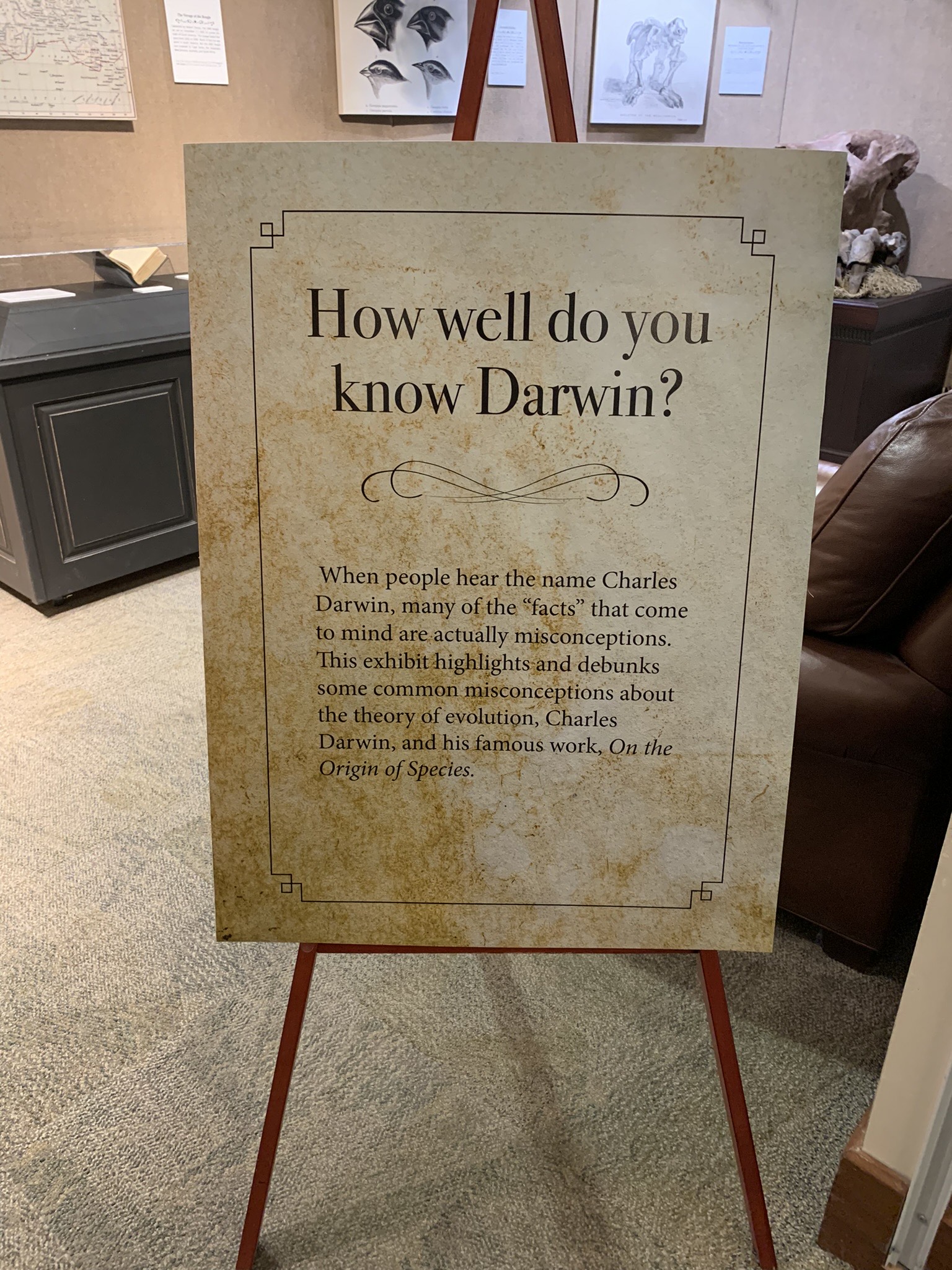
Darwin Exhibition

Currently there is an exhibit of Charles Darwin’s life and work going on at the Bean Life Science Museum on BYU’s campus in Provo, UT. I visited it last week and was very impressed. First, I was amazed that on a religious school’s campus, it would be as well done as it is. That said, it is at the Bean Life Science Museum, which, is very impressive. There are no admission fees, and it is a wonderful activity for all ages.

The exhibit is small and lovely. It talks about Darwin and his adventures. It focuses on his work and common misperceptions about who he was, his work and why it is so important now. There are several copies of the Origin of the Species on display, ranging from children’s books to a copy of the first edition publication. Have fun and enjoy!

Melanie White-Curtis


February 2022

Darwin Day 2022

Charles Darwin

This year we will be celebrating Darwin Day online; again, due to the pandemic.

The history of Darwin Day is intriguing. Charles Darwin, the man who would come to be known as the father of natural selection, was born on February 12, 1809. He was the fifth of six children in a wealthy English family. His father was a doctor, and his grandfathers were naturalists who laid the groundwork for the discoveries that Charles would go on to make. In 1825, Charles, who had been helping his father caring for the poor and sick in Shropshire, left for medical school. He found it dull, and he didn’t put much effort into his studies. It wasn’t long until his father sent him to Christ’s College in Cambridge to become an Anglican parson.

Though he was on a religious course of study, Charles found himself drawn to natural sciences. A friend at the time got him interested in beetle collecting and he became acquainted with other parson naturalists, who spurred his interest even more. He positioned himself to join his professor on a trip to the tropics to study natural history.

After his return, Charles received an offer to serve as a naturalist on an expedition that headed down the coast of South America. The ship was the HMS Beagle, the captain was Robert FitzRoy. The ship set out on it’s voyage in 1831 and spent five years aboard the ship. Across South America, Charles was exposed to a wealth of new geology, anthropology, zoology, and botany. He carefully collected samples of fossils, rocks, plants, and bugs to bring back to England. Darwin and FitzRoy both kept journals of the trip, which are impactful documents to this day.

Darwin’s theories of evolution were already percolating as the HMS Beagle returned to England. It was especially the finches in the Galapagos Islands that illustrated his theories. He madly rewrote his journals from the trip to gain a better understanding, read the work of Malthus, and conducted experiments with plants to test his theories. During this time of overworking, he got married but also developed a chronic illness.

Finally, in 1859, Charles published On the Origin of Species, a book that described the case for natural selection. While the book was unexpectedly popular, there was pushback from the church, that taught Divine Creation as the source of life. He continued to work and publish on evolution and natural selection for the next 22 years. He would eventually die of heart disease in 1882, which likely originated from the chronic Chagas disease he suffered from.

Charles Darwin’s research, journals and legacy is still alive and well and utilized often in the science communities. We honor his work, his legacy, and his vision.

Kindest regards
Melanie White-Curtis
President, HoU


President’s Message

I have been thinking very heavily about the state of the world, the state of our country, our state specifically and especially about our communities. During this time of Covid, which unfortunately is alive and well, our world and lives have been drastically modified all the way down to the way we even interact with each other. I am a people person, so this has been difficult to navigate on many days. I miss seeing you all and talking face to face. I am very grateful that technology is as advanced as it is, so we are not completely isolated and can still do many things we enjoy – such as learning and researching.

This in mind, I admonish you to take time to really develop your humanist beliefs. We will be sending out prompts through social media and emails to give your ideas on where to start searching in your quests for knowledge. All of us are on different levels of our humanist journey. Our lives are unique and beautifully our own. This is part of the human fabric that makes this world wonderful. Deepening where you already are not only helps you, but it also helps all of those you come in contact with and spreads in a pay it forward way.

Some key issues that we are committed to building an inclusive America are – we are grounded in an embrace of reason, ethics, scientific inquiry and compassion rather than religious dogma. This does not mean that we are above anyone or that we are exclusionary of those who are religious. We have members who are spiritual and some who even still religiously practice. This is part of their journey at the present time. We, as an organization, do not include religious dogma in our organization—creating a level space for open minded, free thought conversations and an all-inclusive community. There is no recruitment here—only folks who are looking to promote social justice, scientific integrity, enforce the separation of religion and government (they are independent of each other and should stay this way), defending non-theists and all secular rights and promoting peace.

Charles Darwin Day is in February, and we will not be able to have our normal event due to COVID. We will again do an online version of celebrating the day! So stay tuned to your social media and emails for details to come.

My friends, stay healthy, safe and know that you are in my thoughts often as we navigate this time of COVID. Empower yourself with knowledge during this time – you are worth the investment.

Kindest regards
Melanie White-Curtis

President , HoU


Chaplain’s Corner

A few months ago, I was invited as part of the Salt Lake Interfaith Roundtable to talk to Senate President Adams and members of his staff. During that meeting I was able to share some thoughts about humanism and the increasing number of non-religious Americans and even Utahans. Represent!

At the end of the meeting, we were asked if anyone would be interested in offering the invocation for Senate sessions, as President Adams wanted a range of perspectives. I volunteered. When I received a call inviting me to give an invocation, I felt both eagerness and a sense of responsibility.

My goal with this Humanist Senate Invocation was to share an inspiring message that would resonate with the broadest possible spectrum, while remaining specific and pointed enough to make people feel the importance of showing up to the democratic process. I knew that I wanted to address the dangerous political and cultural divisions that are literally compromising our country.

When my pro-Trump prison Lieutenant and queer black Humanist Chaplain mentor both loved my prayer, I knew I was on the right track.

Utah State Senate Session Invocation
Given by Jared Anderson
January 20, 2022

Let us take a breath and take a moment.

In this moment, as citizens, as servants, as staff, as Senate we take a moment to pause, to breathe, to center ourselves in our values, our principles, our purpose. We take a moment to remind ourselves with gratitude of our privilege, of our great power and great responsibility.

We take a moment to name and honor the fear that so many of our citizens are feeling. We honor the fear and confusion and overwhelm as disease and disaster disrupt our daily lives. We honor the exhaustion of those who work and the despair of those who do not have enough opportunity and support. We honor the complexity and challenge of the current connected world.

We name the fear and confusion as change accelerates, difference illuminates, and anger incinerates.

And in this moment, having named it, we release the fear and confusion and even exhaustion.

In this moment we again connect ourselves to our highest values, to our commitment to freedom and opportunity. We affirm our common humanity and right to dignity. We affirm our need and possibility and invitation to lean in and open up to courage and compassion towards each other. We affirm the need and ability to have the hard conversations and make the right choices. We affirm our ability to show up to life and to our values. We dedicate ourselves to show up to ourselves, to show up to each other, to life, to this precious civilization.

We take a moment to remind ourselves that we have an opportunity to design and facilitate opportunities for better moments and better days, to give us a better chance to be our better selves.

And by showing up to this moment, we dedicate this Session of the Utah State Senate to those highest values, to productivity and purpose, to opportunity.

And so it is, and so with our work may it be even better. Amen.

—Chaplain Jared Anderson


Gloomy Gus

I joined Humanists of Utah in 1996 and have submitted probably over one hundred articles to this newsletter on a wide range of subjects. I published my first “President’s Report in October 2005. Lately, when I sit down to write an article, I discover that what I’ve decided as the subject is one that I’ve written about before. With some subjects like the environment or religion, you all know that is a special interest of mine, for which I’ve made abundantly clear over the years. But in the last few years, I feel like I have been sort of a “Gloomy Gus,” with a fair amount of focus on the bad news and criticizing certain groups of people and some individuals. However, we’ve been through a lot in this country in the last few years and there are a lot of things to be critical of.

Bob Lane

In that vein, there is a quote by Thomas Paine.: “All religious institutions are human inventions, set up to terrify and enslave mankind and monopolize power and profit.” Reading it got me thinking about science deniers and the fact that for the most part, they consider themselves to be religious. I decided that calling them “science deniers” was being too kind. I think we need to call them “science haters.” They hate science because it tells them the earth is round, revolves around the sun, and that the earth is billions of years old. It tells them, by way of DNA, that life has evolved over eons of time on this water planet. They hate it because it turns long held beliefs on their head.

As I am writing this, this would also be the time of year, that we would be getting prepared for our annual Darwin Day event. Unfortunately, the pandemic continues to make it impossible to get together. I want to be hopeful that we might be able to have Darwin Day next year, but we will just have to see. Perhaps soon we can have more outdoor get-togethers, like our BBQ, or just a bring your own picnic.

I also want to close on a few positive notes, one being some actual good news from this Supreme Court and their recent vote of 8 to 1 against Trump’s attempt to keep documents away from Congress. The January 6 Commission and the press already are in possession of many of these documents, which will no doubt make some people squirm a little bit, I think. This is a good news item!

Also, I want to give a review and thumbs up to a CD Amy gave me for Christmas. It’s called “Juno to Jupiter” by Vangelis. The music is reflective of the NASA mission Juno to Jupiter and his involvement in that project. The CD’s liner notes give thanks to pretty much everyone that has ever been involved in the exploration of space. It is quite enjoyable to listen to this music while thinking about how wonderful it is to live in a time when we can launch an instrument-laden vehicle on a journey to help us study such a magnificent planet so far away. I know I have mentioned before the words of Carl Sagan from the first Cosmos series, but it bears repeating: “We are a way for the Cosmos to know itself.” It very satisfying to me to live at a time when we can learn and understand so much about the cosmos from the sub-atomic to the entire universe and be one of those creatures with a brain that allows the Cosmos to know itself.

—Bob Lane