April/May 2018

Darwin: Great Benefactor to the Scientific World

Time was, people believed that a perfect earth was created and would never change. In their old-world view, no change was needed nor would occur since perfection could not be bettered.

But Darwin, that heretic, changed the scope and breadth of science by making the conceptual leap to grasp that things could change. He saw that change had occurred in the past and would continue to change from now into the future. Moreover, Darwin was courageous enough to say the heresy out loud; even if it put him in danger.

Once he was able to transcend the idea of a static earth, which included life unchanging on that earth, Darwin gifted the world with an understanding of how the enormous variation in all life came to exist. Thus arrived Darwin’s theory of evolution by natural selection.

Science reigns in Darwin’s world, not supernatural, immutable perfection, and for this we, humanists, honor him.

For our 11th annual celebration of Darwin, the Humanists of Utah met at the Utah Department of Natural Resources auditorium. We listened to Dr. Randall B. Irmis, Chief Curator at the Natural History Museum of Utah, which is currently hosting a new exhibit, “Nature’s Ultimate Machines.”

Dr. Irmis is also an Associate Professor at the University of Utah in the Department of Geology and Geophysics. He has done field work all around the world studying early dinosaurs and has published major articles in prominent journals such as Nature and Science.

In keeping with Darwin’s monumental idea of evolution, Dr. Irmis spoke on “The Rise of the Dinosaurs: Evolutionary Success Through Competition or Luck?” His writings are based on his hands-on study of the fossil record.

An extinction event about 252 million years ago, thought to be a massive release of greenhouse gases and lots of big rocks hitting the earth, defines the boundary between the end of the Permian Age and the beginning of the Triassic Age. In the late Triassic, the first dinosaurs are found in the fossil record. On first appearance, dinosaurs are not important parts of their ecosystems.

But the end-Permian event which had wiped out many species left ecosystem holes into which dinosaurs could radiate and even thrive.

During the course of the next 140 million years the dinosaurs began to increase in numbers of species and individuals and became the dominant species on our earth. The family tree of dinosaurs split into two, the Ornithischians and the Sauropodomorphs. Later, the Sauropods gave rise to the Theropods which have evolved in modern times to be the birds in our back yards and on our tables.

In the environment of the early Triassic, tiny meat eaters were more successful than the plant eaters. Floral growth was more varied and inconsistent, offering vegetarians variable famine that would have overtaken and dispensed with many plant eaters, especially the large ones.

Associated with low numbers of plants, the percentage of oxygen in the atmosphere was low. Low oxygen tension was less of a challenge to the dinosaurs if a bird-like lung is theorized for them. Current birds’ lungs are more efficient at extracting oxygen from the air than the lungs of other animals, giving the Theropods a physical advantage in the Triassic Age.

Cold blooded reptiles, fish and amphibians would also have had mobility and functional challenges. Posited to be warm-blooded, dinosaurs would have had superior ability to move and function. The fossil record also indicates another reason for more efficient mobility in dinosaurs compared to reptiles. A complete hole in the leg socket of the pelvic bone where the femur articulates is thought to make them more mobile with better locomotion. More efficient mobility is assumed to be an advantageous evolutionary strategy allowing the Theropods to more successfully radiate and fill empty ecological niches.

Even though the luck of surviving one or more extinction events is shared by more than dinosaurs, it is dinosaurs who better adapted to the environment and who thrived while reptile numbers shrank.

In the fossil record, about 1000 species of dinosaurs have been found.

Dr. Irmis thinks Darwin thought both a superior ability to compete as well as luck were involved as he devised his laws of Natural Selection. Thus, from the Divergence of Character and the Extinction of Less Improved Forms “evolve the current species.”

Thank you, Dr. Irmis and Mr. Darwin.

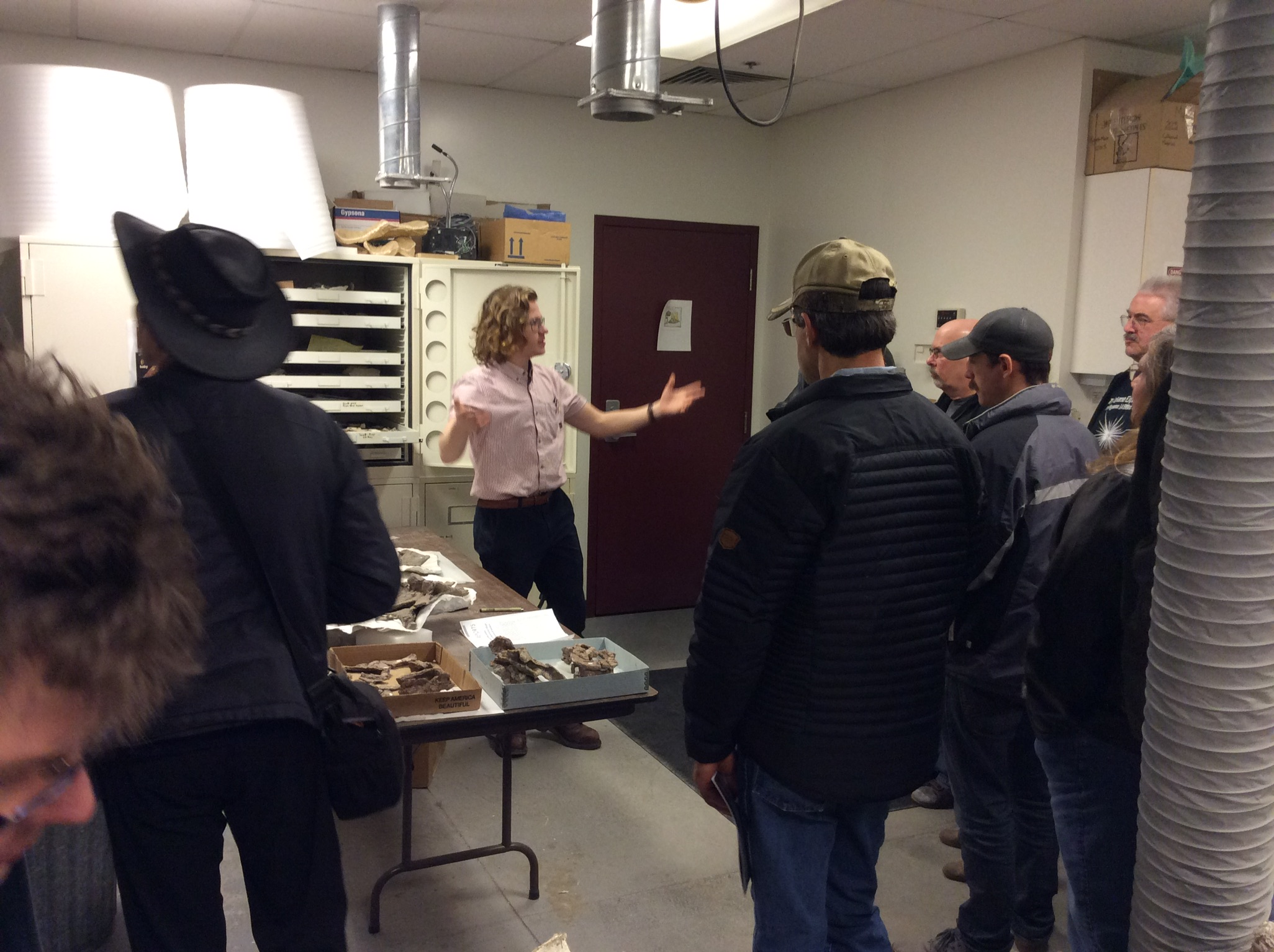
Thank you also, to Dr. James Kirkland and Dr. Evan Cowgill for tours of the Utah Geological Survey paleontology preparation lab where we saw pneumaticity in the bones of Theropods in the forms of grooves and air cells. Removal of bone makes the bones lighter, thereby more like the birds we know and love today.

Pneumaticity In Theropod Fossil


—Lauren Florence, MD


Pictures from Darwin Day taken by Dr. Florence:

Discussion of raptor “kill claw”
Therapod born with “kill claw”. It gets larger as the animal grows.
Unearthed specimen of Therapod spinal column with attached ribs being cleaned and processed
Discussion of raptor “kill claw“
Utahraptors
Another photo of the grooved, and thus less weighty, pelvic bone next to the paper by Dr. James Kirkland, one of our local experts.
Utahraptors
Acrocanthosaurus
Tenontosaurus
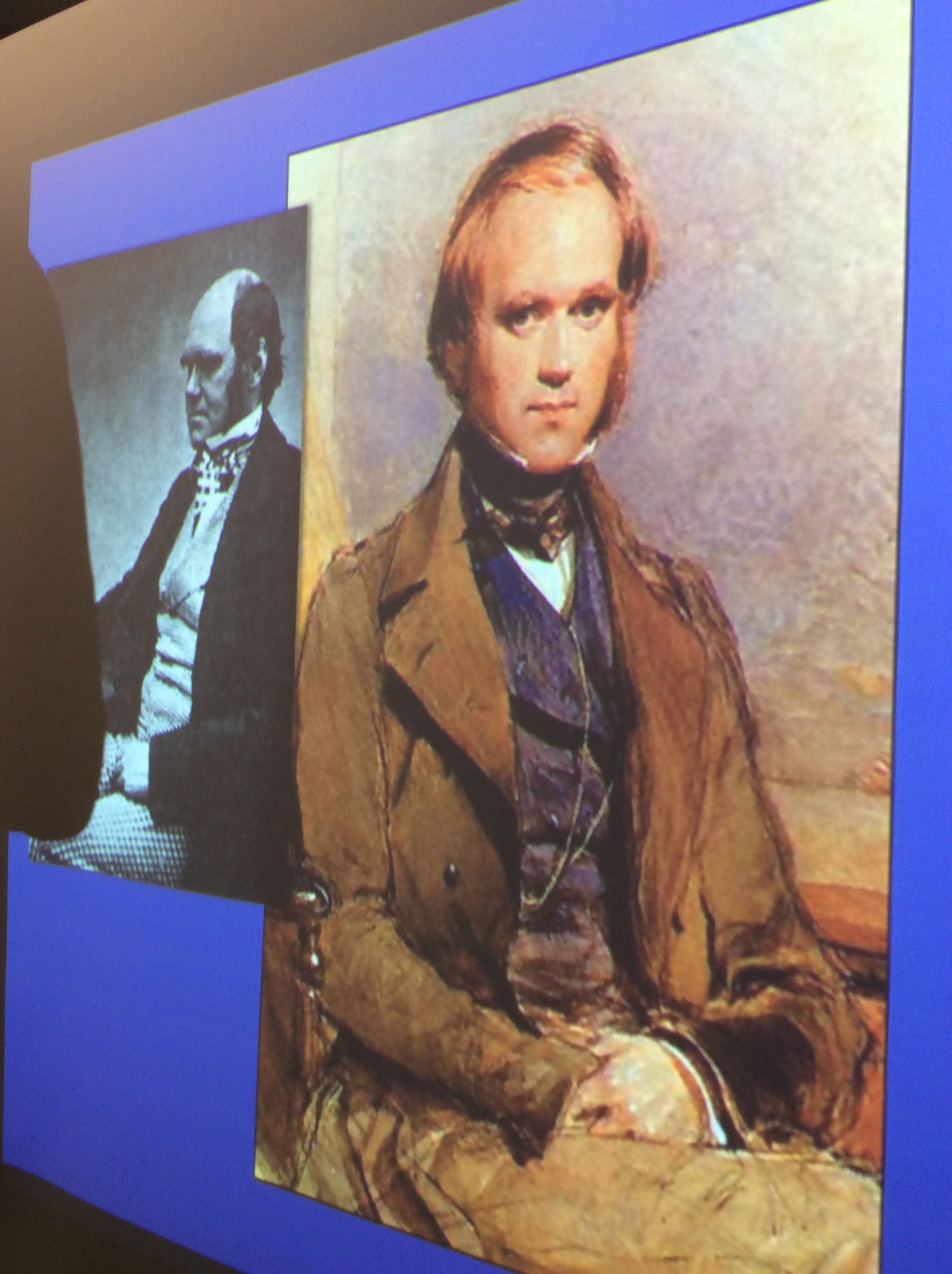
Two pictures of Charles Darwin The man we are celebrating


Stardust

Inspire passion for science and wonder with this children’s STEM book exploring the Big Bang, the Solar System, and our place in space!

My name is Douglas Harris and me and my daughter Bailey (age 12) released a book called My Name is Stardust in 2017. The book has done very well with secular families and was supported by prominent activists such as Michael Shermer and Dale McGowan.

We are launching a Kickstarter campaign for the next book in the Stardust Series, Stardust Explores the Solar System.

You can contribute to the campaign here: https://goo.gl/SWSYD6

—Douglas Harris


President’s Message

I hope you are enjoying the spring weather as much as I am. It is my favorite time of the year as I think I have mentioned every spring that I have been writing these messages. All my life I have enjoyed growing things to eat. And nothing is fresher than what is growing right outside your back door.

Speaking of back doors, some of you may know I am moving into my deceased mother’s house. It is a bit strange, as this is where I grew up. But my mother didn’t grow much food, so I’m having to eek out some spots among the bushes. But I love putting seeds in the ground early. Planting things like carrots, peas, lettuce, spinach, onions, dill, etc. I’m also going to grow some herbs in quantities to be able to give some away to friends and neighbors. There is already lavender, sage, rosemary, thyme and oregano and I plan to plant more. But enough of my gardening zeal.

By now I hope you know that we are going to a bimonthly schedule and to also move the venue around to a variety of places on different times and days of the week. With that in mind, I hope you will give some thought to places you think would be a good place as a venue for a meeting or event. This February’s Darwin Day Celebration at the Utah Division of Natural Resources facility was an excellent venue. And if they are willing, I think we should have Darwin Day there often. I would also ask you to think about what you want us to schedule. With only six dates to plan for, do we want more socials, more speakers, an advocacy project? The Board of Directors would love to hear from you.

Speaking of Darwin Day, it was a great success this year with the work of Craig Wilkinson, MD, Utah Friends of Paleontology, Atheists of Utah, and all the other participating groups making it happen. There were exhibits to check out, a tour given by UFoP members. There was an excellent presentation with birthday cake after.

It is never too soon to start planning next year’s event, so I want to suggest that we think about the theme and subject. Though we have had Climate Change as the subject recently, the threat it presents seems even more pressing with Trump as President. Unfortunately, with this man in the Oval Office, much that has been accomplished environmentally in the past is being attacked and undone. It will make a good theme again as well as an opportunity to advocate for the environment.

With that said I think I’m going to close and go do the environment a little good by getting some seeds planted.

—Robert Lane
President, HoU


February 2018

Getting Ready for Darwin Day 2018

Click on image for a larger rendering


The Other Side of the Story

The Israeli Occupation of the West Bank has gone on for over fifty years and has become the status-quo. Peace talks are not happening, and Israel is satisfied to keep millions of Palestinians living under military law. This Occupation could not happen without US approval. We are protecting the Israelis both by giving them over 3 billion a year in tax payer money and by vetoing measures in the UN Security Council meant to censure Israel. The US government and the media are not telling the public the whole story. The death rate in the Occupied territories is 96% Palestinian and 4% Israelis killed. Genocide, racial profiling and ethnic cleansing are War Crimes.

—Barbara Taylor


The Law of Survival of a Species

I was pretty stressed when I saw both of my daughters use the metoo# hash tag when it began circulating; there were also too many lady friends and acquaintances for my comfort. I wondered what I could have done differently, what I could have taught them while they were growing up? It occurs to me that the simplest answer might be found in basic biology.

I traveled to Denver with a booster club in 1975 to watch the Salt Lake Golden Eagles hockey team clinch their division. We stayed in a hotel with the team; we had an entire floor and there was a huge victory celebration after the game. I witnessed four or five females, who were in committed relationships, offer their own special congratulations to Eagles players. I saw firsthand the mechanism of Survival of a Species. The concept is that female animals are attracted to Alpha males, the females instinctively believe that it is likely that genetic material from alphas makes their own progeny more likely to survive than would with regular males’ offspring.

Another example is Monica Lewinski, she stated that she was “madly in love” with Bill Clinton; it is more likely that the animal in her madly coveted sperm from the most powerful male in the world. She acted as a female animal instead of a woman (human) just as Clinton acted as a male animal rather than a man (human.)

Society is currently grappling with the concept of respect for women; I haven’t heard evolutionary biology mentioned in any discussions yet and I think that this is a very important consideration. I believe that we can and should realize that there is a distinction between animals and humans—it is what makes us human. Humans are, on a basic level, animals but I like to think that humans have grown beyond our simple, basic animal instincts. However, ignoring our inherent animal nature is foolish and may be an important root of the problem everyone is trying to solve now. Powerful (alpha) males exist and they attract more females that average males. When we do not acknowledge this fact the human part of our makeup does not bubble to the surface. I believe that this concept of the distinction between (man/male) and (woman/female) is very important to the way we prepare our children to enter society.

Young people venturing away from the family hearth experience one of the most exciting times in life; they feel unfettered freedom and make their own choices for the first times in their lives. Young women need to understand that the primitive females in their bodies can mask the human qualities of some males that they are attracted to. Analogously, strong males need to realize that just because many females are attracted to them, they do not have intimate physical rights to any woman they are attracted to. If young people are aware of these forces they have a chance to push a pause button, yes that other person is amazing and the feelings going on inside me are exciting and feel so good; but am I sure that this is the right person for me? Maybe, but could it hurt to wait until tomorrow and meet for lunch? If everything is genuine then things will progress, and this really could be the right person for me. The human part of me should have input into this decision and have the authority to overrule my animal component within.

It is not easy to override powerful biological instincts, but I think if we all work on preferring to use our human traits whenever there is a conflict with primitive animal choices that the world will be a better place for everybody.

—Wayne Wilson


President’s Message

Because there was no newsletter last month, this is my first opportunity to say happy new year. So, happy new year. Now that it is February, that means that instead of a general meeting, it is time for or annual Darwin Day celebration. This year board member Dr. Craig Wilkinson has taken the lead in planning the event and we thank him for that. I won’t say much about the event as there will be an announcement elsewhere in the newsletter. But please do attend and bring a friend.

This month my message will be mostly about chapter business. For quite some time now the board of directors has been concerned with the slow decline in membership and a drop off in attendance at meetings. The board is considering various ways to address the chapters problems or needs. There were a couple of problems we have known for a while, Thursday meetings and evening meetings. I know driving at night is a problem that some have told me keep them from coming to our meetings. So, we have decided to start the process of change by switching to a weekend afternoon schedule. This means that we will not be meeting at the Unitarian much anymore, being that the church itself has the weekend use of the facilities understandably tied up. Also, we will be going to a bi-monthly schedule. No meeting January, March, May, July, September, November. If attendance improves or we decide to add something to the schedule like a bus excursion or the like, events can be easily added. This schedule change also means that the newsletter will be bi-monthly. Finding venues will be the biggest new challenge for the chapter, but I think moving it around a little won’t be a problem. Perhaps we can find a venue more centrally located in the valley. If anyone has suggestions as to venues please let us know and we would also love to hear from chapter members with suggestion for improving Humanists of Utah.

The voice of humanism and its aspirations need to be broadened in this trying political times and not allowed to decline or be weakened. I hope our efforts to improve Humanists of Utah will help us to be part of the humanist voice which is very much needed.

This year is the last year of my presidency of the Humanists of Utah. I’ve been the president for a lot of years, and it’s time for a change. Its been an honor to be president and I plan to stay on as a regular board member. But I want to be free of “running things” so to speak. Plus, becoming a regular member will allow me to do what I would like to do, and that is to concentrate on the planning of our special events like Darwin Day, our BBC, possible bus excursions and so on. One last thing, the American Humanist Association is holding its Annual Conference in May this year at the Flamingo Hotel in Las Vegas. Board Member Wayne Wilson and myself will be attending and it would be great if some of you attended also. This will be my fourth conference, once in Amhurst, New York, once in Portland, Oregon and once in Las Angeles, California. They were all excellent with interesting speakers and sessions and a lot of likeminded people to meet. Plus being as close as Las Vegas eliminates the high cost of flying back east or elsewhere. So please give it some thought.

That’s about it for now. Hope to see you at our Darwin Day celebration.

—Robert Lane
President, HoU


December 2017


Don’t Worry–Everything is Made of Chemicals

Chuck and John Welle gave our monthly meeting presentation a witty sense of academia. Chuck, a chemist from the pharmaceutical and medical industries, and his son, John, who has a background in economics and computers, both elevated the science in our discussion in a light-hearted and jovial way.

They started with a reference to Neil de Grasse Tyson, who said, “Before the Big Bang, there was hydrogen. All the other [chemical] elements were made from hydrogen by dying stars.”

These chemical elements were organized into the Periodic Table of the Elements by Mendelov when he noted that some elements behave chemically in the same general manner. Some elements are inert, and some are highly reactive. For instance, oxygen and sulfur are placed into the same column in the Periodic Table. They are both destructive due to both elements being so reactive.

The destruction that oxygen does we have named “oxidation.” A fast burn, i.e. quick oxidation, has been named “an explosion.” A slow oxidation of iron, goes by the name “rust.”

The Periodic Table is a little more complicated than Mendelov imagined. Elements can be different masses and still be the same element due to different numbers of neutrons. The masses of different forms of the same element are averaged in order to identify a box in the Table for it. You’ve heard of “heavy water,” It’s still oxygen and hydrogen (H2O) but with more neutrons.

Our speakers recommended YouTube videos about the Periodic Table put together by the University of Birmingham.

The discussion then took a big leap into DNA from the Periodic Table. As all chemistry starts with the periodic table, so then does the chemical compound, DNA, evoke the most interest from human beings since it is our foundational map. We were referred to the CRISPR site, www.origene.com, where a complicated discussion of CRISPR/Cas9, an RNA-guided targeted genome editing tool, ensues. The CRISPR/Cas9 allows researchers to do gene knockout, knocking SNPs, insertions and deletions in cell lines and animals. I was reminded of how long it has been since I was in school.

DNA determines how an animal carries oxygen to the cells of an organism by providing the blue-prints of the proteins that carry the oxygen in the blood. Humans have hemoglobin, which is red when the iron in the center of the molecule is oxygenated. BTW, this iron does not make blood magnetic. If it did, getting an MRI would kill the patient since the magnet is so powerful it could pull all the iron out of your body and stick it to the sides of the machine.

Hemocyanin is blue and is based on copper instead of iron. Some spiders, crustaceans (notably the horseshoe crab), some mollusks, octopuses and squid have blue blood. This blood is medically useful to use to make a chemical reagent that can be used to assess if a newly developed drug is loaded with toxins or pure. (At this point, how that works was a graduate level discussion. Again, I have been a long time out of school.)

Chlorocruorin, present in many annelids, has a weaker affinity for oxygen than most hemoglobins, by about one fourth. Since it is a dichromatic compound, it appears green when in dilute solutions and red when more concentrated.

As a final point, the Welle team encouraged us to be scientific and to look at evidence. For instance, CaCl2 is a de-icing agent in ice melt. Is also is a pickle crisper. Your first thought might be to avoid pickles. On the other hand, you’ve surely eaten them and not died. The idea that “if something is a chemical, it must be bad” is not always true. The Welle duo encouraged us to mistrust rumor and speculation and fend off scare tactics with scientific information.

The scientific consensus around GMO foods is as strong as the scientific consensus around climate change. GMO foods are subjected to more testing than other food and the tests tell us that GMO foods are generally safe. GMO’s also allow larger yields, so we can feed more of the earth’s 7 billion (and projected to get to 11 billion in the next decade.)

Chuck and John Welle want us to wake up, check facts, be aware and make decisions based on science. Isn’t that what humanists do?

—Lauren Florence, MD


Facts

Fewer than half of Americans inhabit a fact-based reality. Until the 1960’s most American’s shared common sources for their view of reality, with governmental, institutional, corporate and major media serving as reliable sources for a reasonably factual view of current issues. What has happened since then to create the fictional view of reality held now by a majority of Americans? For me this story is at the heart of our dysfunctional political system and incisively explains the election of a president rooted in fantasy.

The link I am sharing to an article published in The Atlantic magazine provides an extensive and brilliant account of the circumstances that led us to this point. Remember the Federal Fairness Doctrine that applied to our airways until 1988? Any outlet broadcasting a political point of view was required by the FCC to give equal time to the opposing view. At the time this served us well because it encouraged legitimacy of view. Anyone advocating fictional viewpoints would be readily corrected by an opponent utilizing recognizable factual data, and exposed as a fool if the viewpoint was at the fringe. Now the fools not only go unpunished but find reward through the mob-like mentality of adherents.

This account cuts both ways; I do believe you will find it thoroughly informative: How America Lost Its Mind.

—Clark Layton


Put Civics 101 Back in High School

An Immodest Proposal
By Timothy Egan

Excerpted from “We’re With Stupid”, on The New York Times OpEd page, 11/17/2017

It would be much easier to sleep at night if you could believe that we’re in such a mess of misinformation simply because Russian agents disseminated inflammatory posts that reached 126 million people on Facebook.

But the problem is not the Russians — it’s us. We’re getting played because too many Americans are ill equipped to perform the basic functions of citizenship. If the point of the Russian campaign, aided domestically by right-wing media, was to get people to think there is no such thing as knowable truth, the bad guys have won.

We have a White House of lies because a huge percentage of the population can’t tell fact from fiction. But a huge percentage is also clueless about the basic laws of the land. In a democracy, we the people are supposed to understand our role in this power-sharing thing.

Nearly one in three Americans cannot name a single branch of government. When NPR tweeted out sections of the Declaration of Independence last year, many people were outraged. They mistook Thomas Jefferson’s words for anti-Trump propaganda.

For that you have to blame all of us: we have allowed the educational system to become negligent in teaching the owner’s manual of citizenship.

Suppose we treated citizenship like getting a driver’s license. People would have to pass a simple test on American values, history and geography before they were allowed to have a say in the system. We do that for immigrants, and 97 percent of them pass, according to one study.

Yet one in three Americans fail the immigrant citizenship test. This is not an elitist barrier. The test includes questions like, “What major event happened on 9/11?” and “What ocean is on the West Coast of the United States?”

One reason that public schools were established across the land was to produce an informed citizenry. And up until the 1960s, it was common for students to take three separate courses in civics and government before they got out of high school. Now only a handful of states require proficiency in civics as a condition of high school graduation. Students are hungry, in this turbulent era, for discussion of politics and government. But the educators are failing them. Civics has fallen to the side, in part because of the standardized test mania.

A related concern is historical ignorance. By a 48 percent to 38 percent margin Americans think states’ rights, rather than slavery, caused the Civil War. So Trump’s chief of staff, John F. Kelly, can say something false about the war, because most people are just as clueless as he is.

There’s hope — and there are many ways — to shed light on the cave of American democracy. More than a dozen states now require high school students to pass the immigrant citizenship test. We should also teach kids how to tell fake news from real, as schools in Europe are doing.

—PIQUE
Newsletter of the Secular Humanist Society of New York
December 2017


Inspiring Donations

Humanists of Utah is enrolled in Smith’s Inspiring Donations program. If you have a Smith’s Fresh Value card, you can register it to benefit Humanists of Utah. Simply visit www.smithsfoodanddrug.com/inspire , create an account, associate it with your Fresh Values card number, and then enter NPO Number: KQ330 within your “account summary.” All future purchases will now benefit HoU.

—Leona Blackbird


President’s Message

Hi All, hope you are enjoying the holidays. In recent months I have often noted and talked about some recent disaster or shooting that has occurred. But this time I just want to wish you all happy holidays and talk about my cookie mill. That’s what Amy and I call the process. I’m mentioning this partly because I have been moving into my mother’s home and have a much larger kitchen to use. So, I have spread out the mill and it makes me chuckle how much stuff I have. Imagine twelve cookie sheets, six wire racks, two stand mixers, a hand mixer and on and on.

At our meetings when individuals find out that I bake the cookies they get somewhat amazed when I tell them that I bake two or three thousand cookies this time of year. But it really isn’t that amazing when you think about the fact that just doubling a batch will give you over two hundred, so that’s a good start. I’ve been baking cookies for over thirty years now. It started when I got tired of trying to shop for gifts this time of year. Plus, cookies freeze well, and I’ve been happy to bake enough to have them available year-round.

After this year though, I plan to cut back on cookies a bit and start trying my hand at baking breads and some pastries I use to make but haven’t tried for a while. I enjoy all kinds of cooking and watch a fair amount of the chef shows and try new things as often as possible. The culinary arts are one of the ways to make life much more enjoyable.

Next week is our Winter Social and I hope you will join us and like I always say, Come and enjoy some good food and good conversation.

—Robert Lane
President, HoU


November 2017

Origin ~ Book Report

Dan Brown’s most recent book is Origin, it is also the next in the series of the Robert Langdon novels; preceded by The Da Vinci Code, Angels & Demons, Inferno, and The Lost Symbol. The common theme among these books is a questioning of organized religion, mostly Christianity, and especially Catholicism. Origin goes much further than the previous titles in what may be Brown’s personal search to ascertain the role of religion in life. Like previous titles Origin is constructed as a mystery where a renegade group tries to prevent new knowledge from displacing religious dogma in explaining the world we experience.

That said, Origin goes much further than previous efforts to present religion as a largely outdated way of thinking. Edmond Kirsch, the main character of this story is an outspoken atheist and a pioneer in technology. His hardware and software skills have made him a fortune via a company he built. We find out that Kirsch was a student in one of Professor Langdon’s classes and was heavily influenced by Langdon’s ideas.

The now wealthy and influential, Kirsch makes an announcement that he has discovered the answers to the two most important questions facing humanity: “Where did we come from?” and “Where are we going.” He arranged to make a live announcement of the “answers” that will be broadcast worldwide at a black tie, invitation only event. He begins the announcement with footage from a Professor Langdon lecture about the importance and meaning of symbols. As he prepares to launch his saved presentation he is struck between the eyes with a bullet and killed. The shot was fired by the classic Langdon-esque religious fanatic villain. So yes, the main character is killed early in the book, but this is a mystery that Langdon needs to solve.

Nobody else has access to the details of Kirsch’s discoveries; but Langdon is able to lift the custom made cellphone from the Kirsch’s lifeless body. With this device he can communicate with Winston, an artificial intelligence personal assistant that Kirsch created. We learn that Kirsch was heavily influenced by freethinkers like Richard Dawkins, Margaret Downey, and Daniel Dennett. The point is made that even though evolution has been demonstrated countless times that the real issue is “First Cause,”…the term Darwin used to describe this elusive moment of creation. Darwin proved that life has continuously evolved, but he could not figure out how the process started. In other words, Darwin’s theory describes the survival of the fittest, but not the arrival of the fittest. The legendary 1950s experiment by Stanley Miller and Harold Urey who tried to simulate earth conditions a few million years ago where a soup of chemicals was subjected to heat, and electrical shocks did not produce life, maybe a few amino acids, which are the building blocks of proteins, but not the hoped for appearance of life.

Like previous Dan Brown mysteries, the setting grabbed my attention. The action takes place in Barcelona, Spain and explores the work of architect Antoni Gaudi whose most famous work is the Sagrada Familia, a cathedral that was begun in 1882 and is still a work in progress to this day. There is also intrigue and romance because Edmond Kirsch is engaged to marry the crown prince of Spain and the king is on his death bed.

Unlike previous Langdon stories the villain is something less than superhuman and is thwarted relatively early in the story. The part of this novel I was most intrigued by is the resolution of the second question: Where are we going? It involves Darwinian evolution, Kirsch argues that an extremely rapid change in humans is coming. If he is correct, and it seems plausible to me that he might be, the possibility that our children and certainly our grandchildren will not be homo sapiens as we know them today.

I found this an intriguing novel and highly recommend it.

—Wayne Wilson

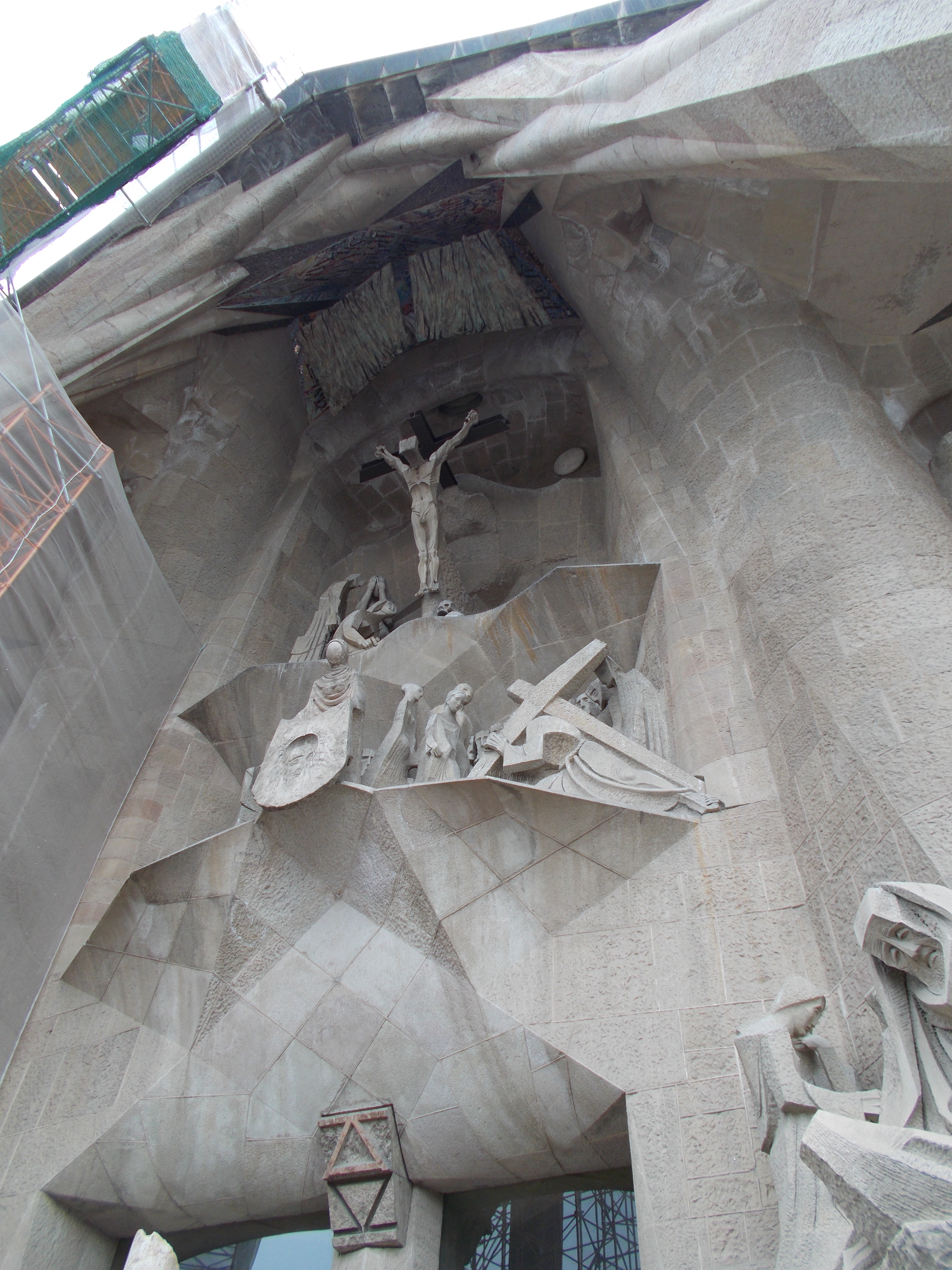
Here are some pictures of the cathedral that I took in 2013:

Exterior facade

Colorful interior columns and ceiling

Jesus seems to be parachuting towards the podium


On Past Judgements

Don’t it always seem to go, that you don’t know what you’ve got ‘till it’s gone
—Joni Mitchell

In the 1976 Presidential election, I voted for John Anderson. I was then, and still am, a liberal. So, Gerald Ford was not a consideration, especially after he pardoned Nixon, which was unforgivable. But I didn’t trust Jimmy Carter, who claimed to be honest. I didn’t know much about the Sothern Baptist Convention but what I did know was that they opposed almost everything I supported. Carter was a Southern Baptist, so Carter was out. Four years later and I had changed my mind. I enthusiastically supporter Carter against Ronald Reagan, and over the years I have grown to appreciate Jimmy Carter more and more.

Carter turned out to be much more honest and thoughtful than the average politician. And he was open to change. He recently left the Southern Baptist Convention after 60 years because of their belief that women should be subservient to men.

Here are some examples of some prescient thoughts from then-President Jimmy Carter’s speeches:

  1. Too many of us now tend to worship self-indulgence and consumption. Human identity is no longer defined by what one does, but by what one owns. But we’ve discovered that owning things and consuming things does not satisfy our longing for meaning.
  2. You see every extreme position defended to the last vote, almost to the last breath by one unyielding group after another. You often see a balanced and fair approach that demands sacrifice, a little sacrifice from everyone, abandoned like an orphan without support and without friends…
  3. Carter warned the nation against following the “path that leads to fragmentation and self-interest,” for “down that road lies a mistaken idea of freedom, the right to grasp for ourselves some advantage over others”
  4. We have lost our way…because we have exalted “a mistaken idea of freedom”; our self-indulgence has led us to assert every right as absolute, every form of compromise or regulation as inimical to freedom, and…to elevate the very avatar of self-absorption to the highest office in the land.

—Pete Barkett
Northwest Humanist Monthly
October 2017


Editor’s Note: I too voted for Anderson in 1976 and switched to Carter in 1980. I think Carter will go down in history as one of the most moral politicians to ever serve; anywhere, anytime.


Traveling Local Humanist Leader

Chapter Treasurer Leona Blackbird traveled to Dayton, Tennessee this summer. She posed in front of a new statue of Clarence Darrow that was erected 7/17/17 at the Rhea County Courthouse where the (in)famous Scopes Monkey Trial took place.


President’s Message

I was thinking how it was odd that for the last several months, when I finally force myself to write my President’s message, there is a disaster of some sorts happening. First with Hurricanes, fires, the Las Vegas shooting, and now on Halloween a terrorist attach with a truck running down people in a bike and pedestrian lane in New York City. But I had to use skepticism to remind myself that what I’m doing in my life here in SLC has very little to do with what happening on the streets of New York. It has, however, been distracting and makes it hard to focus and changes my mood. But I really don’t want to talk about disasters.

What I was thinking about, before the Halloween incident was to say a few words about pejoratives and censorship.

Our previous President and co-founder Flo Winewriter advised us to always try to communicate with those we may disagree with a civil tongue. It’s good advice, if for no other reason than the fact that yelling and name calling rarely accomplish anything. But what do you do when your opponent uses your desire to be nice in conversation against you. Making it look like they won the argument because they are more aggressive and a louder mouth. I’ve heard it said that conservatives are fist pumpers and liberals are hand wringers.

This has become particularly common in our political discourse with President Trump constantly using pejoratives of the derogatory and belittling type. He seems to be unable to engage anyone who disagrees with him without turning it adversarial.

As a rather black humored joke I asked if the list of pejoratives that fit Trump was a big as the list of his lies. But I saw the folly in that as I realized that, while the list of pejoratives that fit Donald Trump is a long one, his lies create a tome that I suspect goes back to when he first uttered a sentence as a toddler.

On the somewhat related subject of censorship, I kind of chuckle and groan when I see the media censor a word like bullshit. With all the horror and coarse language, we see and hear in movies and on TV, it seems rather hypocritical to think we are protecting the public from something shocking by writing bullshit, bulls—t. Its more than hypocritical, it’s quite silly.

One more thing before I sign off. The idea that we should be in some way forced to honor or salute the flag, the pledge of allegiance to the flag or stand for the national anthem is absurd. I didn’t serve four years in the U.S. Air Force for a flag or a song or a pledge. I served for our country and its freedoms which include sitting or kneeling or any other form of protest including burning the flag.

For two of the four years I served I was a Security Police law enforcement Sargent who raised and lowered the base flag with pride. But I also understand that the flag means different things to our diverse population. I believe it was Malcolm X who said “We didn’t land on Plymouth Rock, Plymouth Rock landed on us.” And I remember seeing a Native American on TV say that the only salute he had for the U.S. flag was a middle finger. Pointing out that the U.S. government robbed them of their lands and attempted genocide, somewhat successfully, on Native Americans who were here first.

That’s all for now freethinkers. Let’s hope there’s no disasters for a while.

—Robert Lane
President, HoU


October 2017

Gerrymandering

Gina Eborn, President and one of the founding members of The Fair Redistricting Caucus of Utah (FRCU) was the featured speaker at our September general meeting The FRCU is a non-partisan organization that started in November 2016 with the goal of educating the public on the practice of gerrymandering and how it negatively affects all constituents regardless of political affiliation.

 According to Webster’s Dictionary Gerrymandering is:

  • Manipulate the boundaries of (an electoral constituency) so as to favor one party or class.
  • Achieve a result by manipulating the boundaries of an electoral constituency:

Another definition of gerrymandering is that it “allows politicians to choose their voters rather than the voters choosing their politicians.”

Historically gerrymandering has been around for centuries, but came to prominence under its current coined phrase in 1812, as governor of Massachusetts, Elbridge Gerry signed a bill authorizing the revision of voting districts in his state. Members of Gerry’s party redrew them in order to secure their representation in the state senate. They carved an unlikely-looking district with the shape of a salamander. According to one version of the coining of gerrymander, the shape of the district attracted the eye of the painter Gilbert Stuart, who noticed it on a map in a newspaper editor’s office. Stuart decorated the outline of the district with a head, wings, and claws and then said to the editor, “That will do for a salamander!” “Gerrymander!” came the reply. The image created by Stuart first appeared in the March 26, 1812, edition of the Boston Gazette, where it was accompanied by the following title: The Gerrymander. A New Species of Monster.

The new word gerrymander caught on instantly—within the same year gerrymander is also recorded as a verb. (Gerry’s name, incidentally, was pronounced with a hard (g) sound, although the word which has immortalized him is now commonly pronounced with a soft (j) sound.) Gerry ran for reelection in 1812, but was defeated, although his party went on to win the majority.

With every Census, all 50 state legislatures are required to redraw the borders of their congressional districts to accord with the Supreme Court’s “one person, one vote” rule and to make the districts as equally populous as possible. While the exercise is premised on equality, it presents an irresistible opportunity for political parties to tilt the playing field to their advantage. The party that controls the state legislature inevitably redraws the districts, with patchworks and shapes so bizarre that their creators nearly join the pantheon of postmodern art. The retooling of these boundaries boils down to one purpose: to maximize the number of seats their party can capture in the upcoming election. Bewildered by the complexity of other options, the Supreme Court has mostly upheld this arrangement.

The common misconception is to assume that gerrymandering allows parties to engineer safe districts for their incumbents, ensuring easy reelection. But the exact opposite is true. Redistricting’s real purpose is engineering safe districts for your opponent—to pack as many of them into as few districts as possible. It’s like Patton’s infamous maxim on war: you make the other poor bastard die for his country. If anything, redistricting by conservatives would make Republican House districts slightly less conservative in order to include Republican voters in districts where their votes are needed to win seats. The most common methods used to minimize the impact of a voting block are packing and cracking and there are two types of gerrymandering, racial and political. Racial is a protected class, however political is currently not.Packing concentrates members of a group in a  single district, thereby allowing the other party to win the remainder of the districts.

Cracking splits a bloc among multiple districts, so as to dilute their impact and to prevent them from constituting a majority. These methods are frequently used in conjunction with each other.

Racial

The term racial gerrymandering initially designated the post-Reconstruction practice which, like poll taxes and literacy tests, was designed to disenfranchise African-Americans. Legislative district boundaries were drawn with the aim of diluting the electoral power of newly registered voters from ethnic minority groups.

Following the passage of the Voting Rights Act of 1965, this practice was prohibited; indeed, in many circumstances, the statute in fact requires the creation of majority-minority districts. The practice of drawing districts that would afford racial and ethnic minorities the opportunity for elected representation has come be known as affirmative gerrymandering or—in a somewhat ironic reversal—racial gerrymandering.

Political

Partisan gerrymander is typically conducted by the majority party to strengthen or maintain their electoral advantage. In a 5-4 decision in Vieth v. Jubelirer the Supreme Court rejected a challenge to politically gerrymandered districts due to a lack of justiciable standards, meaning that political gerrymandering can be conducted legally. Partisan gerrymandering is a serious problem in our democracy. In jurisdictions nationwide, legislators have drawn legislative maps so that they can choose their voters, instead of voters being able to choose their representatives. This is usually done in a secret office – away from the Capitol, the public, and the press – and then passage of their plan is rushed through the Assembly.

REDMAP

The idea behind REDMAP was to hit the Democrats at their weakest point. In several state legislatures, Democratic majorities were thin. If the Republicans commissioned polls, brought in high-powered consultants, and flooded out-of-the-way districts with ads, it might be possible to flip enough seats to take charge of them. Then, when it came time to draw the new lines, the G.O.P. would be in control.

The Increasing Need For A Legal Standard

It is clear the current redistricting process is undermining our democracy and partisan gerrymandering has become the political weapon of choice for legislators to maintain political power. The U.S. Supreme Court held that it has the authority and responsibility to decide partisan gerrymandering claims, and in 2006, a majority of justices agreed that excessive partisan gerrymandering violates the Constitution.

However, the Court has yet to adopt a standard for determining whether a redistricting plan constitutes a partisan gerrymander. Every proposed test to date has been deemed unworkable by the courts – too ambiguous and subjective to reliably identify the most objectionable plans. Without a legal standard, voters are free to challenge politically motivated maps in court, but judges, without clear guidance, ordinarily dismiss these cases out of hand. The result is voters are unable to hold their representatives accountable and reign in extreme partisan gerrymanders.

A Legal Challenge To Stop Partisan Gerrymanders Nationwide

CLC is part of a litigation team representing 12 Wisconsin voters who have challenged the state’s Assembly district lines as an unconstitutional partisan gerrymander in Gill v. Whitford. Our case is the first purely partisan gerrymandering case to go to trial in 30 years. Through this litigation, the plaintiffs seek to establish for the first time a manageable standard by which courts nationwide can analyze partisan gerrymandering claims.

Efficiency Gap

Wasted votes are ballots that don’t contribute to victory for candidates, and they come in two forms: lost votes cast for candidates who are defeated, and surplus votes for winning candidates, but in excess of what they needed to prevail. When a party gerrymanders a state, it tries to maximize the wasted votes for the opposing party while minimizing its own, thus producing a large efficiency gap. In a state with perfect partisan symmetry, both parties would have the same number of wasted votes.

Suppose, for example, that a state has five districts with 100 voters each, and two parties, Party A and Party B. Suppose also that Party A wins four of the seats 53 to 47, and Party B wins one of them 85 to 15. Then in each of the four seats that Party A wins, it has 2 surplus votes (53 minus the 51 needed to win), and Party B has 47 lost votes. And in the lone district that Party A loses, it has 15 lost votes, and Party B has 34 surplus votes (85 minus the 51 needed to win). In sum, Party A wastes 23 votes and Party B wastes 222 votes. Subtracting one figure from the other and dividing by the 500 votes cast produces an efficiency gap of 40 percent in Party A’s favor.

On to the Supreme Court

On November 21, 2016, a three-judge panel in the U.S. District Court for the Western District of Wisconsin struck down Wisconsin’s state assembly district map. With this decision, plaintiffs have successfully alleged and proven that a state legislative redistricting plan is an unconstitutional partisan gerrymander for the first time in 30 years.

The ruling issued by the court stated the following: “We find that Act 43 was intended to burden the representational rights of Democratic voters throughout the decennial period by impeding their ability to translate their votes into legislative seats. Moreover, as demonstrated by the results of the 2012 and 2014 elections, among other evidence, we conclude that Act 43 has had its intended effect.”

The plaintiffs’ three-part test, which was adopted in this case, can now be used across the country to fight back against unfair partisan gerrymandering.

The state of Wisconsin filed their notice of appeal on Feb. 24, 2017 and their opposition to CLC’s motion to affirm on May 18, 2017.On June 19, 2017, the Supreme Court decided to hear oral arguments in Gill v. Whitford. The case is set for oral arguments before the Supreme Court on Oct. 3, 2017.

Utah Ballot Initiative

Better Boundaries intends to address the problem of gerrymandering in Utah through a redistricting ballot initiative for the 2018 election.

The initiative will modify the current system of redistricting by establishing an independent redistricting commission and prescribing redistricting standards and requirements. This improved system will reinforce our democracy by making our elected officials more accountable, increasing the competitiveness of our elections, reducing polarization, and strengthening voter participation and civic engagement.

However…In 2000, Arizona voters opted to turn redistricting over to a board made up of two Democrats, two Republicans, and one independent. The commission’s maiden effort, in 2001, was generally regarded as an improvement over previous plans. But by 2011 both Democrats and Republicans had figured out how to game the system, and Arizona’s experiment in bipartisanship devolved into ever more devious forms of ratfucking. One of the commissioners was accused of lying about contacts with Democratic Party officials. A group that claimed to be working for “fair” districts turned out to be funded by a Koch-brothers-linked conservative network. The Republican governor tried to oust the commission’s chairwoman, charging her with “gross misconduct.” The only basis for the charge seemed to be that the governor did not care for the way the new districts had been drawn.

Racial Gerrymandering–Utah

San Juan County has been ordered to redraw political boundaries, following a lawsuit by the Navajo Nation. San Juan County is Utah’s largest county and Native Americans make up about 50% of the population compared to 47% whites. The judge in this case is appointing an independent monitor in this case. San Juan County has been opposed to this option in the past, but says they welcome it.

There is also a second lawsuit over Navajo voting issues that the ACLU is taking on over “mail in” elections as Navajo is an unwritten language. Also there are limited polling places and limited people available to provide translation services.

 —Gina Eborn

As this newsletter is going to print the Wisconsin case of Gill v. Whitford


President’s Message

I’ve always been a procrastinator, so I nearly always submit my message for the newsletter late. But this month Wayne needs it to be done early, (or at least not late). So, being a night person, I decided to start this message late Sunday night/early Monday morning, after finishing some domestic chores. I sat down with a snack and my Laptop. But first I turned on the TV to catch the news and the horror of the Las Vegas shooting was unfolding right in front of me on my 60-inch screen. At that point I knew I couldn’t word process anything. All I could do was watch. So now it’s the day after and I need to write my message and all I can think about is this incident which is being called the worst mass shooting in modern history. So, I’ll just have to write about it.

While I watched I took a few notes. First was that this killer was in a group the FBI call, “rare, random, and unpredictable.” He was 64, which is older than usual. He was wealthy. He left no note or manifesto, nor was he part of a group of any kind that they know of so far and he wasn’t religious. And in that sense that he is that rare uncharacteristic terrorist killer seems to have the media baffled. To think that it was just a common man who became insane at some point and quietly proceeded to plan and execute that plan is hard to fathom. He may well be one of the scariest kinds of killers, the ones who are normal all their life until they snap.

I also noted that as soon as I saw footage with sound, it was obvious that he had full auto weapons. At first, I thought “where did he get full auto,” then said to myself “duh, it’s really not that hard actually. “So far, they have found four or five dozen weapons and explosive material. So, it could be he was thinking about doing some bombings also.

Of course, there is already gun control talk immediately and rightly so. There is much that could be done to tighten up access and the prohibition of weapons and accessories that civilians should not own. At least not without strict licensing.

But I often say, in discussing gun control, that those who want to kill will find a way. Restrict guns somehow and the killers will get better at making bombs, or creating toxins, or just ramming a large vehicle into a crowd and of course as we are aware of, planes into buildings. Unfortunately, we have seen these other means to kill used throughout the world. One commentator said something about how sad it was that as startling and horrible these acts are, they are becoming almost routine.

As I write this message there are 59 confirmed dead and over 500 injured, some critically. I don’t really have much else to say. At a time like this, the often-invoked cliché, “we have to move on” is inadequate but somewhat true. And we’ll be left with another infamous date.

—Bob Lane
President, HoU