September 2019

Rawlins B. Young
1938 ~ 2019

Rawlins B. Young of Salt Lake City has left the third planet from the sun on August 19, 2019, after 81 years of anthropological study. He succumbed to complications of scleroderma. While on this planet he served proudly on the Sugarhouse Community Council for several decades and was active in the Democratic Party. He was a lifelong member of the First Unitarian Church of Salt Lake City and affiliated with the Humanists of Utah.

Rawlins was a son of Luretta Wagner and Rawlins B. Young Sr. He was a brother of Joan Babcock, Diana Haman, and Patricia Miller, who are now on their next tachyon journey. Still remaining on this planet is his brother John A. Young of Salt Lake City. He is also survived by many nieces, great nieces, nephews, and great nephews.

Graveside service will be conducted by Humanist Celebrant Jared Anderson at the Salt Lake City Cemetery, N Street & Forth Avenue, Salt Lake City, Utah at 1:00 PM on September 6, 2019. A Celebration of Life service will be held at the First Unitarian Church of Salt Lake City, 569 South 1300 East, Salt Lake City, Utah on November 10, 2019, at 4:00 PM conducted by Rev. Tom Goldsmith. In lieu of flowers send donations to the First Unitarian Church of Salt Lake and Humanists of Utah.

What is Humanism?

Humanism 101 is the topic of our upcoming September meeting. The question of just what humanism is has been discussed in our chapter since we formed in 1992. Here is one of the first published “answers.”

Flo Wineriter Speaks Out On Humanism

The following article was published in the Daily Herald of Provo, Utah on Sunday, November 22, 1992.

Humanism’s basic message is that man alone is responsible for the world and its dreams, and moral values derive their source from human experience,” said Florien J. Wineriter, President of the Utah Chapter of the American Humanist Association.

Wineriter spoke at a recent Unitarian meeting where he discussed humanism and its message. The former radio journalist said humanism is a quest for life’s values, and a belief that we can solve our own problems without having to ask for supernatural guidance. He has observed that religion attempts to teach moral values through fear of punishment, whereas humanism teaches moral values through caring.

Wineriter’s own journey into humanism was triggered by the events of World War II. As a religious young man, he felt a concern about the ethics of killing another human being on the other side of the world who might believe in the same religion as he. After studying the many religious wars of the past, Wineriter concluded, “If beliefs in God create so much bloodshed, even among those who share the same religion, then I want and need a basic belief that holds more hope for the future of the human race, and for peaceful resolutions of conflicts.”

The Humanist Counselor believes we must have freedom of choice and experience a wide range of full liberties. “There is no area of thought that we are unwilling to explore, to challenge, to question, or to doubt,” as our philosophy tells us.

Humanists want to maintain a separation of church and state. “Our founders were fearful of religious domination because of past experiences when countries mingled faith and government.” Wineriter believes that churches should continue to have the freedom to lobby and take positions on issues, however the fault lies when individual lawmakers make decisions based on the belief that church should be the final authority because their leaders are spokespersons for God. “The authoritarian mentality is not conducive to democratic governments. This nation is politically and economically secular, and we must not equate religious affiliation with patriotism. Our Constitution provides that there shall be no religious test of any kind,” says Wineriter.

Prayer in public meetings should not be allowed because, in rural Utah especially, it becomes an extension of theocracy. “Prayer in civic meetings continues the mood of yesterday’s priesthood meeting,” as Wineriter put it. He believes humanists should take an active role in their communities by helping others recognize the difference between secular authority and religious authority.

Many religions are threatened by humanistic thoughts, says Wineriter. Garth Brooks’ recent song “We Shall Be Free” is presently being censored by radio stations in Tennessee because of its apparent secular message. The following lyrics appear to be the most controversial.

  • “When we’re free to love anyone we choose,
  • When this world’s big enough for all different views,
  • When all can worship from our own kind of pew,
  • Then we shall be free.”

Brooks has summed up humanism in just a few simple words, and it has upset the traditional religious ideas of country music.

Being a humanist does not lead to immoral behavior, as some people believe. “Humanism teaches us to be responsible, caring people and to continually search for the highest human ideals” he emphasized.

—Flo Wineriter

Published in February 1993 Newsletter

Interfaith Prayer Meeting – HoU Represented

I was sitting facing the International Peace Gardens, listening to Imam Yasir talk about the history of Islam in Utah. I had been asked to present at this Interfaith Prayer Meeting as a prison chaplain, but it also gave me an opportunity to introduce myself and speak as a humanist. This meeting was sponsored by Roots of Peace, an organization that removes landmines from war-torn countries and then establishes agriculture, going from “mines to vines.” For example, in Vietnam those who have been injured by explosions now harvest black pepper, the land producing life instead of death.

I used the invitation to speak about prison chaplaincy to speak about humanity. I made the point that those who are incarcerated are not fundamentally different than we are…they just have had different opportunities and challenges. In general, we are as good and successful as we are incentivized and empowered to be. I tell the volunteers I train that prison requires the same life skills as on the outside…just with catastrophic consequences. I dream of a world where we all have the guidance, support, and resources we need to thrive. Taking seriously all the problems the prison industrial complex causes, it still remains true that we invest in inmates to a strikingly high level. The irony has sobered me that the care for inmates is governed by the constitution, while care for staff is governed by capitalism. Staff spend hours with each inmate during their intake interview. They ask about their background, their relationships, their education, their struggles. A care plan is designed to help with each of these factors. Years of programs and opportunities are provided so that inmates can become better versions of themselves.

I clearly stated that many, if not most, inmates are in prison because we have failed them. What would the world be if we invested in every human, not when they fall through the cracks, but when they are children? What if we gathered close each child when they are five, ten, fifteen, every year if needed? What if we asked them about their background, goals, struggles and victories? I submit that prisons would become unnecessary.

Having presented on prison chaplaincy, I walked from location to location and heard prayers offered by different religious leaders. This is one of my dreams…to increase awareness and respect for Humanism by moving through religious and other spaces as an open Humanist. I am grateful to have the chance to participate as a humanist on the Salt Lake Interfaith Roundtable.

—Jared Anderson

Humanist Celebrant

HoU YouTube Channel

Humanists of Utah now has it’s very own YouTube channel!

We will be posting all of our future speaker’s presentations (not counting technical difficulties or the speaker’s privacy choice). We currently have Volunteers of America of Utah CEO Kathy Bray’s talk on the VOA’s Utah Homeless Youth Shelter. More to follow!

Where to find it?

There is a link on the HoU web page under Media->Videos (thanks Lisa Miller!) or search YouTube for the “Humanists of Utah” channel.

Don’t forget to subscribe; this will make it easier to find in the future!

—Brian Trick

August 2019

Helping Rebuild Lives

Kathy Bray, CEO of Volunteers of  America, Utah was the featured speaker out July general meeting. Volunteers of America, Utah (VOA) provides a bridge to self-reliance and health for vulnerable individuals and populations who struggle with homelessness, addiction and mental illness in our Wasatch Front communities. Volunteers of America is a national, nonprofit organization with 122 years of history. The Utah affiliate has operated human service programs for more than 30 years and annually manages more than $11 million in revenue, utilizes more than 3,000 volunteers and serves close to 8,000 clients in multiple programs. These programs include a Detoxification Center, Domestic Violence Counseling, Homeless Outreach, Case Management, Young Men’s and Women’s Transition Homes and our new Youth Resource Center which offers 30 beds for emergency overnight shelter. Upcoming programs include the Geraldine E. King Women’s Resource Center, a state-of-the-art facility which will provide resources and emergency shelter to 200 women each night which will open to the public in Summer of 2019. Volunteers of America, Utah’s is also excited to announce it’s first residential program called The Denver Street Apartments, which is scheduled to open Fall of 2019. These apartments will provide supportive housing for severely mentally ill individuals of Volunteers of America, Utah’s Assertive Community Treatment program. Individuals who are interested in learning more or getting involved with Volunteers of America, Utah can do so by visiting www.voaut.org

Sarah Cavalcanti Marketing & Communication Director, VOA  

Here is a link to VOA describing their organization:


Dehumanization

~Book Review~

It doesn’t take much time in front of the television, YouTube, online news

sites or even in public before the stark realities of us-versus-them politics and judgements come to the forefront. We currently live in a state of unrecognizable vitriol and tension as lack of equilibrium in environmental, economic and other ecologies widen the gap between not only haves and have-nots but between races, genders, health and numerous other categorizations. This has often turned to violence and confrontation and unfortunately resulted in murder on occasions. If you’re like me, you may have wondered: how it is that the human mind, while capable of such illustrious and awe-inspiring accomplishments throughout its history, can turn its back on its own species and lower itself to destroy, denigrate and debase others along the way? What is it that makes some of us monsters instead of saviors to our fellow humans? I have just finished reading Less Than Human: Why We Demean, Enslave, and Exterminate Others by Dr. David Livingstone Smith with that very question in mind. This is a book I recommend with the highest intensity and encourage all who read this article to pursue in reading. The author traces the roles, psychologies, cognitive processes, and outcomes of historical and current situations wherein dehumanization was used effectively to devastating results. Some of these cognitive processes are subconscious while others are emotional reactions to fear. Dr. Smith issues warnings to us today that this can easily happen again if we do not understand the processes, triggers and propagandic manipulation involved in lowering others of our species to less than human and fight them with understanding. Dehumanization is the act of removing the humanness from another. It involves lowering “others” to a reduced place of importance on the Great Chain of Being (a medieval philosophy that placed humans second below God, above animals and flora) that justifies them not being treated as equals. The others must become subhuman —less than us—or we find ourselves constrained by social contracts and mores that prohibit murder, slavery and other harmful actions. The attacking people see themselves as true and pure humans, untainted by foreign blood, culture or religions, so it is by relegating “others” to the status of subhuman that we overcome these social and ethical concerns about killing and hurting others. The thinking goes that if the others aren’t really human but rather lower-level counterfeits who deserve neither the empathy and tolerance reserved for others of our kind nor justice when they oppose our ways, then we aren’t killing humans after all and therefore a moral conundrum about our actions is needless. The systemized cruelty of spreading death and pain to slaves, captives, immigrants, war opponents and despised others comes from a collective acceptance and embracing of the corroded status of their humanity. To accomplish this, there are many proven methodologies that have—and are—being utilized as dog whistles for sowing hate, division, and violence towards others. Typically, government or military propaganda against an opponent will label the others as monsters or strange beings due to their culture and appearance as a way of frightening people. Media may fall in line with authority to promote division by referring to the others as vermin, insects or diseases, and often their writing utilizes phrases or words that are pegged to these categories. Look for them in the headlines and you will be surprised at how others are described. This is happening in front of our eyes right now with regard to racism with undocumented immigrants and their families, from ICE raids to police brutality to immigrant children staying (and dying) in cages, rooted on by a bigoted authoritarian who has scared many constituents into hatred against innocent folks and fellow Americans. As humanists, the greatest weapon we have against the present demagoguery an d populist nationalism that is adopting dehumanization and fear is the understanding of dehumanization and where it comes from. By recognizing it and calling it out for what it is, we can help others stop and realize what is happening. By highlighting and resisting the sue of derogatory terms, labels, treatment and classification of our fellow humans, we can attempt to break much of the cycle that has led to the denigration of many people and a life of pain, ruin, and servitude. If you see dehumanization occurring, call it out! Talk to others about the subtlety of this cancerous attitude and be an example to all around you of tolerance, respect, peace and understanding! We can make a difference daily at a ground level, one by one, by using our awareness of the dehumanization process to mitigate its spread and bring hope to others. Whatever you do, take action for good—it is the humanist way.

–Jeff Curtis
President HoU


Soap Box

Greetings Freethinkers, I hope your summer is going well. It’s amazing to me that it’s August already, and for me, that means getting to work on some outside projects I have started. But there is plenty of hot weather left before skiers can start getting excited. Speaking of hot weather, I want to comment on a Salt Lake Tribune article from Friday, July 5, 2019 titled, “Best way to fight climate change? A trillion trees.” The article cites some Swiss scientists who say, “there is enough space for new trees to cover 3.5 million square miles.” The article also quotes these scientists as stating that this is the cheapest and most effective climate change solution. The trees would help by taking in carbon dioxide, which the study says may be as much as 830 billion tons removed. The article also shows a park in Milan, Italy with the caption stating that the city plans to plant 3 million trees by 2030. This got me to wondering if there are volunteer groups that plant trees. I haven’t looked into it yet, but I bet there are and I think the Arbor Day Foundation might be a good place to start. This could be a way to get involved in being advocates for fighting human caused climate change. It’s something to think about. I can see myself planting trees. —Switching Gears— This month I wanted to add a personal note. It’s a cat story. I’ve told it a number of times because it’s hilarious (at least to me it is). Recently we lost our 16-year-old black cat. To help me deal with the loss, I’ve made myself think of the ways he enriched our lives rather than dwelling on his illness and death. The cat story is about how he gave me one of the best laughs of my life. Several years ago, Amy and I lived at a four plex with Larry our black cat. The apartments had a covered walkway in front with a few steps up to ground level on each end, with some lawn close to the front steps. The Jehovah’s Witnesses came around a lot in that neighborhood and one of our neighbors in the four plex started having some weekly sessions with “witnesses” on the lawn near the steps. During one of these sessions I happened to step out onto the walkway wearing my black Heretic-in good company t-shirt. At the same time Larry came walking up with a medium sized robin in his mouth. As Larry approached the stairs up to the lawn, I asked him what he had in his mouth and as I touched him he let go and this pissed off robin went flying and screeching out of his mouth towards this session with scriptures in their hands. The bird brushed the side of one of the Witnesses head causing him to drop his scriptures and scattering the other session goers. They looked at me and Larry as if we had just attacked them. I couldn’t hold it in and started to laugh and laugh and laugh. When later I related this to Amy we laughed and laughed. We thanked Larry profusely for the gift. Now that he is gone, we thank him again for scaring the shit out of the Jehovah’s Witnesses. See you at the Barbecue.

—Bob Lane  


The Four Horsemen

~Book Review~

The Four Horsemen, The Conversation That Sparked an Atheist Revolution. It is a transcription of a conversation among Christopher Hitchens, Richard Dawkins, Sam Harris and Daniel Dennett in 2007. It is an enjoyable read. I found it at the County Library.  

—Leona Blackbird  


July 2019

Searching For Peace

On June 13, Jason Torpy, President of the Military Association of Atheists and Freethinkers, spoke at the First Unitarian church about military and patriotic programs for humanists. Vietnam Era Veteran Wayne Wilson started the program by advocating for peace and an end to war. Jason reiterated those values, denouncing imperialistic, commercial, and religious bases for war and supporting only humanitarian justifications. Jason called on humanists to support military personnel not to support war but to ensure war is a last resort only to stop the worst expressions of humanity. Jason also advocated for supporting troops who very often are young people joining the military or joining conflicts with limited understanding of the larger political contexts. Support by humanists is a path to ensuring military personnel understand proper ethical conduct, refuse unethical, unlawful orders, and speak up to stop atrocities. And these ethical veterans become the most fervent and effective advocates for peace. The focus of Jason’s talk was to highlight the entanglement of pro-American and anti-atheist sentiment, and how that can be mitigated. The “Christian Nation” sentiment and the “godless communist” sentiment are widespread. These narratives are disproven by highlighting that there are atheists in foxholes. Knowing the military stories and making sure the local community knows these stories can erode anti-atheist sentiment. We don’t need to buy into toxic nationalism to show we are Americans and we serve the nation. Aside from knowing and telling our stories, we can participate in military parades, do joint events with local military at Hill Air Force Base and University ROTC programs, and provide humanist materials and service to local VA clinics. Veterans of Foreign Wars and other military membership organizations are sorely in need of humanist and progressive ideas and may be open to joint events. These are just examples of ways to reach out to the local community, to show we have American values they may appreciate, and in that way, ensure peaceful and humanist military values. More information on Jason, the Military Association of Atheists and Freethinkers, and military outreach at www.militaryatheists.org

—Jason Torpy


HoU Proponents For Peace

Humanists of Utah members have always been proponents of Peace. Here is an article from our April 1991 newsletter reporting a presentation given by Robert Goff who was, according to his March 1997 obituary, written by Flo Wineriter, always devoted to the problems of humanity made a significant improvement in many areas of life. His primary cause was working to end the hostilities among peoples and nations by supporting ideas and organizations that promote peaceful solutions to problems. He was active in the United Nations Organization and in the World Federalist. He participated in peace tours of Russia and Cuba, picketed the U.S. Atomic facility in Nevada, and wrote dozens of Letters to the Editors urging peace talks between all nations threatening to settle their difference with bullets rather than ballots. He also took an active role in seeking interracial understanding and respect for cultural diversity. He was an early advocate of Drivers Education for High School students in Utah and helped to shape and enact legislation making Drivers Ed mandatory for teens getting their first driver’s license. Bob Goff was an exemplary citizen and an outstanding member of the Unitarian-Universalist Society and the Humanists of Utah. The world is a better place because of his efforts, and we are the beneficiaries of his devotion to improving the human condition. Dreaming: Peace With Justice April 1991 These remarks are mine, are not original, are a result of much reading, listening, asking questions of friends, even tiny bits of thinking. I have concentrated on goals rather than means of reaching these goals. Since there is little unanimity, and many alternatives, I am calling this path my “Dream for a Peace with Justice,” as peace alone is not enough. Back in 1945, the United Nations grew from a dream into a reality. I was present at that historic San Francisco gathering. In my dream of a peace with justice, I envision a greatly strengthened United Nations truly functioning as a world government, as was that dream of a half century ago. My emphasis is on peace with justice. Mere non-shooting is not enough; peace in my vision is positive. Justice will require change–major change–in the way we think, in our lifestyles, in the way we interact with other people and societies, and our planet. Peace with Justice means that there shall be no more billionaires in the Middle East–or the world–when so many millions have little or no material comfort of their own. The bounty of the region must be shared among all peoples of the region. The gap between rich and poor must be substantially narrowed. · The United Nations (or its successor) must be the dominant controlling force in international politics, much stronger than any nation. The UN must control all international military forces, including raising, training and deployment of all troops, and the manufacture and possession of all military munitions. In the transition process, all countries including the United States, the Soviet Union, and others, shall transfer control of their weapons and munitions factories to control of the U.N. Each nation would be authorized to maintain a national emergency relief force capable of assistance during natural disasters, such as floods, earthquakes, fires, hurricanes. The U.N. would supervise the removal and disposition of all military type weapons, and demobilization of excess military troops and material. · Five nations, including the United States, will have to give up their veto power in the Security Council. · The United States should pay up promptly all of its arrears to the U.N. · The United States should reaffirm its adherence to the decisions of the World Court. In the process, it should accept the decision against it in the case of mining Nicaraguan harbors, and pay the fine levied against us by that Court · An international Court for individual international criminals needs to be established. · An international code of conduct must be established for multinational corporations. Far reaching as these changes may be, there is even a more far reaching change that everyone of us must consider making, that from the unrestrained growth concept of society, to a sustainable society. This may be a new concept to many; yet, it is as old as human society. In my opinion, it is an integral part of a world peace with justice. You say it’s too Utopian? That’s why I have called my comments a dream, a dream of what could be when peace with justice would be achieved in this global village of ours.


Plea for Peace

Here is an excerpt from our October 2001 newsletter published in the wake

of heinous terrorist attack of September 11, 2001: A Plea For Peace October 2001 We are moved by the alarming news and crisis our country is facing. This is a great nation founded in the belief that “all men are created equal” and that we are the “land of the free.” May each of us have the strength to assist in every way possible to help and comfort those who are suffering, hurting, and in fear. Our nation is one of justice and due process and we seek humbly for wisdom, constraint, and patience as we search to bring to justice those responsible for these acts of terrorism. May we reach out to all those affected by this tragedy, providing refuge for those who lost security, strength to those who have been weakened, and peace to those in turmoil. In peace,

—Tawna Skousen
HoU Chapter Member


Soap Box

Human population growth is, in my mind, the most difficult issue to deal with. When I was born in 1948, the world population was about 2.5 billion. Now that number is closer to 7.7 billion. An app on my cell phone shows that the current earth population shows a net population growth today at 221,050 and counting, plus a population growth this year at over 41 million so far. All the efforts we make to mitigate the harm we do to this planet will be diminished by an ever-increasing population. The refusal of humans to place any restrictions on reproduction, like for instance, only replacing yourself (two per couple), is why I think it’s the hardest problem of all. That’s kind of depressing, but we still need to continue to do what we can to force changes that will be beneficial to the planet. Someone said that if the earth could speak, it would ask for somebody to please do something about this horrible skin disease called humanity. Saying something like, please help me, they drill holes in me, they dig tunnels, they scrape off my skin, they pave me over, they dump all sorts of crap in my waters and air, they set off nuclear weapons, please help. Funny, but disturbingly true. Recently I attended a presentation given by Utah State University entitled Knowledge to improve Utah’s Waterscape. This is one in a series called Research Landscapes. They had a couple dozen handouts about various research projects, like Improving the Understanding and Prediction of Climate, The future of the Colorado River, Optimizing Use Of Agriculture Water, to name just a few. Their web site is (researchlandscapes.usu.edu). Optimizing the use of agricultural water is one of the subjects I am somewhat familiar with. As an undergraduate student at the University of Utah, I did a research paper that was a critical analysis of the Bonneville Unit of the Central Utah Project and its environmental impact statement. While researching this paper I learned that approximately 80% of the water consumed by the United States is used for irrigation and farmland. Half of this water is lost by way of evaporation, transpiration, water loving plants growing on the banks of canals and irrigation ditches, and especially loss into the bed of irrigation waterways. There seems to be a consensus that not enough is being done to mitigate these issues, and of course, the cost of the changes. Regardless of climate change these water saving measures should be taken as part of the overall efforts to mitigate human impact and conserve water. Next time I think I’ll write about the edge of the cryosphere and how it is one of the places where you actually can observe climate change.

—Bob Lane  


June 2019

International Rescue Committee

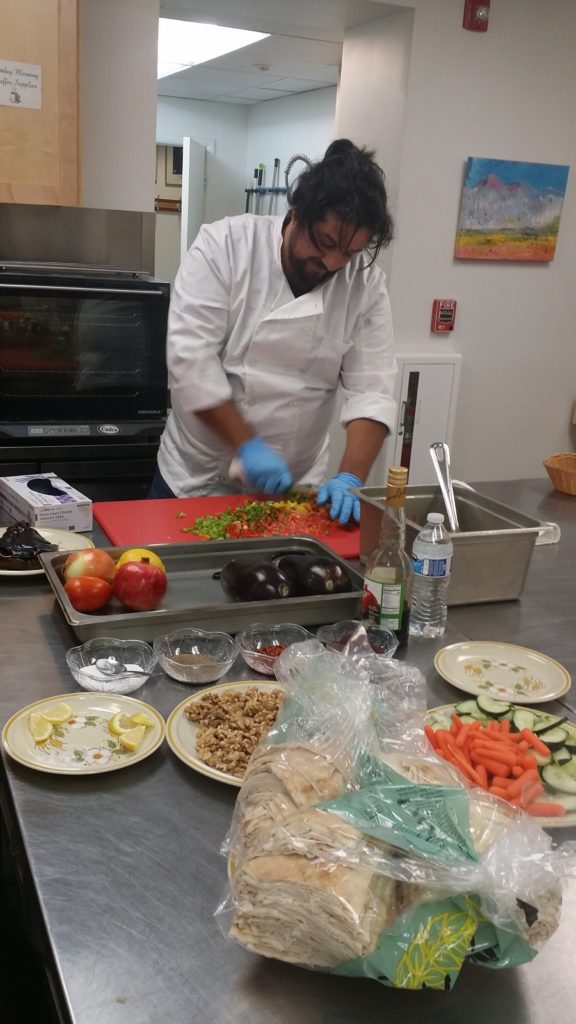
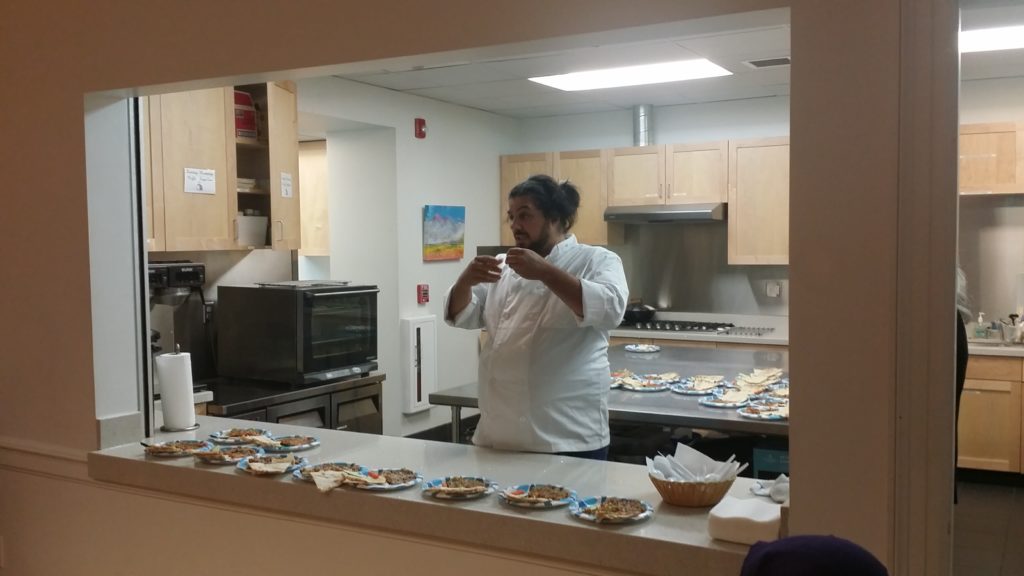
Our May meeting featured Chef Noor and owner of Noor Al Sham restaurant and members of the International Rescue Committee (IRC) in Salt Lake City. The presentation focused on the IRC’s work with refugees in the area and highlighted the Spice Kitchen Incubator program, which helps international refugees with food backgrounds to come to Salt Lake City and to make a living off those skills, whether it be opening a restaurant, a food truck or catering. Successful programs all over the valley are up and running and support these entrepreneurial families in making their transition to America. Chef Noor afterwards treated us to on-site prepared Syrian baba ganouche and HoU provided a flavored fruit water bar. We had a great experience eating and empathizing with the refugee community by learning about the process and struggles they have had in trying to better their lives against tremendous odds and violence. You can order delicious international cuisine from a variety of countries and support the Spice Kitchen Incubator refugees at https://spicekitchenincubator.org

—Melanie Curtis
Vice President, HoU

Pride Celebration

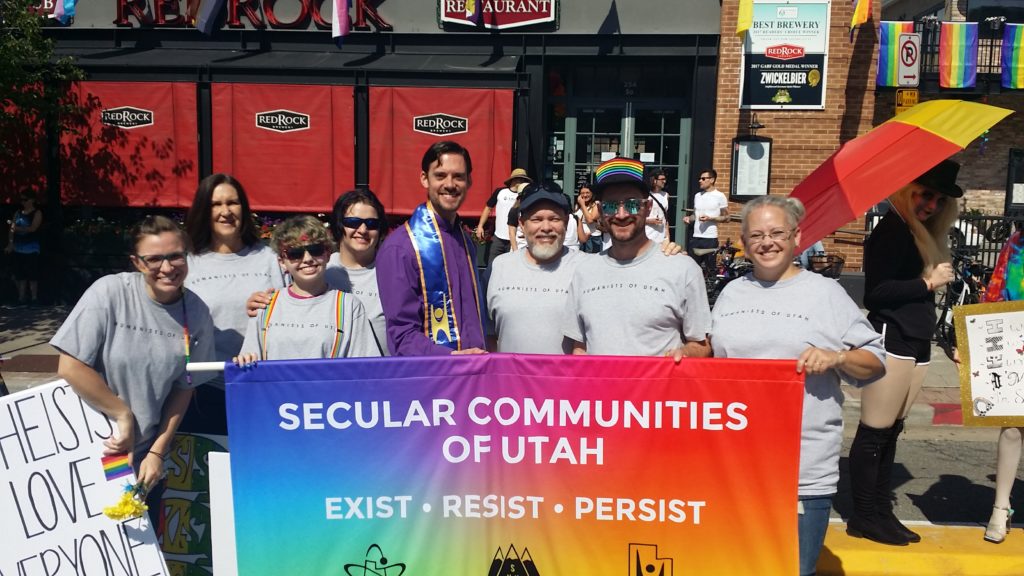
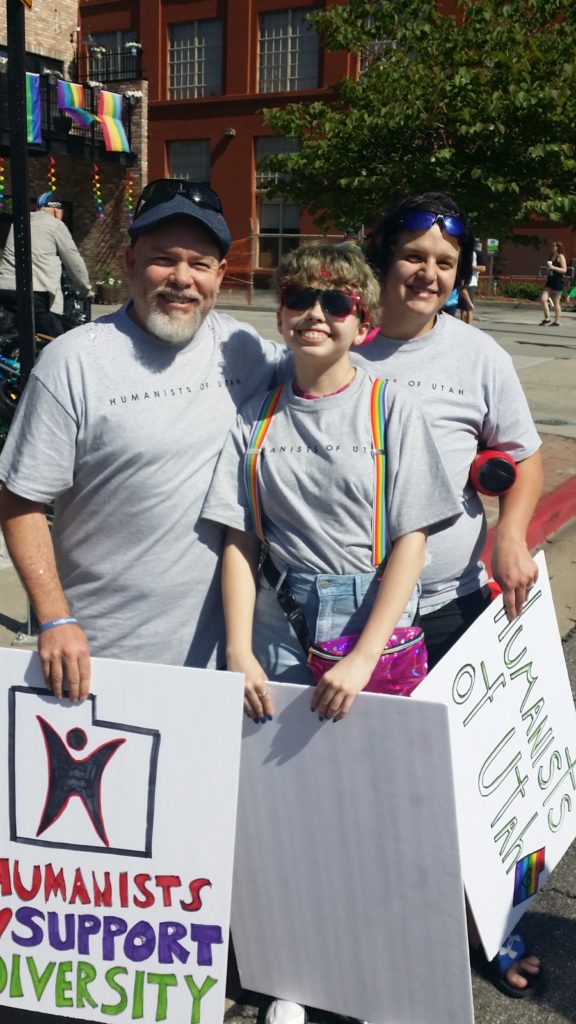
June is LGBTQ+ Pride month and HOU participated in the Utah Pride parade as part of a secular alliance with our friends at Atheists of Utah and Sunday Assembly. There is indeed strength in numbers and the opportunity to band together to let over 100,000 people know that there exists in Utah a place for freethinkers, rationalists and do-gooders without God is invaluable. We had several people show up from our Facebook group and from the local HoU group to march in the parade, where we debuted our new Humanists of Utah t-shirts (purchase yours for only $20 at HoU meetings or at our Facebook group site). This cooperation reinforces the value of allies and community in promoting a philosophy and lifestyle that many people don’t understand yet by the word “humanism” and is a tradition that we plan to continue in the future.

—Melanie Curtis
Vice President, HoU

Chapter Direction

Humanists of Utah has had a very busy—yet exciting—last couple of months! This has been part of our 2019 goal for extending our reach in the community as well as offering a large variety of humanist subjects and interactions at our monthly meetups. We have worked to boost public awareness and appearances as well as grow our relationships with allies and other groups in the state and it is paying off. This mix has enabled us to interact with more people than ever before and meet potential HoU members as well as members of our Facebook group online. If you haven’t been to our monthly meetings in a while (or have never been to one), you will be surprised—come on out and socialize and learn with other humanists in northern Utah!

—Melanie Curtis
Vice President, HoU

Podcasts

Are you a fan of podcasts? I’m almost 100% podcasts on the daily commute these days. It’s so much more fun to listen to something specifically tailored to your interests (they’re also a great insomnia companion). Here are a few rock-solid favorites to check out.

Ologies by Alie Ward. Alie interviews experts in the ‘ologies’ fields – subjects like Teuthology, Phonology, Selenology, Malacology. It’s thoroughly fascinating and very well done! The main problem I have is wanting to start a hobby of almost everything I hear about—hiving my own bees, brewing beer, sponsoring a dinosaur dig.

This Podcast Will Kill You. Hosted by an ecologist and epidemiologist, they take on diseases and explain them from a historical side and biology side – how diseases ‘work’, how our bodies ‘work’, how cures are found/discovered/imagined. I must admit that the range from “oh, that’s so gross”, to “oh, that’s so cool” makes this a lot of fun to listen to.

Levar Burton Reads. Levar Burton reads short stories—mostly in the SciFi/Fantasy realm. From Ursula Le Guin to Haruki Murakami. It’s like snuggling down with a cozy blanket and warm mug of something. Many of the stories hold powers to stay banging around in your head for months to come.

—Lisa Miller

Solstice

This piece was originally published in the January 1996 edition of this newsletter. I consider it to be one of my better pieces and it is the month of the Summer Solstice.

Imagine our ancestors sometime between 30,000 and 200,000 years ago gazing at the sky considering the solstice. Then, as now, there must have been two basic approaches to nature: fear and wonder. Unfortunately, fear is the stronger emotion. Its legacies include myth, superstition, religion, and authoritarian governments and rulers.

Those who stood in wonder were able, through empirical observations, to explain the natural phenomenon of the solstice. The progeny of wonder are the arts, the sciences, and the humanities.

It is unlikely that most people approach the unknown exclusively with either fear or wonder. We all have a different mixture of these two basic emotions. Our challenge is to try to suppress the fears, and then experience and explain the wonders.

—Wayne Wilson

Stonehenge at Summer Solstice

May 2019

Solving the Climate Challenge

On April 11 Bill Barron and Tom Moyer, Citizens’ Climate Lobby Leaders in Utah, spoke with the Humanists of Utah on “Solving the Climate Challenge.” Here is some background information on the challenge of climate change and some key points from their talk.

Skiers and water managers loved our 2018-2019 winter. According to hydrologists quoted in a recent Salt Lake Tribune article, “It’s official: Utah’s snowpack is fantastic this year!” Does this mean we can ignore the longer-term trends of warming temperatures and less snowfall?

The answer is a resounding NO! We easily forget that 2018 was the driest year ever recorded in Utah and wildfires burned a near-record number of acres in the West. Lake Powell sits at 37% of capacity. Globally the last four years were the warmest in human history. Add to this the extensive lag between the time we stop adding greenhouse gasses to the atmosphere and the time that global warming diminishes, and you see the scope of the problem.

Why is there such inertia in our climate system? At the risk of oversimplifying, I’ll highlight two processes. The first concerns the ocean, which absorbs 93% of excess heat trapped from human-derived greenhouse gasses. It takes years or even decades for this heat to equilibrate with the atmosphere. The second is feedback loops, which play out over decades or centuries. For instance, bright white arctic sea ice reflects energy back into space, but as our climate warms and sea ice melts, the dark ocean water absorbs heat and adds to the warming caused by greenhouse gasses.

Unfortunately, there is also a stubborn lag in the political process that will bring about energy transition; this lag is much more obvious. Beyond the time needed to create the political will for a policy, it takes time for a new law to take effect, for it to stimulate innovations, and for our behavior to change. Also, an enormous infrastructure is already in place to support the use of fossil fuel energy.

So what can one do? Action must occur at all levels of society. As President Obama’s Science Advisor John Holdren has said, “There is no silver bullet. We need silver buckshot-we need to do a lot of thins at once.” On an individual basis, perhaps no clearer direction exists than that given in the Provo Clean Air Toolkit, created under the direction of Representative John Curtis when he was mayor. Check out https://provocleanair.org to learn what individuals, business, and cities can do. From walking or riding a bike for short trips to adopting “Meatless Mondays”, many personal actions will be healthier for you and for the air we breathe.

While we must all take personal responsibility, the scale of this problem demands federal and international action. This is where citizen advocacy like Citizens’ Climate Lobby (CCL) comes in. CCL is a non-partisan, non-profit, volunteer-based group that supports individual actions. As they describe, “we exist to create the political will for climate solutions by enabling individual breakthroughs in personal and political power.” CCL accomplishes this through the volunteer work of over 124,000 U.S. supporters in 449 local chapters (543 worldwide), including seven in Utah. (St. George, Utah Valley, Moab, Salt Lake City, Park City-Wasatch Back, Ogden, and Logan). This is a values-driven organization whose members whose members flourish through Focus, Optimism, Relationships, Integrity, Personal Power, and Being Nonpartisan.

For nine of the ten years that CCL has been in existence, they have sought passage of a carbon fee and dividend policy in Congress. We are convinced that for such a policy to endure, it must be bipartisan, so we welcome members throughout the political spectrum. CCL members have exerted their political power by developing relationships with members of Congress and stakeholders in their communities, and educating the public. They call, write to, and meet with members of Congress and their staff, speak to community groups, table at various events, seek endorsements from community leaders, write letters-to-the editor and op-eds, meet with editorial boards, and travel to Washington DC to lobby. 23 Utah members including 14 students will travel to the nation’s capitol to lobby this June. They will meet with all six Utah members of Congress or their aides.

CCL members are fond of saying “we bet the farm on relationships.” CCL assigns a Liaison to each member of Congress. He or she gets to know the Congressmen and women and their staff and find common ground to start discussions. Tom Moyer, former Liaison to Mia Love, tells of a town hall where almost all of the constituents had gone home and the staff was left to put the chairs away. Tom joined them in this task and connected in a personal way that couldn’t have happened in the formal meeting.

These energetic efforts have born fruit. With an issue that is among the most politically divisive of any, we have brought Republicans and Democrats together. In the 115th Congress Republican Carlos Curbelo and Democrat Ted Deutsch formed the Climate Solutions Caucus with the support of CCL. The rule for admission to the caucus was that members had to join with someone from the opposite party. By the end of the Congressional session 45 Democrats and 45 Republicans were meeting together to explore climate policy. Members of this caucus had a significant role is voting down some bad climate policy and introducing good climate legislation.

In the 116th Congress CCL’s bipartisan work bore fruit with introduction of the Energy Innovation and Carbon Dividend Act. This legislation will put a steadily rising fee on fossil fuels such as coal, oil, and gas. It will return the proceeds equally to Americans with a monthly dividend to spend as they see fit. The Republican cosponsor, Francis Rooney affirmed “When you think about a carbon tax, that’s the most free-market, least intrusive way to price carbon.

This policy will be effective, reducing greenhouse gas production by 40% over the first 12 years. It will be good for people, as it improves health by reducing air pollution. It will protect those with lower incomes, as most will receive more in the dividend than they pay from increased costs. It will be good for the economy by creating 2.1 million jobs, thanks to economic growth in local communities across America. It will be revenue neutral, meaning the government will not keep any of the fees collected, so the size of government won’t grow.

Here’s where we all have an opportunity for Responsible Behavior. Our elected officials work for us. Call and/or write to you members of Congress. Ask Senators Lee and Romney, and your Representative, Bishop, Steward, Curtis, or McAdams, to support the Energy Innovation and Carbon Dividend Act now. Only by responding to the challenge of climate change, can we create healthier and more resilient communities.

For further information contact:

David Folland, CCL-SLC co-leader dsfolland@gmail.com, 801-891-7152

Tom Moyer, Utah State Director, tmoyer@xmission.com, 801-573-5863

Bill Barron, Regional Director, bill.barron@citizensclimatelobby.org, 801-699-5705

Citizens’ Climate Lobby, www.citizensclimatelobby.org

Energy Innovation and Carbon Dividend Act, www.energyinnovationact.org

—David Folland, MD

Soap Box

Greetings freethinkers, it has been several months since I last submitted a President’s Message to the newsletter. As I am no longer President, I have decided to start a column that will focus on science. Wayne Wilson suggested that we call it “The Soap Box,” and ask that other members and readers get involved and make contributions. I think that’s a good idea. I plan to make submissions bimonthly for the most part. So, I hope you will all consider submitting your ideas to help make this new science column informative and interesting.

But first I want to recognize the good work being done by the Board of Directors. Our new President, Jeff Curtis, along with new board members Melanie Curtis, Lisa Miller, and Brian Trick have brought new energy and ideas to the chapter. Their efforts and dedication along with the continuing work of long-standing board members, Leona Blackbird, Dr. Craig Wilkinson, Dr. Lauren Florence, Wayne Wilson and myself, make me confident in the future of our chapter. This confidence was reinforced with the success of our Darwin Day celebration. Dr. Wilkinson’s presentation was excellent, and the board did a great job promoting and running the event. Special thanks to the Atheists of Utah for partnering with us and providing the birthday cake.

Focusing on science makes for a wide variety of subjects. I have some insight on some disciplines such as climate change and issues concerning the state of Utah’s water resources. Other subjects such as medical science, astronomy, and a wide variety of scientific inquiry are all worthy of discussion.

So where do we begin? In the medical science area, I would like to discuss the ethics of growing tobacco. Tobacco is a plant that is basically a poison, grown and manufactured into addictive products which kill approximately 480,000 people per year in the U.S. Also, for me, issues concerning the environment are at the top of the list. And the list for the environment is huge on its own.

I think a good place to start is climate change. We got a good start with last month’s presentation by the Utah Citizen’s Climate Lobby, where they advocated fighting climate change with democracy.

Many of my subjects will be about the environment, from my perspective as a Geomorphologist and as a citizen and inhabitant of this planet. For example, my studies took me to the High Uinta Mountains where I studied the Alpine and Periglacial environments. These are areas where the transition between the two approximates the edge of the cryosphere or the continuous frozen areas of the planet.

I’m excited to do this and I hope some of you will also participate with your own submissions, suggestions, links, etc.

P.S. Speaking of links, you should look at this web site; nsidc.org (national snow and ice data center), they have a huge data center for research but also a lot of things for the average person to check out.

—Bob Lane

Irene Fryer

1928 ~ 2019

Irene Fryer died March 22, 2019 in Salt Lake City, Utah. She was born December 8, 1928 in Tremonton, Utah to Ira and Doris Merrell Fridal, the youngest of their 5 children. She grew up alongside her sister Mary and brothers Ed, Dave, Jim. She attended schools in Tremonton and graduated from Bear River High School in 1947. Irene met and married Don Fryer in 1947. Together they began married life on their farm in Riverside, later moving their young family to Salt Lake City. Irene graduated from Stevens-Henager Business College and began working for the state of Utah in the Purchasing Department. She retired from the Department of Transportation.

Over the years, Irene enjoyed traveling, hiking, skiing, golfing, reading, and sewing. Being a remarkable seamstress, she found great joy in tying quilts for family, friends, and those in need. Irene was a true humanitarian, joining and participating in organizations that focused on human rights for all. She was a member of the First Unitarian Church which provided opportunities to exercise her commitment to making the world a better place. Irene was a founding member of Humanists of Utah and served as Treasurer for several years. In keeping with her commitment to others, Irene donated her body to the University of Utah School of Medicine.

A celebration of Irene’s life will be held on Friday, May 24 at the First Unitarian Church, 569 South 1300 East Salt Lake City Utah from 5 to 8 in the evening.

—Salt Lake Tribune